Countess Ottilie von Faber-Castell, née Baroness Ottilie von Faber, is pictured above wearing her elegant Greek key diamond tiara.
The jewel is designed as a short diamond tiara with a classical meander pattern, also known as a Greek key motif. It is set with approximately 28 carats of old mine-cut diamonds, mounted in silver and gold, and dates from around 1900, possibly from the time of her marriage.
This shorter form of diamond tiara was especially fashionable at the turn of the century, when ladies wore their hair arranged in high rolls and elaborate updos. Such hairstyles required tiaras of more compact height and refined architectural form, sitting neatly above the coiffure rather than rising too high from it.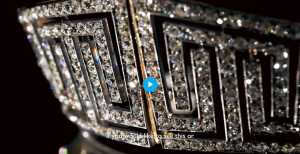
The Hanau workshop of Kreuter appears to have produced several impressive versions of this Greek key, or meander, diamond tiara type. Yet despite more than 2 weeks of research, the maker’s marks and their precise attribution could not yet be conclusively clarified.
Baroness Ottilie von Faber granddaughter of the "pencil tycoon" Baron Lothar von Faber, married Count Alexander zu Castell-Rüdenhausen in 1898. The marriage was described as a “ray of light in the life of the Faber family” after years of mourning. Two years after the wedding, trusting in Count Alexander’s abilities, Ottilie brought him into the management of the family company.
The Greek key tiara therefore belongs not only to the world of aristocratic jewels around 1900, but also to the remarkable history of the Faber-Castell family: a jewel of classical design, old mine diamonds and family representation at the beginning of a new chapter.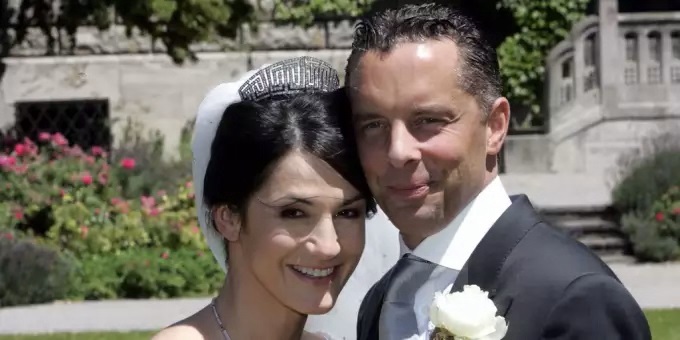
The tiara later reappeared in the family when Count Patrick von Faber-Castell,son of Hubertus Alexander Wolfgang Rüdiger Emanuel Wilhelm Graf von Faber-Castell, a great-grandson of Countess Ottilie von Faber-Castell, married Mariella Ahrend in. July 2007. On that occasion, the bride wore the same meander diamond tiara, bringing this historic family jewel back into view in a new generation. Now for auction at Dorotheum Vienna 2026.
Hubertus Graf von Faber-Castell was born the son of two economic dynasties. His father, Roland Graf von Faber-Castell, was the sole managing partner of Faber-Castell AG. The mother of Count Hubertus, Alix-May von Frankenberg and Ludwigsdorf, belonged to the owner family of the largest European private bank Sal. Oppenheim Jr. & Cie.
Faber-Castell worked briefly in both family businesses. In Faber-Castell AG, he gave the younger brother Anton-Wolfgang Graf von Faber-Castell the management of the Franconian stationery manufacturer. In this context, Faber-Castell sold the majority of its shares in the paternal pencil company. Faber-Castell moved to Asia, where he set up advertising-supported television stations in China. Count Hubertus was publicly described by the government as the “great friend of China”, later Faber-Castell became an honorary citizen of the city of Beijing. He had three children from two different marriages. From his first marriage to the co-owner of the Rheinish industrial group Hünnebeck, Patrick Graf von Faber-Castell.
Sources:Dorotheum;Archive Ursula Butschal;Wikipedia
THE COLLECTION:

















