
Provenienz des Fabergé – Wintereis (1913–2025)
(basierend auf den historischen Aufzeichnungen, Auktionskatalogen Christie’s/Sotheby’s/Wartski und der üblichen Sekundärliteratur)
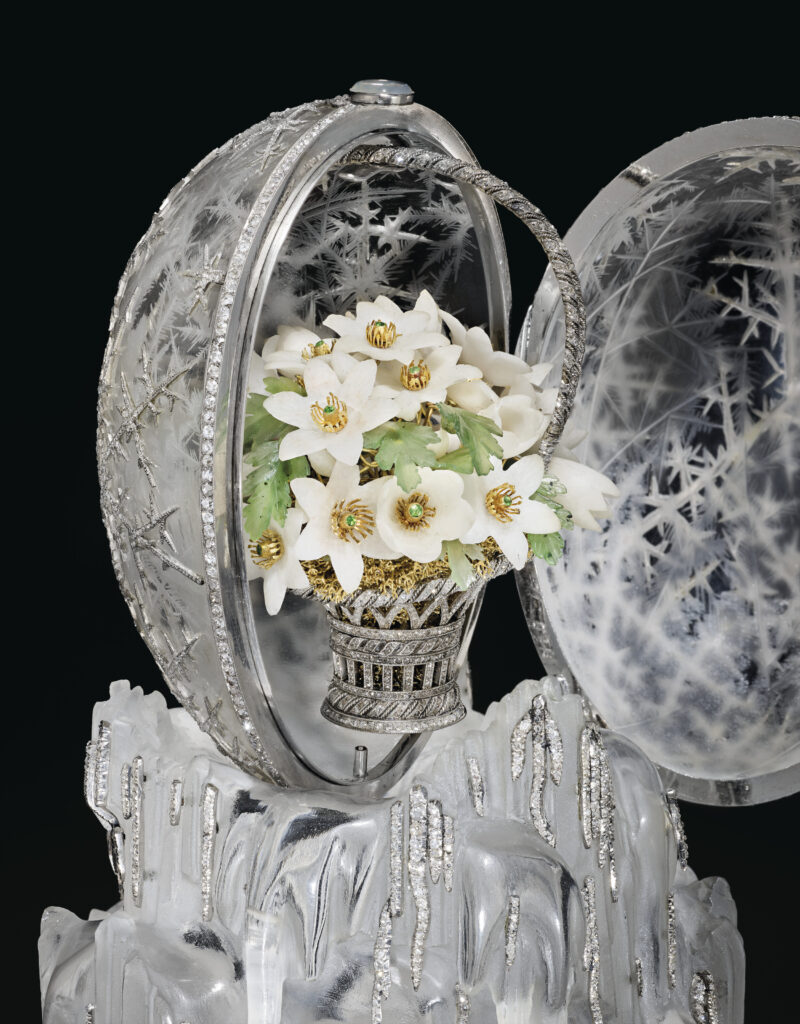
Fabergé, Entwurf Alma Theresia Pihl – Werkstatt Albert Holmström, St. Petersburg, 1913
Das Winterei von 1913 gehört zu den ungewöhnlichsten Kreationen der kaiserlichen Fabergé-Werkstätten. Die Komplexität, die technische Meisterschaft und die poetische Umsetzung des Themas „Schnee, Eis und Frühjahr“ machen es zu einem absoluten Höhepunkt des Hofjuweliers.
IMPERIAL WINTER EGG
Fabergé, Entwurf Alma Theresia Pihl – Werkstatt Albert Holmström, St. Petersburg, 1913
Das Winterei von 1913 gehört zu den ungewöhnlichsten Kreationen der kaiserlichen Fabergé-Werkstätten. Die Komplexität, die technische Meisterschaft und die poetische Umsetzung des Themas „Schnee, Eis und Frühjahr“ machen es zu einem absoluten Höhepunkt des Hofjuweliers.
Das Ei
- Material: Bergkristall, innen fein mattiert und mit einem Frost-Dekor graviert.
- Außen: mit rosenschnitt-besetzten Platin-Schneeflocken und platinmontierten Diamantbordüren appliziert.
- Die vertikale Ornamentik verbirgt die Scharniermechanik.
- Bekrönt von einem gravierten Mondstein Cabochon, datiert 1913.
Der Sockel
- Modelliert als schmelzender Eisblock aus Bergkristall.
- Überzogen mit Diamant Rinnsalen aus Platin, die die Tauwirkung verstärken.
- Ein zentraler Platin-Zapfen stabilisiert das Ei.
Die „Überraschung“
Der Innenmechanismus trägt einen zarten, doppelt gebänderter Platin-Korb, vollständig besetzt mit Rosenschliffdiamanten.
Darin:
- Anemonen aus weißem Quarz,
- goldene Staubgefäße,
- Blätter aus Nephrit,
- im Blütenzentrum Demantoid-Granate,
- eingebettet in Goldmoos.
Der Boden der Überraschung ist graviert: FABERGÉ 1913.
Maße
Überraschung: 8,2 cm (3 ¼ in.)
Ei mit Sockel: 14,2 cm (5 ⅝ in.)
1913
Kommissioniert von Kaiser Nikolaus II. als Ostergeschenk für seine Mutter Zarinmutter Maria Fjodorowna.
St. Petersburg, 13. April 1913. Preis 24.600 Rubel.
1913–1917
Privatsammlung der Zarinmutter, Anitschkow-Palast, St. Petersburg.
September 1917
Vom Provisorischen Gouvernement zur Kreml-Waffenkammer überführt.
1922
Durch die Sonderkommission für Schmuckwerte ausgewählt und an Gokhran, Moskau, übergeben.
1929–1933
Von Wartski, London(Snowman der Schwiegersohn, gehörte zu den wenigen Pionieren, die zwischen 1927 und 1933 Einkäufe bei der sowjetischen Regierungsabteilung, dem sogenannten Antiquariat, tätigten), in der sowjetischen Verkaufsperiode erworben (Preis £450).
1934
Erworben von Napier Sturt, 3rd Baron Alington (Preis £1.500).
1934–1948
Sammlung Sir Bernard Eckstein.
1949
Nachfolgerverkauf: Sotheby’s London, 8. Februar 1949, Lot 128 (Preis £1.870).
Erworben für die Sammlung Arthur Bryan Ledbrook.
1974
Nach dessen Tod im Besitz eines Trusts.
1994
Christie’s Genf, 16. November 1994, Lot 464.
Zuschlag CHF 7.263.500 — Weltrekord für Fabergé.
2002
Christie’s New York, 19. April 2002, Lot 150.
Zuschlag $9.579.500 — erneuter Weltrekord.
ab 2002 (inoffiziell)
Zuschlag an Sheikh Saud bin Mohammed Al-Thani (Qatar).
Gerüchte seit Jahren: Werk möglicherweise nie bezahlt und nie abgeholt → Christie’s verbleibt wirtschaftlicher Eigentümer.
2025
Christie’s London, 2. Dez. 2025, Lot 7.
GBP 22,895,000 Verkauf als Teil einer „Princely Collection“ an Wartski nach 100 Jahren ….
THE IMPERIAL WINTER EGG BY FABERGÉ (1913)
A Masterpiece of Alma Theresia Pihl and the Holmström Workshop
St Petersburg, 1913
Commissioned by Emperor Nicholas II as his Easter gift to his mother, the Dowager Empress Maria Feodorovna, the Imperial Winter Egg stands among the most poetic and technically sophisticated creations of Carl Fabergé’s ateliers. Conceived by the young designer Alma Theresia Pihl and executed in the celebrated workshop of Albert Holmström, it is a triumph of imagination, virtuosity and symbolic refinement.
Description of the Egg
Carved from a single block of rock crystal, the egg reveals a delicately frosted interior, suggesting winter light caught beneath a thin layer of ice. The exterior is adorned with a constellation of platinum snowflakes set with rose-cut diamonds and two vertical diamond-set borders cleverly disguising the hinge. At its apex sits a cabochon moonstone engraved with the date 1913, a subtle reminder of the Romanov tercentenary.
The Base
The egg rests upon a sculptural block of melting ice, also carved in rock crystal, its surface enlivened with flowing platinum rivulets set with rose-cut diamonds. A central platinum pin rises from the base to support the egg with absolute precision.
The Surprise
Suspended within is one of the most enchanting surprises in the Fabergé oeuvre:
a double-handled trelliswork basket in platinum, entirely pavé-set with rose-cut diamonds. It overflows with lifelike wood anemones carved from white quartz, each with gold wire stamens and a demantoid garnet at its centre. The leaves, rendered in exquisitely shaped nephrite, emerge from a bed of finely modelled gold moss.
The base of the basket is engraved ‘FABERGÉ 1913’.
Measurements
- Egg with base: 14.2 cm (5 5/8 in.) high
- Surprise: 8.2 cm (3 1/4 in.) high
Provenance
- 1913: Commissioned by Emperor Nicholas II and presented to the Dowager Empress Maria Feodorovna.
- 1913–1917: Anichkov Palace, St Petersburg.
- 1917: Transferred by the Provisional Government to the Kremlin Armoury for safekeeping.
- 1922: Selected by the Special Commission and transferred to Gokhran.
- 1929–1933: Acquired by Wartski, London (Snowman was one of a pioneering few who made purchases from the Soviet Government department, known as the Antiquariat, between 1927 until 1933. (£450).
- 1934: Purchased by Napier Sturt, 3rd Baron Alington (£1,500).
- 1934–1948: Collection of Sir Bernard Eckstein.
- 1949: Sotheby’s London, 8 February, Lot 128 (£1,870), acquired by Arthur Bryan Ledbrook.
- 1994: Property of a Trust; Christie’s Geneva, 16 November, Lot 464 (CHF 7,263,500 – world record for Fabergé).
- 2002: Christie’s New York, 19 April, Lot 150 ($9,579,500 – world record for Fabergé).
- After 2002: Attributed to the collection of Sheikh Saud bin Mohammed Al-Thani (He became one of the most voracious contemporary art buyers around the turn of the Millennium, serving as Qatar’s chief cultural patron. Sheikh Saud bin Mohammed Al-Thani is believed to have spent close to £1 billion on art acquisitions before facing allegations of misusing public funds in 2005; he died nine years later, in exile, at the age of just 48. Persistent rumours suggest that the Winter Egg was never collected from Christie’s — nor fully paid for — and that the auction house may now be offering it in order to recover the funds it advanced at the time of the 2002 sale.)
- 2025: sold again at Christie’s London as part of a “Princely Collection” GBP 22,895,000 to Wartski after 100 years.