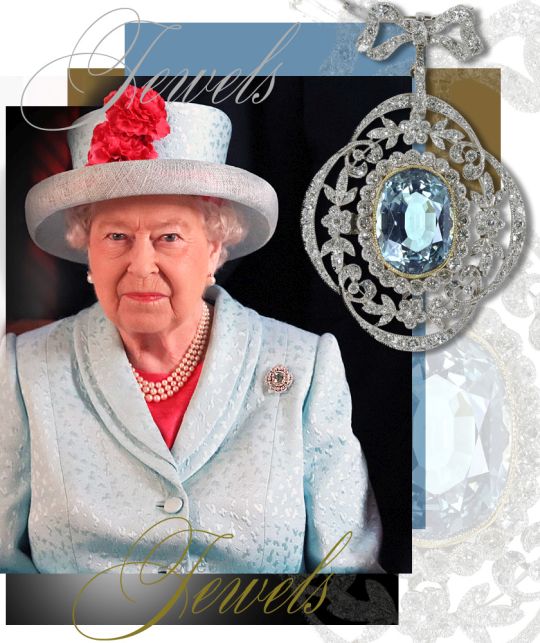
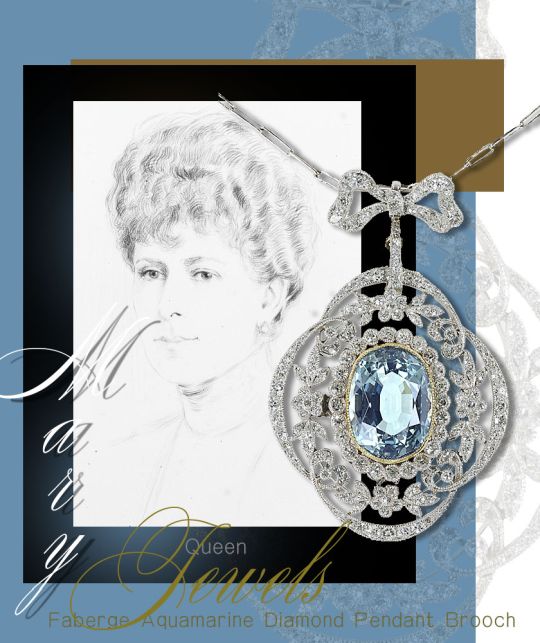
Queen Elizabeth II|Diamond Aquamarine Pendant Brooch Gift from King George V to Queen Mary| Fabergé aquamarine and diamond pendant 1909 Royal Jewels Great Britain and Irland
On display at the exhibition «Royal Jewellery: From Coronations to Keepsakes» will be shown at the King’s Gallery in London from 25 June 2027 to 19 March 2028.
Diamond Aquamarine Pendant Brooch Gift from King George V to Queen Mary| Fabergé aquamarine and diamond pendant 1909 Royal Jewels Great Britain and Irland
(basierend auf den historischen Aufzeichnungen, Auktionskatalogen Christie’s/Sotheby’s/Wartski und der üblichen Sekundärliteratur)
A MAGNIFICENT AND HIGHLY IMPORTANT IMPERIAL WINTER EGG Fabergé, Entwurf Alma Theresia Pihl – Werkstatt Albert Holmström, St. Petersburg, 1913
Das Winterei von 1913 gehört zu den ungewöhnlichsten Kreationen der kaiserlichen Fabergé-Werkstätten. Die Komplexität, die technische Meisterschaft und die poetische Umsetzung des Themas „Schnee, Eis und Frühjahr“ machen es zu einem absoluten Höhepunkt des Hofjuweliers.
IMPERIAL WINTER EGG Fabergé, Entwurf Alma Theresia Pihl – Werkstatt Albert Holmström, St. Petersburg, 1913
Das Winterei von 1913 gehört zu den ungewöhnlichsten Kreationen der kaiserlichen Fabergé-Werkstätten. Die Komplexität, die technische Meisterschaft und die poetische Umsetzung des Themas „Schnee, Eis und Frühjahr“ machen es zu einem absoluten Höhepunkt des Hofjuweliers.
Das Ei
Material: Bergkristall, innen fein mattiert und mit einem Frost-Dekor graviert.
Außen: mit rosenschnitt-besetzten Platin-Schneeflocken und platinmontierten Diamantbordüren appliziert.
Die vertikale Ornamentik verbirgt die Scharniermechanik.
Bekrönt von einem gravierten Mondstein Cabochon, datiert 1913.
Der Sockel
Modelliert als schmelzender Eisblock aus Bergkristall.
Überzogen mit Diamant Rinnsalen aus Platin, die die Tauwirkung verstärken.
Ein zentraler Platin-Zapfen stabilisiert das Ei.
Die „Überraschung“
Der Innenmechanismus trägt einen zarten, doppelt gebänderter Platin-Korb, vollständig besetzt mit Rosenschliffdiamanten. Darin:
Anemonen aus weißem Quarz,
goldene Staubgefäße,
Blätter aus Nephrit,
im Blütenzentrum Demantoid-Granate,
eingebettet in Goldmoos.
Der Boden der Überraschung ist graviert: FABERGÉ 1913.
Maße
Überraschung: 8,2 cm (3 ¼ in.)
Ei mit Sockel: 14,2 cm (5 ⅝ in.)
1913 Kommissioniert von Kaiser Nikolaus II. als Ostergeschenk für seine Mutter Zarinmutter Maria Fjodorowna. St. Petersburg, 13. April 1913. Preis 24.600 Rubel.
1913–1917 Privatsammlung der Zarinmutter, Anitschkow-Palast, St. Petersburg.
September 1917 Vom Provisorischen Gouvernement zur Kreml-Waffenkammer überführt.
1922 Durch die Sonderkommission für Schmuckwerte ausgewählt und an Gokhran, Moskau, übergeben.
1929–1933 Von Wartski, London(Snowman der Schwiegersohn, gehörte zu den wenigen Pionieren, die zwischen 1927 und 1933 Einkäufe bei der sowjetischen Regierungsabteilung, dem sogenannten Antiquariat, tätigten), in der sowjetischen Verkaufsperiode erworben (Preis £450).
1934 Erworben von Napier Sturt, 3rd Baron Alington (Preis £1.500).
1934–1948 Sammlung Sir Bernard Eckstein.
1949 Nachfolgerverkauf: Sotheby’s London, 8. Februar 1949, Lot 128 (Preis £1.870). Erworben für die Sammlung Arthur Bryan Ledbrook.
1974 Nach dessen Tod im Besitz eines Trusts.
1994 Christie’s Genf, 16. November 1994, Lot 464. Zuschlag CHF 7.263.500 — Weltrekord für Fabergé.
2002 Christie’s New York, 19. April 2002, Lot 150. Zuschlag $9.579.500 — erneuter Weltrekord.
ab 2002 (inoffiziell) Zuschlag an Sheikh Saud bin Mohammed Al-Thani (Qatar). Gerüchte seit Jahren: Werk möglicherweise nie bezahlt und nie abgeholt → Christie’s verbleibt wirtschaftlicher Eigentümer.
2025 Christie’s London, 2. Dez. 2025, Lot 7. GBP 22,895,000 Verkauf als Teil einer „Princely Collection“ an Wartski nach 100 Jahren ….
THE IMPERIAL WINTER EGG BY FABERGÉ (1913)
A Masterpiece of Alma Theresia Pihl and the Holmström Workshop St Petersburg, 1913
Commissioned by Emperor Nicholas II as his Easter gift to his mother, the Dowager Empress Maria Feodorovna, the Imperial Winter Egg stands among the most poetic and technically sophisticated creations of Carl Fabergé’s ateliers. Conceived by the young designer Alma Theresia Pihl and executed in the celebrated workshop of Albert Holmström, it is a triumph of imagination, virtuosity and symbolic refinement.
Description of the Egg
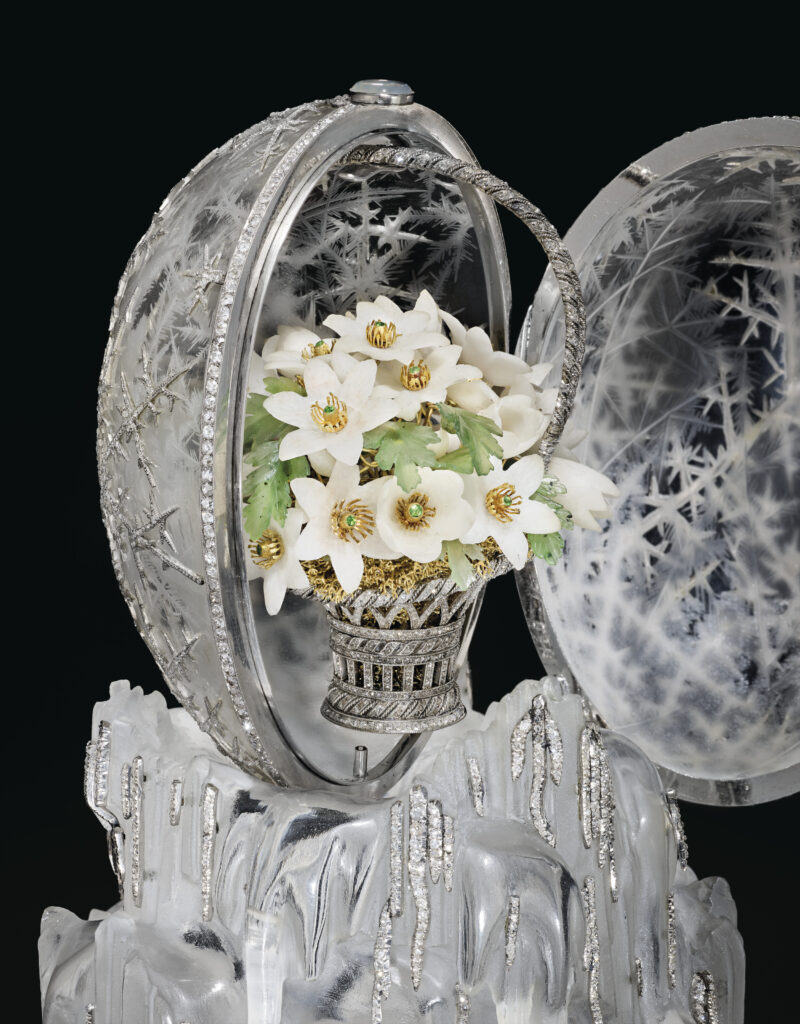
Carved from a single block of rock crystal, the egg reveals a delicately frosted interior, suggesting winter light caught beneath a thin layer of ice. The exterior is adorned with a constellation of platinum snowflakes set with rose-cut diamonds and two vertical diamond-set borders cleverly disguising the hinge. At its apex sits a cabochon moonstone engraved with the date 1913, a subtle reminder of the Romanov tercentenary.
The Base
The egg rests upon a sculptural block of melting ice, also carved in rock crystal, its surface enlivened with flowing platinum rivulets set with rose-cut diamonds. A central platinum pin rises from the base to support the egg with absolute precision.
The Surprise
Suspended within is one of the most enchanting surprises in the Fabergé oeuvre: a double-handled trelliswork basket in platinum, entirely pavé-set with rose-cut diamonds. It overflows with lifelike wood anemones carved from white quartz, each with gold wire stamens and a demantoid garnet at its centre. The leaves, rendered in exquisitely shaped nephrite, emerge from a bed of finely modelled gold moss. The base of the basket is engraved ‘FABERGÉ 1913’.
Measurements
Egg with base: 14.2 cm (5 5/8 in.) high
Surprise: 8.2 cm (3 1/4 in.) high
Provenance
1913: Commissioned by Emperor Nicholas II and presented to the Dowager Empress Maria Feodorovna.
1913–1917: Anichkov Palace, St Petersburg.
1917: Transferred by the Provisional Government to the Kremlin Armoury for safekeeping.
1922: Selected by the Special Commission and transferred to Gokhran.
1929–1933: Acquired by Wartski, London (Snowman was one of a pioneering few who made purchases from the Soviet Government department, known as the Antiquariat, between 1927 until 1933. (£450).
1934: Purchased by Napier Sturt, 3rd Baron Alington (£1,500).
1934–1948: Collection of Sir Bernard Eckstein.
1949: Sotheby’s London, 8 February, Lot 128 (£1,870), acquired by Arthur Bryan Ledbrook.
1994: Property of a Trust; Christie’s Geneva, 16 November, Lot 464 (CHF 7,263,500 – world record for Fabergé).
2002: Christie’s New York, 19 April, Lot 150 ($9,579,500 – world record for Fabergé).
After 2002: Attributed to the collection of Sheikh Saud bin Mohammed Al-Thani (He became one of the most voracious contemporary art buyers around the turn of the Millennium, serving as Qatar’s chief cultural patron. Sheikh Saud bin Mohammed Al-Thani is believed to have spent close to £1 billion on art acquisitions before facing allegations of misusing public funds in 2005; he died nine years later, in exile, at the age of just 48. Persistent rumours suggest that the Winter Egg was never collected from Christie’s — nor fully paid for — and that the auction house may now be offering it in order to recover the funds it advanced at the time of the 2002 sale.)
2025: sold again at Christie’s London as part of a “Princely Collection” GBP 22,895,000 to Wartski after 100 years.
Who was the Lady who got the Faberge Tiara as wedding gift? She was the mother of two Dukes of Westminster…..
Lady Mabel Florence Crichton| Lady Grosvenor Wedding|Duchess of Westminster Faberge Tiara Diamond Wreath | Myrtle-Leaves and berries Faberge Diamond Wreath Tiara Myrtle-Leaves and Berries Diadem Duchess of Westminster, Wedding TiaraOlivia Henson Duchess of Westminster Wedding Tiara – Faberge Tiara Diamond Wreath | Myrtle-Leaves and berries as a Diadem
Princess Elisabeth of Hesse and by Rhine daughter of Ernst-Ludwig, last Grand Duke of Hesse and by Rhine, and Princess Victoria Melita of Saxe-Coburg-Gotha
Fabergé Easter Eggs Royal and Imperial Gifts – Presents to the Princess Elisabeth of Hesse. Royal Jewel History – jewellery of the HousE of Hesse 32 Easter eggs from Faberge presented by the Romanovs to Princess Elisabeth of Hesse, see the details below: Fabergé Easter Eggs Royal and Imperial Gifts – Presents to the Princess Elisabeth of Hesse. Royal Jewel History – jewellery of the Hous of Hesse
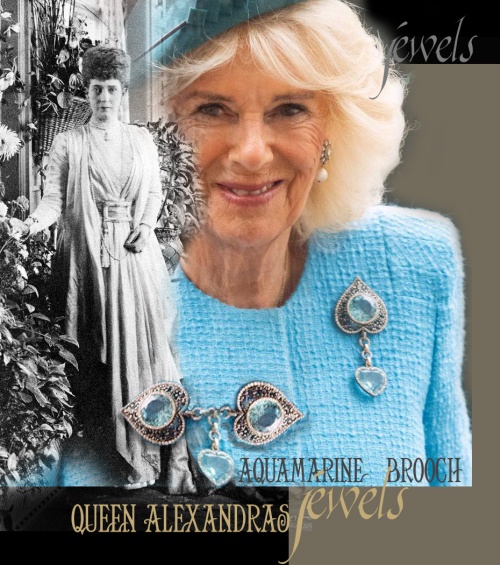
A previously undisclosed Fabergé Brooch emerged into public view when Queen Camilla adorned herself with a heritage piece of Queen Alexandra on the 11th of March, in celebration of Commonwealth Day. This remarkable piece revealed two portions of what are three components of a royal Fabergé Cloak Clasp.
The tradition of gifting, particularly for occasions such as birthdays and Easter, saw her receiving numerous presents from her sister, Empress Marie Feodorovna of Russia. The Empress held a particular preference for the exquisite craftsmanship of Fabergé for such esteemed events.
Queen Alexandra’s Aquamarine Brooch an exquisite cloak clasp adorned with a heart pendant, encased within frames of lustrous diamonds, and complemented by a chain meticulously set with diamonds. This remarkable piece, believed to have been crafted by the renowned Fabergé around 1904 , later became a part of Queen Mary of England’s Royal Jewel Collection. To enrich our exploration, let us also consider the third component of this regal jewel, inviting a comprehensive appreciation of its historical and artistic significance.
Four of Princess Alice’s surviving children and their spouses gave their grandmother a magnificent diamond and sapphire brooch. The Emperor and Empress of Russia, the Grand Duke and Duchess of Hesse, the Grand Duchess Elizabeth Feodorovna “Ella” and the Grand Duke Serge along with Princess Victoria and Prince Louis of Battenberg’s gift was “…a brooch with an open pendant heart of diamonds, bearing in the centre the number „60“ in Slavonic characters. It has on the top a cabochon sapphire and there are two large sapphire drops.” The jewel was made in the workshops of Fabergé(the see note from Empress Alexandra about the payment) more >>>
update from the year 2012 | The Diamond and Sapphire Brooch – gift to Queen Victoria in 1897 from The Emperor and Empress of Russia, the Grand Duke and Duchess of Hesse, the Grand Duchess Elizabeth Feodorovna “Ella” and the Grand Duke Serge along with Princess Victoria and Prince Louis of Battenberg
Grand Duchess Vladimir | Diamond Coronation Brooch 1896 | Romanov Imperial Crown one of the
Grand Duchess Vladimir of Russia | Diamond Coronation Brooch 1896 | Romanov Imperial Crown Imperial Crown in Diamonds|Coronation Brooch 1896 Faberge Diamond Presentation Brooch |Grossfürstin Maria Pawlowna| Imperial Jewelry Romanov | Royal Magazin
Grand Duchess Alexandra Iosifovna of Russia| Grand Duchess Konstaninovich | Diamond Coronation Brooch 1896 Imperial Coronation Brooch Tsar Nicholas II Romanov, Princess Alexandra of Sachsen-Altenburg, Grand Duchess Sanny
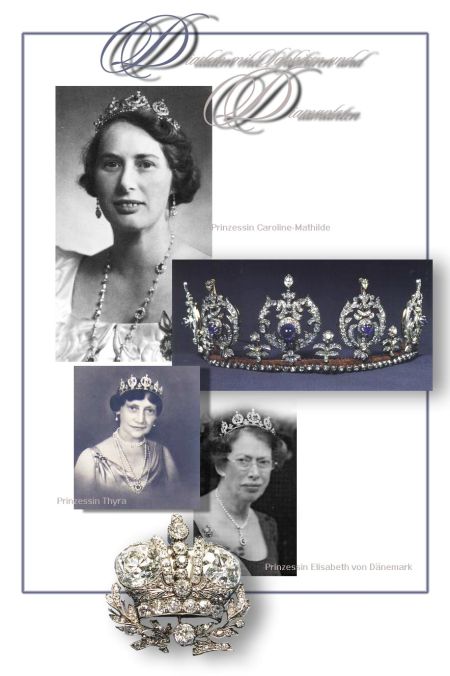
In the picture Princess Thyra’s Sapphire Tiara · Princess Elisabeth of Denmark diamond brooch, imperial coronation jewels Coronation Brooch Faberge, Brooch in the form of the russian imperial crown, imperial gift from the tsar | Grand Duchess Anastasia Mikhailovna’s Coronation Brooch
Princess Thyra’s Sapphire Tiara
The Princess Thyra Sapphire Tiara is a rare and highly distinctive Danish royal jewel, created in the late nineteenth century for Princess Thyra of Denmark (1880–1945), daughter of the future King Frederik VIII and Queen Lovisa of Denmark. The tiara was a gift from her parents, possibly marking her eighteenth birthday and debut into society in 1898.
But where does the tiara come from? There is no clear answer, but a presumption. Already in connection with Princess Lovisa of Sweden’s wedding with Crown Prince Frederik (VIII) of Denmark in 1869 there was a rumour about her large jewellery collection. It has been said that it could fill an entire billiard table. And this was only the beginning. Soon after and within the span of just a few years, she also inherited many pieces of jewellery from her parents, King Karl XV (1826- 1872)
and Queen Lovisa of Sweden (1828-1871), her grandmother, the Dowager Queen Josephina of Sweden (1807-1876) and her grandparents, Prince Frederick (1797-1881) and Princess Louise of the Netherlands (1808-1870).
It has been suggested that the Princess Thyra Sap- phire Tiara could come from her mother’s jewellery collection. There is, however, no solid proof that Queen Lovisa gave away many or larger pieces of jewellery while she lived. She probably did it at her daughter Princess Ingeborg’s wedding in 1897, but it was as a wedding gift, and Princess Thyra remained unwed. At the same time Queen Lovisa’s collection of jewellery – in particular the larger pieces – is fairly well covered in history books, and the Princess Thyra Sapphire Tiara cannot readily be found in any of the sections of the mother’s familial inheritance lots.
in the front row. The name Thyra was very popular in Denmark in the second half of the 19th century due to a historical interest for the Viking Age. Thus, King Gorm the Old of Denmark, who lived in the 900s, was married to Queen Thyra.
Designed in the Historicist style, the tiara consists of five graduated upright, heart-shaped foliate ornaments, each centred by a cabochon natural Ceylon sapphire and surrounded by rose-cut diamonds. Stylised flowers, buds and scrolling foliage are set with old mine, rose and single-cut diamonds, with small pearls incorporated into the design. The jewel is mounted in 14-carat gold, rose gold and silver on a curved circlet.
One of its most unusual features is its versatility: the five sapphires can be removed and replaced by five cabochon turquoises, transforming the appearance of the tiara. The sapphires weigh approximately 15.61 carats in total, including the large central stone of approximately 8.90 carats, while the diamonds total about 10 carats.
Although the tiara bears no maker’s mark, its striking similarity to the King Edward VII Ruby Tiara, made by E. Wolff & Co. of London for Princess Margaret of Connaught in 1905, has led to the suggestion that Thyra’s tiara was produced by the same workshop. Its original fitted case, however, is signed by the Copenhagen court jeweller A. Michelsen, which may have acted as the retailer. The attribution to E. Wolff & Co. therefore remains a well-founded hypothesis rather than a documented fact.
Princess Thyra remained unmarried and retained the jewel throughout her life. By testament she left it to her niece Hereditary Princess Caroline-Mathilde of Denmark, who in 1963 gave it to her daughter Princess Elisabeth of Denmark (1935–2018). It subsequently remained among the descendants of King Frederik VIII and Queen Lovisa.
A later modification also tells something of the tiara’s personal history: during the 1920s or 1930s, when tiaras were fashionable worn low across the forehead, a velvet band was added to make it more comfortable to wear. Intriguingly, the fitted case contains space apparently intended for another jewel, suggesting that a bracelet may originally have formed part of the set. The Sapphire Diamond Tiara is now in the Albion Art Collection.
Diamond Brooch in the form of the Russian Imperial Crown, set with 149 diamonds of abourt 21,1 carats. The two largest diamonds are ca 6,8ct and 7,3ct.
This brooch and 17 others were executed on the order of Tsar Nicholas II to Carl Faberge . The brooch cost 4000 silver roubles.
These brooches were Imperial gifts presented on 24. May 1894. The day before the coronation of Nicholas II and Alexandra Feodorovna.
They were given to both the Grand Duchesses living in Russia and also to those that had, through their marriages, become queens or duchesses outside Russia and attended the coronation.
Their daughter Alexandrine inherited this brooch in 1922. She married in 1898 the Danish Crown Prince Christian. Later Queen Alexandrine of Denmark left it to her daughter-in-law Princess Caroline-Mathilde (Prince Knud’s wife). In 1995 the brooch was inherited by her daughter, Princess Elisabeth of Denmark.
Princess Elisabeth of Denmark, left it to The Royal Danish Collection in her will.
Carl Faberge also executed brooches, in this design but larger diamonds, for the Dowager Empress Maria Feodorovna 10 000 roubles and Empress Alexandra Feodorovna 12 000 roubles. The Queen of Siam was also presented with such a brooch in 1897 the price beeing 5100 roubles.
Schmuck und Juwelen der Deutsche Fürstenhäuser | Royal Jewels – Historical Jewerly and Treasure of Royals and Aristocracy | bijoux historiques| исторические драгоценности