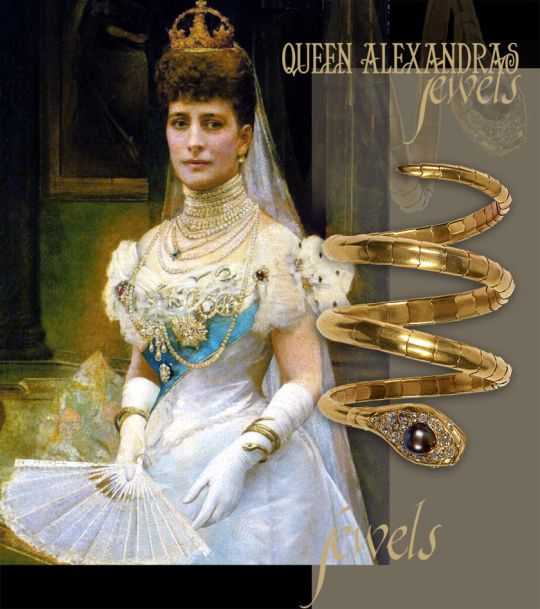
Queen Alexandra’s Serpent Diamond and Black Pearl Bracelet | Gold Snake Cuff Queen Alexandra| British Royal Jewels History Queen Alexandra’s articulated serpent bracelet, c. 1870 Jewels of Queen Alexandra
On display at the exhibition «Royal Jewellery: From Coronations to Keepsakes» will be shown at the King’s Gallery in London from 25 June 2027 to 19 March 2028.
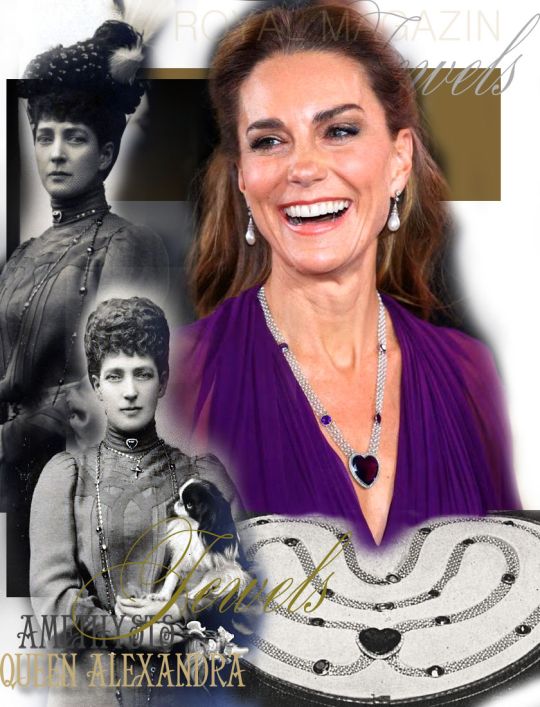
Queen Alexandra’s Amethysts – A Royal Wedding Gift Returns
When Catherine, Princess of Wales, appeared wearing a magnificent amethyst, pearl and diamond necklace in September 2026, she brought back into the public eye a jewel that had been seen only once in recent decades. But its story begins more than a century earlier, with Queen Alexandra and her particular love of amethysts.
From April 11 to November 23, 2025, The King’s Gallery at Buckingham Palace will host a major exhibition titled The Edwardians: Age of Elegance. This groundbreaking event explores the opulence, style, and societal shifts of the Edwardian era through the lives of King Edward VII and Queen Alexandra, and King George V and Queen Mary.
Two of Britain’s most fashionable royal couples – King Edward VII and Queen Alexandra, and King George V and Queen Mary – from their family lives and personal collecting to their glittering social circles and spectacular royal events
The exhibition will showcase over 300 artifacts, many on display for the first time, including jewelry, fashion, art, and personal items.
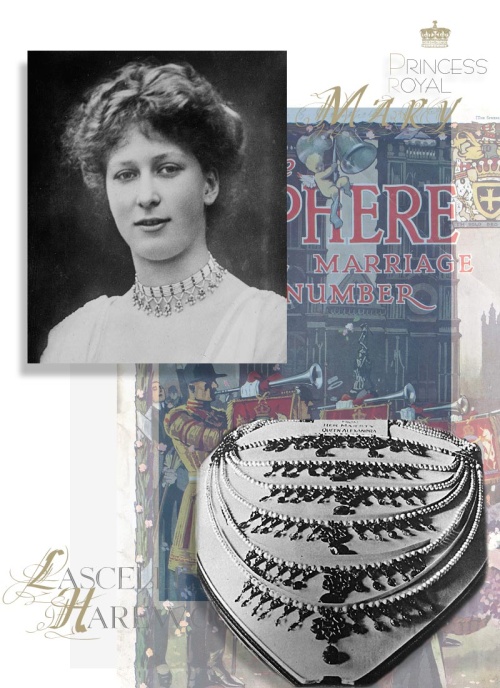
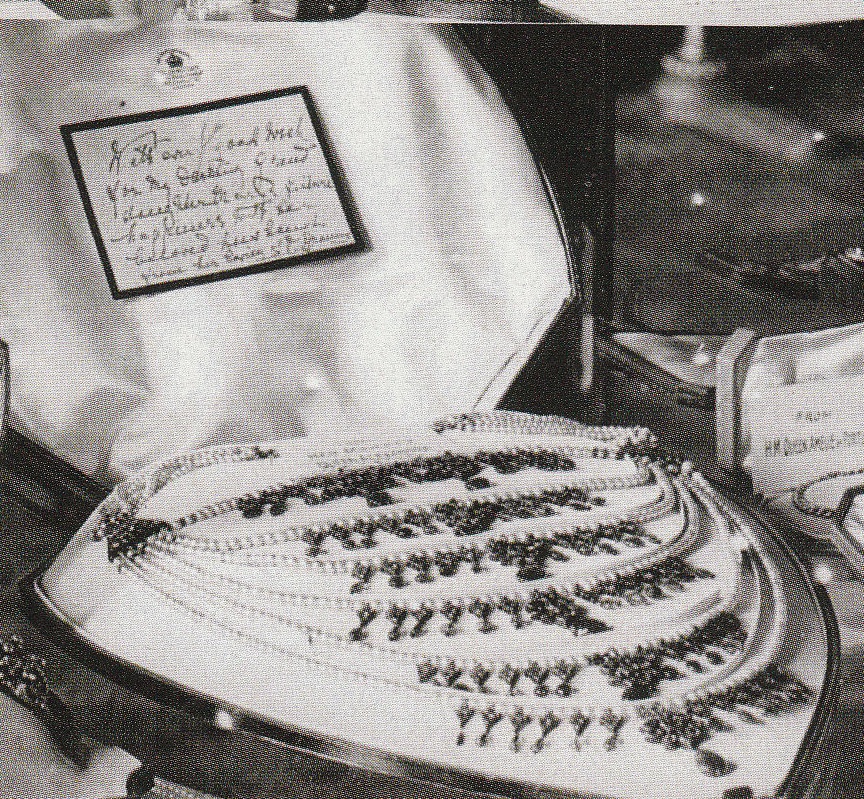
Queen Mary’s Love Trophy Collar Diamond Choker Necklace Eduardian Style jewelry update from the earlier version of 2015
The display will recreate the lavish interiors of Marlborough House and Sandringham House, adorned with family photographs, decorative treasures, and society mementos.
See an Egyptian scarab brooch given to Alexandra by Edward following his tour of the Middle East in 1863.
Visitors can immerse themselves in Edwardian culture through paintings by luminaries like John Singer Sargent the Duchess of Connaught, Frederic Leighton, and Edward Burne-Jones, alongside new trends like Aestheticism and Art Nouveau. Personal items and souvenirs from royal travels and events will provide insight into the couple’s global influence and vibrant social lives. Photography, a burgeoning art form of the era, will also be featured, including works by pioneering female photographers and snapshots taken by Alexandra herself.
The exhibition captures the grandeur and transitions of a golden age brought to an abrupt end by World War I, offering a poignant glimpse into the lives, tastes, and artistic patronage of the Edwardian royals.
A previously undisclosed Fabergé Brooch emerged into public view when Queen Camilla adorned herself with a heritage piece of Queen Alexandra on the 11th of March, in celebration of Commonwealth Day. This remarkable piece revealed two portions of what are three components of a royal Fabergé Cloak Clasp.
The tradition of gifting, particularly for occasions such as birthdays and Easter, saw her receiving numerous presents from her sister, Empress Marie Feodorovna of Russia. The Empress held a particular preference for the exquisite craftsmanship of Fabergé for such esteemed events.
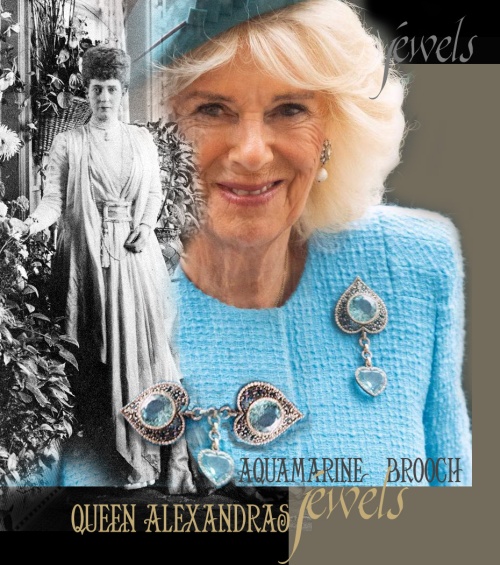
Queen Alexandra’s Aquamarine Brooch an exquisite cloak clasp adorned with a heart pendant, encased within frames of lustrous diamonds, and complemented by a chain meticulously set with diamonds. This remarkable piece, believed to have been crafted by the renowned Fabergé around 1904 , later became a part of Queen Mary of England’s Royal Jewel Collection. To enrich our exploration, let us also consider the third component of this regal jewel, inviting a comprehensive appreciation of its historical and artistic significance.
Coronation Day, 9 August 1902. Coronation, Alexandra made an unequivocal declaration of intent: ‘I know better than all the milliners and antiquaries. I shall wear exactly what I like and so shall my ladies – basta!’ On the day itself, she dispensed with the customary maids of honour in favour of a bevy of adolescent peers, who carried velvet robes dyed what one observer described as ‘petunia’. They were worn over a shimmering gown of gold silk, itself veiled by a diaphanous overdress intricately embroidered, through the offices of the American-born Vicereine, Mary Curzon, by Indian craftswomen.
After four decades of mourning under Queen Victoria, the coronation of King Edward VII and Queen Alexandra was envisioned as a dazzling public spectacle, symbolizing a new era of glamour for the monarchy. However, just three days before the scheduled ceremony, Edward underwent emergency surgery for appendicitis, postponing the event by six weeks. When the coronation finally took place on August 9, 1902, it became one of the most opulent royal celebrations in British history.
Traditionally, coronation gowns were simple white or cream robes, inspired by ecclesiastical attire. Yet Alexandra, a global fashion icon, defied convention with a striking gold dress designed by the Parisian fashion house Morin Blossier, led by women. The gown was adorned with thousands of tiny gold spangles, meticulously crafted to shimmer under the newly installed electric lights in Westminster Abbey—a first for such an event.
At Alexandra’s suggestion, her coronation dress became the first royal ensemble to incorporate Britain’s national emblems—the rose, thistle, and shamrock—a tradition upheld in every subsequent coronation dress, including those of Queen Elizabeth II and Queen Camilla. The intricate gold net of the gown was embroidered over five months by forty artisans in Delhi before being sent to Paris, where it was layered over cloth of gold to create the final masterpiece. Now exceedingly fragile, the rarely exhibited dress required over 100 hours of meticulous conservation work to prepare for display.
Alexandra adorned herself with an array of jewels and pearls for the coronation, including a diamond necklace and earrings—a wedding gift from Edward—displayed here for the first time, alongside the Dagmar necklace, a present from the King of Denmark. Also featured is her ostrich feather fan, its handle embellished with a diamond crown, an ‘A,’ and the national emblems.
The choice of a radiant gold fabric would have been breathtaking at the time, with contemporary accounts describing moments during the ceremony when the Queen appeared bathed in a golden glow, her dress illuminated by the Abbey’s electric lights. This shimmering vision epitomized Edward and Alexandra’s delicate balance of tradition and modernity as they ushered in the 20th century—a fleeting moment of splendor before the world descended into war.
Queen Alexandra’s Kokoshnik Tiara, one of the favorite Diamond Tiaras of Queen Elizabeth II from England, could be also worn as necklace in the time of Queen Alexandra, but later fixed only for a tiara and reduced 16 Diamond-Fringe….more…
Royal Jewels of Queen Alexandra Rubies and Diamond Bracelet | Wedding Gift of the Ladies of Hampshire and the Isles of Wight| the bracelet raised a large cross – a copy of the old County Wykehlan Cross
Historic Turquoise Parure Queen Anna, Queen Charlotte,Queen Victoria, Empress Friedrich, Queen Sophie of Greece, Queen Maud, Queen of Norway, Princess Astrid Turquoise diadem, turquoise stomacher, turquoise brooch, turquoise bracelet, turquoise necklace, turquoise choker, turquoise collier, turquoise earrings, turquoise diamond parure
Journal des villes et des campagnes, 20 octobre 1889 Les principaux bijoux de la corbeille de mariage de la princesse Sophie, fiancée du prince royal de Grèce, consistent en un diadème et un collier en brillants.
Le diadème, qui est un cadeau do l’empereur, est fait de trois rangées do turquoises entourées de diamants. La plus grande des turquoises, ayant la forme d’une poire, forme le sommet du diamant. Elle est tout ornée de diamants. Le collier est également en turquoises et d’une très grande valeur; les pierres sont très pures. Ce collier est un joyau de famille et provient, d’après la tradition, de la raine Anne d’Angleterre, a appartenu à la princesse Charlotte de Galles et est revenu, après la mort, de son mari, Léopold Ier, roi des Belges, à la reine Victoria. Il tut donné à l’impératrice Frédéric, qui vient de le donner à son tour u sa fille la princesse Sophie.Le Gaulois, 28 octobre 1889
Historic Turquoise Parure – Wedding Gift – Historic Turquoise Parure Queen Anne of England, Queen Charlotte of Belgium ,Queen Victoria, Empress Friedrich, Queen Sophie of Greece, Queen Maud, Queen of Norway, Princess Astrid Turquoise diadem, turquoise stomacher, turquoise brooch, turquoise bracelet, turquoise necklace, turquoise choker, turquoise collier, turquoise earrings, turquoise diamond parure
…Die Ausstattung der Prinzessin Sophie an Juwelen hat den Werths eines Schatzes. Das Hauptstück derselben ist ein Schmuck aus Brillanten und Türkisen, bestehend aus Diadem, Brosche und Halsband. Das Diadem ist ein Geschenk des Kaisers. Es ist sehr hochgearbeitet, die Zeichnung von graziöser Erfindung. Drei übereinander stehende Reihen von Türkisen in sich vergrößerndem Maßstabe sind von den zierlichsten Arabesken in Brillanten umgeben. Die größten Türkise in Birnenform bilden krönende Spitzen, eingefaßt von großen Brillanten. Nach den beiden Endseiten hin verkleinert sich das Diadem. Das Halsband ist in Form von Bandschleifen in Brillanten gearbeitet, die Knoten desselben von großen Türkisen gebildet. Von großem Werth und seltener Schönheit, namentlich der Türkise, ist das daranhängende Kreuz.
Es ist ein Erbstück der Englischen Königsfamilie. Nach einer Tradition soll es von der Königin Anna stammen, factisch war es im Besitz der Prinzessin Charlotte von Wales, der einzigen, früh verstorbenen Tochter Georg IV. Ihr Gemahl, der spätere König Leopold I. der Belgier, schenkte es der Königin Victoria, diese der Prinzess Royal und Kaiserin Friedrich gab es zum Brautschatz der Prinzessin Sophie, ebenso auch einen großen runden, von großen Brillanten umgebenen Türkis, der als Armband wie als Brosche getragen werden kann und mit welchem der Vater, der PrinceConsort, einst das Taufkleid seines ersten Kindes, der Princess Royal, geschmückt hatte.
Der Türkisschmuck wurde von der Prinzessin von Sparta nicht öffentlich getragen. Er ging vermutlich zurück nach England und dann an Königin Maud von Norwegen….
Schmuck und Juwelen der Deutsche Fürstenhäuser | Royal Jewels – Historical Jewerly and Treasure of Royals and Aristocracy | bijoux historiques| исторические драгоценности