Kategoriearchiv: Stomacher | Devante de Corsage | Large Brooch

stomacher, diamond stomacher, diamond large brooch, devante de corsage, pearl diamond stomacher, diamonds, brillants, sapphire stomacher, emerald stomacher

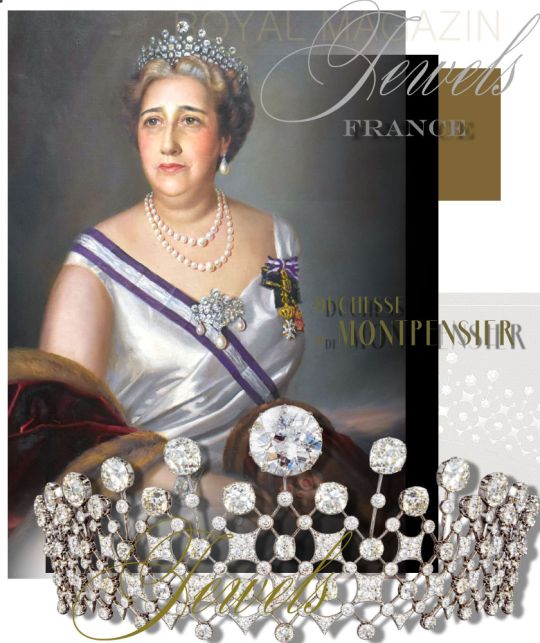
Duchesse de Montpensier Mellerio dits Meller Diamond Lattice Tiara |Isabelle de Valdeterrazo, Duchesse de Montpensier Imperial Royal Jewels France

Duchesse de Montpensier Mellerio dits Meller Diamond Lattice Tiara |Isabelle de Valdeterrazo, Duchesse de Montpensier Imperial Royal Jewels France

Duchesse de Montpensier Mellerio dits Meller Diamond Lattice Tiara |Isabelle de Valdeterrazo, Duchesse de Montpensier Imperial Royal Jewels France

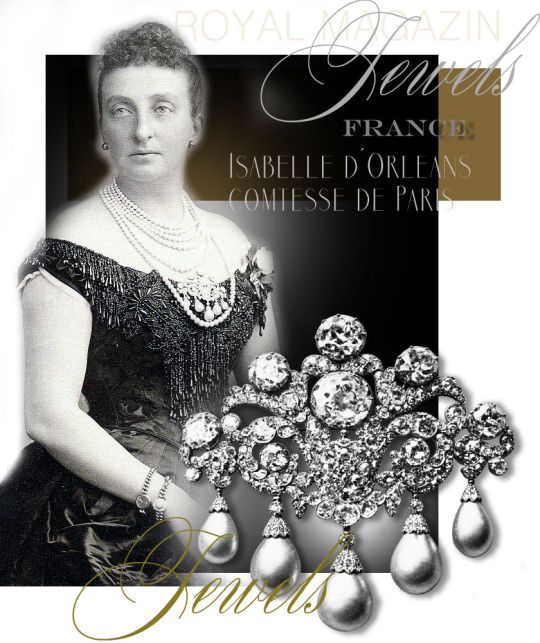
Marie Isabelle de Orleans Countess of Paris Famous Pearls |Pearl Necklace and Pearl and Diamond Stomacher made by Bapst Imperial Royal Jewels France The Bapst Pearl and Diamond Brooch – House of Orléans, 1846 An extraordinary pearl and diamond brooch created by the renowned Parisian jeweller Bapst for the French royal House of Orléans. « Broche de perles et diamants exécutée par la maison Bapst pour la famille d'Orléans en 1846 » The magnificent jewel features an elaborate openwork composition of scrolling diamond-set motifs, richly adorned with large diamonds of varying sizes. The intricate design is crowned by prominent diamonds, while the lower section is embellished with five magnificent pear-shaped pearl drops, suspended from ornate diamond-set caps. The central pearl hangs slightly lower than the others, creating an elegant, balanced arrangement and emphasising the impressive dimensions of the jewel. The historical illustration bears the original French caption: “Broche perles et brillants, exécutée par Bapst pour la famille d’Orléans.” This remarkable creation exemplifies the splendour and craftsmanship of nineteenth-century French royal jewellery, combining the brilliance of diamonds with the timeless elegance of pearls. It was worn by the last Duchess of Montpensier with three of the large pearls and two of the pearshaped pearls are the earrings. Interestingly, the inventory of Queen Marie-Amélie's personal jewels, drawn up by the Crown Jeweller Constant Bapst on 25 November 1839, describes another remarkable pearl and diamond jewel: a large Sévigné brooch with diamond-set foliage, adorned with ten pearls, including five pear-shaped drops, valued at 8,500 French francs. The similarity is intriguing. However, the brooch illustrated by Vever is dated 1846, seven years after the inventory. Whether the two descriptions refer to entirely separate jewels or to an earlier brooch subsequently altered remains to be established. Historical sources: Queen Marie-Amélie's jewellery inventory, 25 November 1839; Henri Vever, La Bijouterie française au XIXe siècle, Vol. I, p. 195; historical jewellery research, Royal Magazin – Ursula Butschal. Marie Isabelle de Orleans Countess of Paris Famous Pearls |Pearl Necklace and Pearl and Diamond Stomacher made by Bapst Imperial Royal Jewels France The Four-Strand Pearl Necklace of the Countess of Paris A remarkable series of historical portraits shows Marie Isabelle d’Orléans (1848–1919), Countess of Paris, repeatedly wearing an impressive four-strand pearl necklace. The jewel may be connected with an important provision in the will of her mother-in-law, Hélène of Mecklenburg-Schwerin, Duchess of Orléans, who died in 1858. A contemporary newspaper report explicitly mentions a magnificent four-strand pearl necklace intended to be worn by the future Countess of Paris. « Ce beau collier de perles, à quatre rangs » Following her marriage to Prince Philippe d’Orléans, Count of Paris, in 1864, Marie Isabelle was frequently portrayed wearing four rows of pearls, see above. The repeated appearance of this distinctive arrangement in historical portraits provides valuable visual evidence alongside the written testamentary record. Whether every portrait depicts the very same necklace, and whether it can be identified with the pearl parure presented to Hélène in 1837, remains an intriguing question for further historical research. Historical research and documentation © Royal Magazin – Ursula Butschal. Quelle:Mellerio Archive,Archive Ursula Butschal; Duchesse de Montpensier Mellerio dits Meller Diamond Lattice Tiara |Isabelle de Valdeterrazo, Duchesse de Montpensier Imperial Royal Jewels France
Marie Isabelle de Orleans Countess of Paris Famous Pearls |Pearl Necklace and Pearl and Diamond Stomacher made by Bapst Imperial Royal Jewels France
The Bapst Pearl and Diamond Brooch – House of Orléans, 1846


Marie Isabelle de Orleans Countess of Paris Famous Pearls |Pearl Necklace and Pearl and Diamond Stomacher made by Bapst Imperial Royal Jewels France


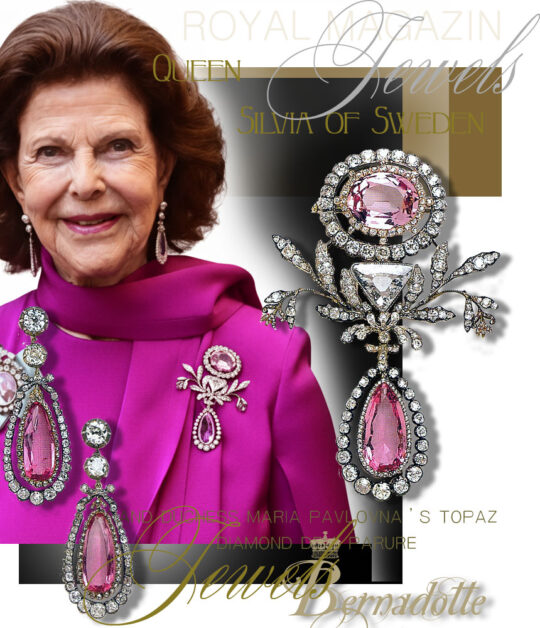
Grand Duchess Maria Pavlovna’s Pink Topaz and Diamond Demi Parure| Queen Silvia of Sweden’s|Bernadotte Royal Jewels

Grand Duchess Maria Pavlovna's Pink Topaz and Diamond Demi Parure| Queen Silvia of Sweden's|Bernadotte Royal Jewels
Grand Duchess Maria Pavlovna’s Pink Topaz and Diamond Demi Parure| Queen Silvia of Sweden’s|Bernadotte Royal Jewels SwedishRoyalJewels JewelsWithHistory queen pinktourmaline pinktopas royaljewellery royaljewels bernadotte grandduchess mariapavlovna romanov parure royalfamily royals swedishroyalfamily topaz stomacher maria pavlovna Historic Jewels

Grand Duchess Maria Pavlovna’s Pink Topaz and Diamond Demi Parure| Queen Silvia of Sweden’s|Bernadotte Royal Jewels

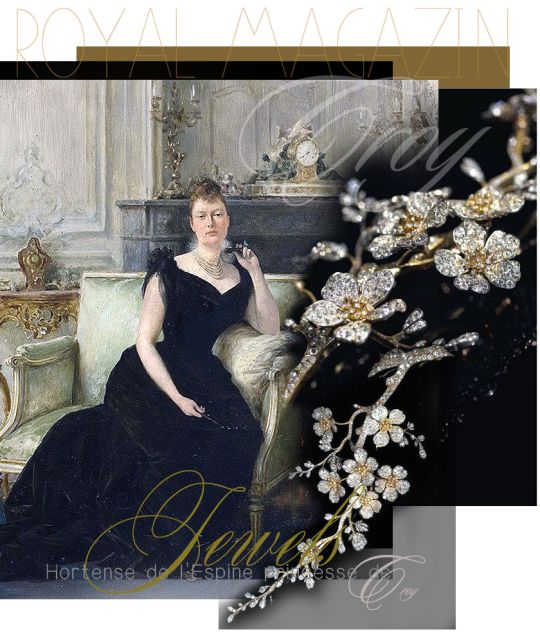
Princess Hortense de L’Espine de Croÿ| Impressive important Diamond Corsage Ornament made by Lalique for Vever |Stomacher Princesse Louis de Croÿ

Princess Hortense de L'Espine de Croÿ| Impressive important Diamond Corsage Ornament made by Lalique for Vever |Stomacher Princesse Louis de Croÿ German Royal Jewels The corsage ornament, signed Vever, is composed as an articulated branch, set throughout with cushion-shaped, circular- and rose-cut diamonds, the delicate flowerheads mounted en tremblant to catch the light with every movement. Executed in silver, yellow and pink gold, the jewel could be divided into three smaller brooches and accompanied by two detachable diamond caps — a hallmark of Parisian versatility and engineering in haute joaillerie of the period.
Princess Hortense de L’Espine de Croÿ| Impressive important Diamond Corsage Ornament made by Lalique for Vever |Stomacher Princesse Louis de Croÿ German Royal Jewels The corsage ornament, signed Vever, is composed as an articulated branch, set throughout with cushion-shaped, circular- and rose-cut diamonds, the delicate flowerheads mounted en tremblant to catch the light with every movement. A spray of cherry blossom set with diamonds….

Princess Hortense de L’Espine de Croÿ| Impressive important Diamond Corsage Ornament made by Lalique for Vever |Stomacher Princesse Louis de Croÿ German Royal Jewels

Large Aquamarine Brooch and Aquamarine Pearshaped Pendant |Deborah Duchess of Devonshire|Important Noble Jewelry

Large Aquamarine Brooch and Aquamarine Pearshaped Pendant |Deborah Duchess of Devonshire|Important Noble Jewelry

Large Aquamarine Brooch and Aquamarine Pearshaped Pendant |Deborah Duchess of Devonshire|Important Noble Jewelry

Double Heart Sapphire and Diamond Brooch | Countess Cornelia Craven 

Jewels of the Mitford Sisters - important jewels - lady Craven- important brooch
Double Heart Sapphire and Diamond Brooch | Countess Cornelia Craven

Jewels of the Mitford Sisters – important jewels – lady Craven- important brooch – update from the year 2020

Double Heart Sapphire and Diamond Brooch |Deborah Duchess Devonshire Countess Cornelia Craven

Green Vault Germany Saxony| Grünes Gewölbe Dresden Sachsen

13. August 2024

Staatlichen Kunstsammlungen Dresden (SKD), zur neuen Präsentation der Juwelen im Historischen Grünen Gewölbe

Grünes Gewölbe Dresden - Green Vault Saxony's royal jewels - queens diamonds - royal saxony
Grünes Gewölbe Dresden – Green Vault Saxony’s royal jewels – green vault treasury jewel room – Grünes Gewölbe und Rüstkammer der SKD 13.08.24 im Historischen Grünen Gewölbe im Residenzschloss Dresden // Foto: David Pinzer

Fast fünf Jahre waren seit dem spektakulären Einbruch in das Historische Grüne Gewölbe vergangen, als endlich ein Lichtblick am Horizont erschien. Die Juwelen, die im Dezember 2022 nach langen Ermittlungen zurückerlangt wurden, sollten nun erstmals wieder der Öffentlichkeit präsentiert werden. Es war ein bedeutender Moment, auf den viele lange gewartet hatten.

Green Vault Germany Saxony| Grünes Gewölbe Dresden Sachsen juwelenzimmer Staatlichen Kunstsammlungen Dresden SKD die Präsentation der zurückerlangten Juwelen im Historischen Grünen Gewölbe im Residenzschloss

Das Landgericht Dresden hatte seine Zustimmung gegeben, die kostbaren Stücke an ihren angestammten Platz zurückzubringen. Trotz dieser Rückkehr blieben die Juwelen weiterhin für die gerichtliche Begutachtung unter Sicherstellung, doch ihre Anwesenheit im Grünen Gewölbe erlaubte es den Menschen, das Museum wieder in seiner fast vollständigen Pracht zu erleben. Die Vitrine, die einst leer und verlassen gewirkt hatte, erstrahlte nun erneut und zog zahlreiche Besucherinnen und Besucher an, die sich von der Schönheit und dem Glanz der ausgestellten Stücke verzaubern ließen.

Die Juwelen selbst wurden in dem Zustand präsentiert, in dem sie den Staatlichen Kunstsammlungen Dresden übergeben worden waren. Trotz der kaum sichtbaren, aber dennoch vorhandenen Schäden, die eine Restaurierung erforderlich machten, strahlte das barocke Schmuckensemble eine einzigartige Aura aus, die es weltweit in seiner Art unübertroffen machte. Inmitten dieser Pracht wurde deutlich, dass Museen weit mehr sind als nur Orte des Schauens – sie sind Bewahrer und Forscher kultureller Werte. Hier, im Grünen Gewölbe, zählte nicht allein der materielle Wert der Juwelen, sondern vor allem ihr kultureller und historischer Wert.

Green Vault Germany Saxony| Grünes Gewölbe Dresden Sachsen juwelenzimmer Staatlichen Kunstsammlungen Dresden SKD die Präsentation der zurückerlangten Juwelen im Historischen Grünen Gewölbe im Residenzschloss

Die Rückkehr dieser Juwelen bedeutete eine neue Phase der Hoffnung und Erwartung. Es waren Werke der sächsischen und internationalen Juwelierkunst des 18. Jahrhunderts, die als künstlerische Hauptwerke galten. Die Schäden, die sie erlitten hatten, schienen zwar reparierbar, doch diese Aufgabe würde eine internationale Expertenkommission übernehmen, sobald die Juwelen endgültig freigegeben würden.

Doch es blieb ein Wunsch, der nicht erlosch: Eines Tages würden vielleicht auch die übrigen verlorenen Juwelen wieder ihren Weg zurück ins Grüne Gewölbe finden. Die Soko Epaulette, die die Ermittlungen weiterführte, ließ keinen Hinweis unbeachtet. Es war eine leise, aber entschlossene Hoffnung, die hinter den Mauern des Museums lebte.

Die Vergangenheit konnte zwar nicht rückgängig gemacht werden, aber die Zukunft sollte sicherer sein. Die Sicherheitsarchitektur, die die Sammlungen und Liegenschaften schützte, war gründlich überarbeitet worden. In enger Zusammenarbeit mit den zuständigen Behörden wurden Maßnahmen ergriffen, um sicherzustellen, dass ein solcher Einbruch niemals wieder geschehen könnte. So blickte man im Grünen Gewölbe nach vorn, mit einem neu gefestigten Vertrauen und dem Wissen, dass die Kultur und Geschichte, die in diesen Mauern bewahrt wird, sicherer war als je zuvor.

August des Starken King of Sachsen’s Diamond Treasury – the Historic Green Vault

Nearly five years had passed since the dramatic break-in at the Historic Green Vault, when at last a glimmer of hope emerged. The jewels, recovered in December 2022 after extensive investigations, were now ready to be displayed to the public for the first time. It was a momentous occasion, long awaited by many.

The Dresden Regional Court had granted permission for these precious pieces to be returned to their rightful place. Though the jewels remained under judicial custody for further examination, their presence in the Green Vault allowed the museum to once again be seen in nearly all its former splendor. The once empty and forlorn display case now shone brightly, drawing countless visitors who were captivated by the beauty and brilliance of the treasures on display.

The jewels were presented in the exact condition in which they had been returned to the State Art Collections of Dresden. Despite the barely visible yet existent damage that required restoration, the baroque jewelry ensemble radiated a unique aura, unmatched anywhere in the world. It was a powerful reminder that museums are far more than mere places for viewing—they are guardians and researchers of cultural values. Here, in the Green Vault, the jewels‘ cultural and historical significance far outweighed their material value.

The return of these jewels marked a new phase of hope and anticipation. These pieces were masterpieces of 18th-century Saxon and international jewelry craftsmanship, and despite the damage they had suffered, experts believed they were repairable. An international commission of experts was set to take on the restoration work once the jewels were fully released.

Yet, one wish remained unfulfilled: that one day, the other missing jewels might also find their way back to the Green Vault. The ongoing efforts of the „Soko Epaulette“ investigative team ensured that no lead was overlooked. It was a quiet but determined hope that resonated within the museum’s walls.

While the past could not be undone, the future was made more secure. The security architecture protecting the collections and properties had been thoroughly revised. In close collaboration with the relevant authorities, measures were implemented to ensure that such an intrusion could never happen again. And so, the Green Vault looked forward with renewed confidence, knowing that the culture and history preserved within its walls were safer than ever before.


Princess Beatrice, Duchess of Galliera’s Heraldic Fleur-de- Lys Brooch/Stomacher set with diamonds made by Chaumet

Diamond Fleur-de-Lys Brooch

Princess Baby Bee Sachsen-Coburg-Gotha | Infanta Beatrice of Spain, Duchess of Galliera Brooch Heraldic Bourbon Lily -Could be worn as decorative hair ornament and Stomacher or Devante de Corsage

Princess Baby Bee Sachsen-Coburg-Gotha | Infanta Beatrice of Spain, Duchess of Galliera Brooch Heraldic Bourbon Lily -Could be worn as decorative hair ornament and Stomacher or Devent de Corsage , Saxon-Coburg-Gotha, Duchess of Edinburgh daughter, Orleans Bourbon, Infanta of Spain, 1922, spanish royal jewels, fleur de lys pendant, lilies in diamond, pearls, Beatrice Duchess of Galliera, joyas reales,diadema,diademes,Baby Bee,Princess Baby Bee, wedding     Baby Bee
    Princess Beatrice Leopoldine Victoria of Saxe-Coburg and Gotha
    Beatrice Leopoldine Victoria
    Princess Beatrice Leopoldine Victoria
    Beatrice Leopoldine Victoria Saxe-Coburg and Gotha, Princess of the United Kingdom
    Princess Beatrice, Duchess of Galliera
    Beatrice of Saxe-Coburg and Gotha
    Beatrice of Edinburgh
    Princess Beatrice Leopoldine Victoria, Duchess of Galliera
Princess Baby Bee of Saxon-Coburg-Gotha | Infanta Beatrice of Spain, Duchess of Galliera Brooch Heraldic Bourbon Lily -Could be worn as decorative hair ornament and Stomacher or Devante de Corsage

Princess Beatrice, Duchess of Galliera’s Heraldic Fleur-de- Lys Brooch/Stomacher set with diamonds made by Chaumet

Queen Victoria Eugenie’s Emerald Art deco Pendant Brooch| Donna Alessandra Sandra Torlonia

Queen Ena's extraordinary emerald and diamond brooch - Queen Ena Victoria Eugenie's Emerald Art deco Pendant Brooch| Donna Alesandra Sandra Torlonia Brooch Sugarloaf Emeralds caushion double brooch - spanish royal jewel history EARLY 20TH CENTURY EMERALD AND DIAMOND PENDENT BROOCH
Sugarloaf and oval-shaped cabochon emerald Donna Alessandra Sandra Torlonia  daughter  Infanta Beatriz of Spain, Princess of Civitella-Cesif.
Queen Victoria Eugenie’s Emerald Art deco Pendant Brooch|Princess Alessandra Sandra Torlonia daughter Infanta Beatriz of Spain, Princess of Civitella-Cesif.

Queen Victoria Eugenie’s Emerald Art deco Pendant Brooch| Princess Alessandra Sandra Torlonia Brooch Spanish royal jewel history

Turquoise and Diamond Jewels | Important Russian Turquoise and Diamond Set Queen Ingrid of Denmark | Queen Margarethe of Denmark

Important Romanov Turquoises, the collection of Turquoises of Queen Ingrid of Denmark left from her mother Princess Margareta of Connaught, the Crown Princess of Sweden. Turquoise Bracelet, Turquise Diamond Cuff, Turquoise Tiara, Turquoise Diamond Cluster Brooch, Turquoise Diamond earrings, Turquoise Diamond smaller earpandants now Crownprincess Mary of Denmark, Turquoise Diamond Hear Brooch, Turquoise Diamond Ring, Turquoise Diamond pendant, Turquoise Diamond ornament, Turquoise DiamondPaisley brooch, Turquoise Diamond pear shaped pendant,tiara with turquoises and diasies, Turquoise Diamondjewellery

Important Romanov Turquoises. The Russian empress Catherine the Great passed down a set of diamond turquoise jewels through the generations, Princess Louise of Prussia – the Duchess of Connaught to Princess Margaret of Connaught, Princess Ingrid of Sweden her daughter is the late Queen Ingrid of Denmark.

Important Romanov Turquoises. The Russian empress Catherine the Great passed down a set of diamond turquoise jewels through the generations,  Princess Louise of Prussia - the Duchess of Connaught  to Princess Margaret of Connaught, Princess Ingrid of Sweden her daughter is the late Queen Ingrid of Denmark.Princess Margaret is a maternal grandmother of Queen Margrethe and the paternal grandmother of King Carl-Gustav of Sweden.

 That is how these jewels found their way to Queen Margrethe,see above with the older setting and the smaller earpendants, and she gifted them to Crown Princess Mary in 2022 for her 50th birthday.


Princess Margaret is a maternal grandmother of Queen Margrethe and the paternal grandmother of King Carl-Gustav of Sweden.

That is how these jewels found their way to Queen Margrethe, see above with the older setting and the smaller ear pendants, and she gifted them to Crown Princess Mary in 2022 for her 50th birthday.

Important Turquoises Crown Princess of Sweden Jewels|Royal |Large Turquoise Set Ingrid Queen of Denmark

The collection of Turquoises of Queen Ingrid of Denmark left from her mother Princess Margareta of Connaught, the Crown Princess of Sweden.

Turquoise Bracelet,
Turquoise Diamond Cuff with seven oval Turquoises,
Turquoise Tiara,

Princess Isabella’s Diadem The Turquoise Flower Tiara| Royal Jewels History Denmark

Princess Isabella's Diadem The Turquoise Flower Tiara| Royal Jewels History Denmark The Turquoise Daisy Bandeau Tiara 18th birthday gift from Queen Margrethe 
  Turquoise Earrings  Queen Mary’s 50th birthday gift from Queen Margrethe
Princess Isabella’s Diadem The Turquoise Flower Tiara| Royal Jewels History Denmark The Turquoise Daisy Bandeau Tiara 18th birthday gift from Queen Margrethe
||Turquoise Earrings Queen Mary’s 50th birthday gift from Queen Margrethe

Turquoise Diamond Cluster Brooch,
Turquoise Diamond earrings,
Turquoise Diamond smaller ear pendants now Crown princess Mary of Denmark,
Turquoise Diamond Heart Brooch,
Turquoise Diamond Ring,
Turquoise Diamond pendant,
Turquoise Diamond ornament,
Turquoise Diamond Paisley brooch,
Turquoise Diamond pear shaped pendant,
Turquoise tiara with turquoises and daisies,
Turquoise Diamond jewellery

Turquoise and Diamond Brooch Crown Princess Margaret of Sweden Wedding Jewels|Devonshire Brooch| Royal Marriage Presents

Romanov Turquoise and Diamond Brooch Cluster with Pendant and Turquoise Earrings |Crown Princess Margaret of Sweden Wedding Jewels|Royal Marriage Presents

Important Turquoise Parure | Royal Jewel History

Historic Turquoise Parure Queen Anna, Queen Charlotte,Queen Victoria, Empress Friedrich, Queen Sophie of Greece, Queen Maud, Queen of Norway, Princess Astrid Turquoise diadem,turquoise stomacher, turquoise brooch,turquoise bracelet,turquoise necklace, turqoise choker, turquoise collier, turquoise earrings, turquoise diamond parure
Historic Turquoise Parure Queen Anna, Queen Charlotte,Queen Victoria, Empress Friedrich, Queen Sophie of Greece, Queen Maud, Queen of Norway, Princess Astrid Turquoise diadem, turquoise stomacher, turquoise brooch, turquoise bracelet, turquoise necklace, turquoise choker, turquoise collier, turquoise earrings, turquoise diamond parure

Journal des villes et des campagnes, 20 octobre 1889
Les principaux bijoux de la corbeille de mariage de la princesse Sophie, fiancée du prince royal de Grèce, consistent en un diadème et un collier en brillants.

Le diadème, qui est un cadeau do l’empereur, est fait de trois rangées do turquoises entourées de diamants. La plus grande des turquoises, ayant la forme d’une poire, forme le sommet du diamant. Elle est tout ornée de diamants. Le collier est également en turquoises et d’une très grande valeur; les pierres sont très pures. Ce collier est un joyau de famille et provient, d’après la tradition, de la raine Anne d’Angleterre, a appartenu à la princesse Charlotte de Galles et est revenu, après la mort, de son mari, Léopold Ier, roi des Belges, à la reine Victoria. Il tut donné à l’impératrice Frédéric, qui vient de le donner à son tour u sa fille la princesse Sophie.Le Gaulois, 28 octobre 1889

Wedding Princess Sophia of Prussia | Queen Consort of the Hellenes| Greece Royal Jewels | Marriage gifts and presents

Prinzessin Sophie von Preussen | Hochzeit | Kronprinzessin von Griechenland, Königin der Hellenen

Historic Turquoise Parure Queen Anna, Queen Charlotte,Queen Victoria, Empress Friedrich, Queen Sophie of Greece, Queen Maud, Queen of Norway, Princess Astrid Turquoise diadem,turquoise stomacher, turquoise brooch,turquoise bracelet,turquoise necklace, turqoise choker, turquoise collier, turquoise earrings, turquoise diamond parure
Historic Turquoise Parure – Wedding Gift – Historic Turquoise Parure Queen Anne of England, Queen Charlotte of Belgium ,Queen Victoria, Empress Friedrich, Queen Sophie of Greece, Queen Maud, Queen of Norway, Princess Astrid Turquoise diadem, turquoise stomacher, turquoise brooch, turquoise bracelet, turquoise necklace, turquoise choker, turquoise collier, turquoise earrings, turquoise diamond parure

…Die Ausstattung der Prinzessin Sophie an Juwelen hat den Werths eines Schatzes. Das Hauptstück derselben ist ein Schmuck aus Brillanten und Türkisen, bestehend aus Diadem, Brosche und Halsband. Das Diadem ist ein Geschenk des Kaisers.
Es ist sehr hochgearbeitet, die Zeichnung von graziöser Erfindung. Drei übereinander stehende Reihen von
Türkisen in sich vergrößerndem Maßstabe sind von den zierlichsten Arabesken in Brillanten umgeben. Die größten Türkise in Birnenform bilden krönende Spitzen, eingefaßt von großen Brillanten.
Nach den beiden Endseiten hin verkleinert sich das Diadem. Das Halsband ist in Form von Bandschleifen in Brillanten gearbeitet, die Knoten desselben von großen Türkisen gebildet. Von großem Werth und seltener Schönheit, namentlich der Türkise, ist das daranhängende Kreuz.

Es ist ein Erbstück der Englischen Königsfamilie. Nach einer Tradition soll es von der Königin Anna stammen, factisch war es im Besitz der Prinzessin Charlotte von Wales, der einzigen, früh verstorbenen Tochter Georg IV. Ihr Gemahl, der spätere König Leopold I. der Belgier, schenkte es der Königin Victoria, diese der Prinzess Royal und Kaiserin Friedrich gab es zum Brautschatz der Prinzessin Sophie, ebenso auch einen großen runden, von großen Brillanten umgebenen Türkis, der als Armband wie als Brosche getragen werden kann und mit welchem der Vater, der PrinceConsort, einst das Taufkleid seines ersten Kindes, der Princess Royal, geschmückt hatte.

Der Türkisschmuck wurde von der Prinzessin von Sparta nicht öffentlich getragen. Er ging vermutlich zurück nach England und dann an Königin Maud von Norwegen….

Princess Astrid of Norway | Turquoise Stars | Queen Maud Jewels | Royal Turquoises
Türkisschmuck von Königin Maud von Norwegen | Diadem, Halsband, Armband, Broschen, Choker, Sterne mit Türkisen besetzt

Hesse Emerald Jewelry| Grand Duchess Alice| Grand Duchess Eleonore| Grand Duchess Cecilie Medival Emerald Diadem Pears Shaped Emeralds Suite

Hesse Emerald Jewelry| Grand Duchess Alice,| Grand Duchess Eleonore| Grand Duchess Cecilie Medival Emerald Diadem Pears Shaped Emeralds Suite
Hesse Emerald Jewelry| Grand Duchess Alice | Großherzogin Alice von Hessen Smaragd Anhänger, Smaragd Brosche aus dem Hessischen Hausschatz
Hesse Medieval Emerald Tiara  Hesse Medieval Emerald Choker Hesse Emerald Jewelry| Grand Duchess Alice,| Grand Duchess Eleonore| Grand Duchess Cecilie Medival Emerald Diadem Pears Shaped Emeralds Suite|  Großherzogin von Hessen Kreuter Koch tiara,Kreuter Tiara
Hesse Emerald Choker –Hesse Emerald Jewelry| Grand Duchess Eleonore| Grand Duchess Cecilie Medieval Emerald Diadem Pears Shaped Emeralds Suite – on the bottom – Princess Cecile of Greece and Denmark married the hereditary Grand Duke of Hesse and By Rhine. The sister of the late Duke of Edinburgh died tragically young in an air crash in 1937.

The emerald suite, emerald pendant, emerald brooches, emerald stomacher, emerald tiara, emerald necklace, emerald medieval diadem, emerald pear shaped large pendant, was not personal property of the Grand Duchesses, this was part of the Hessian Jewelry Treasure.

Hesse Medival Tiara Hesse Medival Diadem Coronet Hereditary Grand Duchess Cecilie of Hesse and by Rhine , Princess Cecilie of Greece and Denmark
Cecilie was the third child and daughter of Prince Andrew of Greece and Denmark and Princess Alice of Battenberg.  Through her mother, she was a great-great-granddaughter of Queen Victoria.

On 2 February 1931 at Darmstadt, Cécile married Georg Donatus, Hereditary Grand Duke of Hesse and by Rhine, above we see her wearing the altered emerald and diamond jewels in medivial style in 1905, from the workshop of Kreuter Hanau. The drawing of the emerald tiara or impressive coronet is still in the archive.
Hereditary Grand Duchess Cecilie of Hesse and by Rhine wore the emerald parure at the coronation of Georg V. of England, Great Britain and Ireland in London May 1937, with the emerald choker, the emerald stomacher, the emerald necklace, the emerald earrings with pendant.


On 16 November 1937, Georg Donatus, Cecilie, their two young sons and Georg's mother Grand Duchess Eleonore left Darmstadt for London, where they planned to attend the wedding of Prinz Ludwig von Hessen und bei Rhein  and Hon. Margaret 'Peg' Campbell Geddes. The aircraft in which they were travelling crashed in flames after hitting a factory chimney near Ostend, Belgium, killing all on board. Cecilie was eight months pregnant with her fourth child at the time of the crash, and the remains of the baby were found in the wreckage.
.Kreuter Koch tiara

.
Hesse Medival Tiara ||The medieval emerald suite with matching tiara, an impressive circlet of cabochon-cut stones set in clusters and rose diamonds in 1905 from Koch, Frankfurt made by Gebr Kreuter, Hanau.

Princess Alice wore this part of the royal jewels as a clasp on a pearl necklace with the large pear shaped pendant. It was later altered and arranged with diamonds, in the medieval suite with matching tiara, an impressive circlet of cabochon-cut stones set in clusters and rose diamonds in 1905 from Koch, Frankfurt made by Kreuter, Hanau.

Princess Alix of Hessen, lent it for one costume ball in the year 1893, it was not her own.