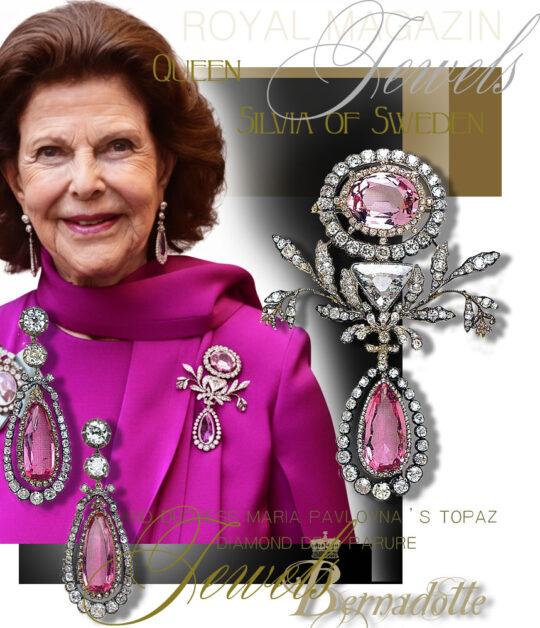
Grand Duchess Maria Pavlovna’s Pink Topaz and Diamond Demi Parure| Queen Silvia of Sweden’s|Bernadotte Royal Jewels

Preussen Prussia Hohenzollern history Royal Jewellery & Aristocratic Jewels antique jewellery historian diamonds tiara jewels jewel royaljewels princesssophie princesskira crownprincesscecilie prussianroyalfamily germanimperialfamily hohenzollern imperialfamily germanroyalty germanroyals royal royals royalty Kaiserin von Preussen, Königin von Deutschland, Kaiserin von Deutschland,kronprinzessin, princely majesties royalhighnesses imperialhighness royals royalty realeza royauté almanachdegotha europeanroyalty royaldynasty imperialfamily royalfamily princelyfamily royalfamilies hohenzollern prussianroyalty prussianroyalfamily germanempire germanroyalty germanroyals,prussia royal tiara,prussian royal tiaras, prussian aquamarine, Prussian Royal Aquamarine, Prussian Royal Aquamarine Tiara, Prussian Royal Aquamarine Necklace, Prussian Royal Aquamarine Earrings,
Diamond brooches, diamond jewelry elements and Devant de Corsage | from the Dowry of the Princess Louise of Prussia
The tiara was originally a diamond stomacher / devante de corsage – with 27 pearls and six pendants with a poire pearl each.
Queen Ingrid of Denmark changed this 4-piece set into a historic Pearls and Diamond Tiara with a pendant >>
A jewelry with many possibilities – in change – the different versions as a large picture >>


The tiara’s provenance traces directly to Princess Louise of Prussia (1838–1923), the intellectual and philanthropic Grand Duchess of Baden, and her husband, Grand Duke Frederick I of Baden.
Their daughter, Victoria of Baden (1862–1930), became Queen of Sweden upon marrying King Gustaf V in 1881.
Victoria’s son, Gustaf VI Adolf of Sweden, later married Princess Margaret of Connaught (1882–1920). Margaret, a granddaughter of Queen Victoria of Britain, became Crown Princess of Sweden and mother of Ingrid of Sweden (later Queen Ingrid of Denmark). Thus, Victoria of Baden was not only Queen Ingrid’s grandmother but also the original link between the Prussian diamonds and the Swedish-Danish-Greek royal axis.
This lineage explains how the jewels passed from the dowry of Princess Louise of Prussia – Baden → her daughter Queen Victoria of Sweden → to Queen Ingrid (via her father, Gustaf VI Adolf) → and ultimately to Queen Anne-Marie of Greece.

The tiara’s resurgence at Prince Nicholas’ 2025 wedding to his 2nd wife Chrysi Vardinogiannis underscores its timeless role in Greek royal ceremonies.

Dieser atemberaubende Kronleuchter stammt aus Königsberg und wurde um 1650 hergestellt. Er besteht aus feinstem Bernstein und besitzt zwölf Kerzen, die ein warmes und magisches Licht erzeugen. Weltweit gibt es nur zwei weitere Kronleuchter dieser Art, und sie werden beide im Schloss Rosenborg in Kopenhagen aufbewahrt. Der Kronleuchter der SPSG ist jedoch das einzige Exemplar, dessen Arme vollständig aus dem kostbaren Bernstein gefertigt sind.
Ursprünglich gehörte der Kronleuchter zur Sammlung von Baron Mayer Amschel de Rothschild (1818–1874) und wurde 1977 von der West-Berliner Schlösserverwaltung bei einer Auktion bei Sotheby’s erworben. Um ihn in seinen heutigen Glanz zurückzuversetzen, wurden umfangreiche Restaurierungsmaßnahmen durchgeführt. Von 1983 bis 2001 hing der Kronleuchter im Schloss Charlottenburg, bevor er in den Depots der SPSG aufbewahrt wurde, bis er nun endlich im Schlossmuseum Oranienburg seinen verdienten Platz gefunden hat.
Der Bernsteinkronleuchter ist ein beeindruckendes Zeugnis der Bernsteintradition des Hauses Brandenburg-Preußen. In der Frühen Neuzeit wurden viele Kunstobjekte aus diesem seltenen Material gesammelt und verschenkt. Berühmt ist dabei das Bernsteinzimmer, das König Friedrich Wilhelm I. von Preußen (1688-1740) Zar Peter „dem Großen“ von Russland (1672-1725) überreichte. Auch Kronleuchter aus Bernstein waren hochgeschätzte Kunstwerke und wurden als diplomatische Geschenke überreicht.
Der Kronleuchter im Schlossmuseum Oranienburg wurde vom flämischen Messingkronleuchter des 17. Jahrhunderts inspiriert. Er besteht aus einer zentralen Eisenstange mit verschiedenen Segmenten, in die geschwungene Arme und Verzierungen eingefügt sind. Das Highlight ist eine heraldische Adlerfigur als Krönung. Beim Bernsteinkronleuchter wurden dieselben Elemente verwendet: Die Schaftelemente, die Mittelkugel und die große Abschlusskugel sind alle aus gebogenen Bernsteinplättchen gefertigt. Die Oberflächen sind kunstvoll verziert mit Reliefs von Ranken, Blättern, Früchten und Vögeln. Die Arme des Kronleuchters sind tierähnlich gestaltet und mit gravierten Schuppen verziert. Sie sind durch stilisierte Weinreben und transparenten Bernstein verbunden, auf dem Imperatoren-Köpfe, Halbfiguren, Vögel und Früchte prachtvoll dargestellt sind.
Die Stiftung Preußische Schlösser und Gärten Berlin-Brandenburg (SPSG) hat beschlossen, dieses kostbare Kunstwerk der Öffentlichkeit dauerhaft zugänglich zu machen.

Important Romanov Turquoises. The Russian empress Catherine the Great passed down a set of diamond turquoise jewels through the generations, Princess Louise of Prussia – the Duchess of Connaught to Princess Margaret of Connaught, Princess Ingrid of Sweden her daughter is the late Queen Ingrid of Denmark.

Princess Margaret is a maternal grandmother of Queen Margrethe and the paternal grandmother of King Carl-Gustav of Sweden.
That is how these jewels found their way to Queen Margrethe, see above with the older setting and the smaller ear pendants, and she gifted them to Crown Princess Mary in 2022 for her 50th birthday.
The collection of Turquoises of Queen Ingrid of Denmark left from her mother Princess Margareta of Connaught, the Crown Princess of Sweden.
Turquoise Bracelet,
Turquoise Diamond Cuff with seven oval Turquoises,
Turquoise Tiara,
Princess Isabella’s Diadem The Turquoise Flower Tiara| Royal Jewels History Denmark

Turquoise Diamond Cluster Brooch,
Turquoise Diamond earrings,
Turquoise Diamond smaller ear pendants now Crown princess Mary of Denmark,
Turquoise Diamond Heart Brooch,
Turquoise Diamond Ring,
Turquoise Diamond pendant,
Turquoise Diamond ornament,
Turquoise Diamond Paisley brooch,
Turquoise Diamond pear shaped pendant,
Turquoise tiara with turquoises and daisies,
Turquoise Diamond jewellery
update Cumberland Diamond Brooch from the year 2006

Viktoria Luise Adelheid Mathilde Charlotte von Preußen, Prinzessin von Preußen, Herzogin zu Braunschweig-Lüneburg, Prinzessin von Hannover, Prinzessin von Großbritannien und Irland
Cumberland Diamond Brooch | Princess Victoria Luise of Prussia Duchess of Brunswick Hannover | Wedding Gift worn by the Duchess after the birth of Prince Georg Wilhelm of Hanover, the jewel is left to Princes Georg Wilhelm of Hanover. His wife Princess Sophie wore it in the year 1964 at Athens. The brooch was made in 1910, the sketch of the brooch is from the Köchert Archive.
This brooch was not the wedding gift of the King and Queen of England – probably, it was the pendant which she wore, on this picture on a chain – a diamond brooch with tassel!
Übersicht Hannover-Juwelen | Hanover Jewels and Tiaras
Die Juwelen und der private Schmuck der Herzogin | Princess Victoria-Luise`s Private Trove
Das Hochzeitsgeschenk ihrer Mutter der Kaiserin | Royal Wedding Gift from her mother the Queen of Germany
Diamant-Diadem von Victoria – Luise Herzogin von Braunschweig | Victoria – Luises Diamond Diadem
Das Köchert-Collier-Diadem | Imperial wedding gift, the Koechert-Tiara-Necklace


On Thursday the festivities for the marriage of Princess Margarethe began with a grand court before their Majesties; This is followed by a ball on the 20th, a family dinner on the 22nd, a gala dinner on the 23rd and a gala dinner at the Empress Friedrich’s on the 24th. M. The civil marriage will take place in the palace of the Empress Friedrich, the church wedding in the castle chapel.
Numerous high guests are expected in Berlin. The Russian heir to the throne meets on 23 d. My; the voyage of the King of Denmark still seems uncertain, because of the blocking of the crossing by ice.
On the evening before the marriage of her youngest daughter, the Empress Friedrich had brought together the large number of family members who had rushed here for the special day to a gala family dinner.
The main table, at which the distinguished guests dined, was set in the large, magnificent dining room, which was filled with art treasures. The tapestry of the walls, which bear large golden flowers and arabesques on a golden silk background, are here and there covered with long hanging tapestries; the narrow wall opposite the entrance is separated from the adjoining room by a large red velvet drapery and decorated with costly silver shields, bowls and dividers. Right at the entrance is a work of art, a silver anniversary present, a clock of great value that serves as a resting point for a delightful group of marbles.
The table itself bore the gift which Queen Victoria of England had given to the Emperor and Empress Frederick in front of their Majesties‘ seatssilver wedding , three showpieces made of solid silver, serving as candelabra. The middle main piece depicts a hunting procession, a lady on horseback pulling out to hunt, with two dogs on a leash, which trot past a thick tree trunk, from whose branches the candlesticks rise. The side pieces are groups of trees with candelabra. Graduating in size, a number of other candlesticks, only in silver, lined up at the two ends of the table. In between there were display devices, fruit and flower bowls.
Threads of green leaves wound their way around the individual implements over the snow-white linen.
The whole was outshined by a mighty chandelier.
The bridal couple, Prince Friedrich Karl von Hessen in uniform, ate at the center of the table.Princess Margarethe in a delicate yellow silk robe richly trimmed with yellow feathers. To the right of the bride sat the reigning Empress, next to her Landgrave Alexander Friedrich von Hessen, to the left of the bridegroom the Empress Friedrich, dressed entirely in black silk, and next to her the King of Saxony in the blue uniform of the 10th Dragoons.
The Emperor’s seat was next to his sister, Princess Margarethe, opposite between the Grand Duchess of Baden and the groom’s mother, Landgravine Anna von Hessen, whose table neighbors were the Grand Duke of Baden and the Duke of Edinburgh. Since not all 60 guests had space at the table, a second table was set in the adjoining small dining room.


****


above the sketch of the wedding gift the “parure” of opals and diamonds from both her parents


Royal Jewels with Opals |Princess Louise of Great Britain & Irland | Duchess of Argyll

Journal des villes et des campagnes, 20 octobre 1889
Les principaux bijoux de la corbeille de mariage de la princesse Sophie, fiancée du prince royal de Grèce, consistent en un diadème et un collier en brillants.
Le diadème, qui est un cadeau do l’empereur, est fait de trois rangées do turquoises entourées de diamants. La plus grande des turquoises, ayant la forme d’une poire, forme le sommet du diamant. Elle est tout ornée de diamants. Le collier est également en turquoises et d’une très grande valeur; les pierres sont très pures. Ce collier est un joyau de famille et provient, d’après la tradition, de la raine Anne d’Angleterre, a appartenu à la princesse Charlotte de Galles et est revenu, après la mort, de son mari, Léopold Ier, roi des Belges, à la reine Victoria. Il tut donné à l’impératrice Frédéric, qui vient de le donner à son tour u sa fille la princesse Sophie.Le Gaulois, 28 octobre 1889

…Die Ausstattung der Prinzessin Sophie an Juwelen hat den Werths eines Schatzes. Das Hauptstück derselben ist ein Schmuck aus Brillanten und Türkisen, bestehend aus Diadem, Brosche und Halsband. Das Diadem ist ein Geschenk des Kaisers.
Es ist sehr hochgearbeitet, die Zeichnung von graziöser Erfindung. Drei übereinander stehende Reihen von
Türkisen in sich vergrößerndem Maßstabe sind von den zierlichsten Arabesken in Brillanten umgeben. Die größten Türkise in Birnenform bilden krönende Spitzen, eingefaßt von großen Brillanten.
Nach den beiden Endseiten hin verkleinert sich das Diadem. Das Halsband ist in Form von Bandschleifen in Brillanten gearbeitet, die Knoten desselben von großen Türkisen gebildet. Von großem Werth und seltener Schönheit, namentlich der Türkise, ist das daranhängende Kreuz.
Es ist ein Erbstück der Englischen Königsfamilie. Nach einer Tradition soll es von der Königin Anna stammen, factisch war es im Besitz der Prinzessin Charlotte von Wales, der einzigen, früh verstorbenen Tochter Georg IV. Ihr Gemahl, der spätere König Leopold I. der Belgier, schenkte es der Königin Victoria, diese der Prinzess Royal und Kaiserin Friedrich gab es zum Brautschatz der Prinzessin Sophie, ebenso auch einen großen runden, von großen Brillanten umgebenen Türkis, der als Armband wie als Brosche getragen werden kann und mit welchem der Vater, der PrinceConsort, einst das Taufkleid seines ersten Kindes, der Princess Royal, geschmückt hatte.
Der Türkisschmuck wurde von der Prinzessin von Sparta nicht öffentlich getragen. Er ging vermutlich zurück nach England und dann an Königin Maud von Norwegen….
Die Schwester der Kaiserin. Louise Sophie wurde als Tochter des Herzogs Friedrich VIII. von Schleswig-Holstein (1829–1880) und dessen Ehefrau Prinzessin Adelheid zu Hohenlohe-Langenburg (1835–1900), Tochter des Fürsten Ernst I. zu Hohenlohe-Langenburg und dessen Gattin Prinzessin Feodora zu Leiningen geboren.


Das Kaiserinnendiadem, Empress Auguste Viktorias Eleven Pearshaped Pearls Diamond Tiara |
 essen Geschenk der Kaiserin Friedrich