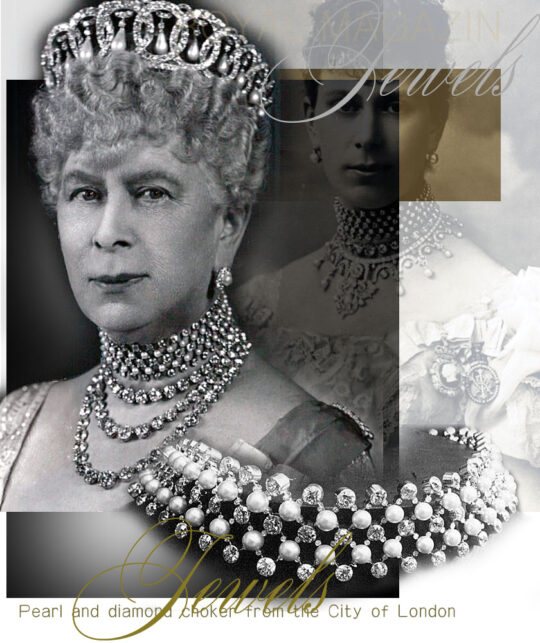
Queen Mary’s City of London Diamond and Pearl Choker

Queen Mary’s City of London Choker Necklace| British Royal Jewels Queen Mary England

Queen Mary’s City of London Diamond and Pearl Choker

Queen Mary’s City of London Choker Necklace| British Royal Jewels Queen Mary England


Designed in 1938, this exquisite brooch is shaped like a curling oriental palm leaf. It was specially commissioned by Queen Elizabeth The Queen Mother using diamonds from her own collection.


Queen Sofia of Sweden’s large sapphire and diamond brooch – pendant. A Burmese sapphire, imperial diamonds — and a surprising Franco-Swedish peace gesture

This deep blue Burmese sapphire framed by a double border of brilliant-cut diamonds was presented by Napoléon III to the then Duchess of Östergötland during her visit to Paris in 1865.
That same year, Napoléon III (a first cousin of Sophie’s mother-in-law, Dowager Queen Joséphine) even stood godfather to Sophie’s youngest child: Prince Eugen Napoleon Nicolaus.

Found at the foot of the Galerie d’Apollon, the Crown of Empress Eugénie narrowly escaped complete destruction after falling from its display on 19 October 2025 during the violent incident at the Louvre Museum. One element of a diamond-and-emerald palmette was discovered not far from the window in which the crown had been exhibited in the Galerie d’Apollon.
Although the crown suffered severe crushing and was found to be significantly deformed, it retained its near-complete structural integrity, making a full restoration possible.

Seized by the Judicial Police for investigation, the crown was transferred on 20 October 2025 to the Department of Decorative Arts. A first official assessment was carried out by Olivier Gabet, Director of the Department, together with Anne Dion, Deputy Director and curator responsible for this section of the collections.
The following observations were recorded:
Although the overall form of the crown has been altered, almost all of its original components survive. Only a single decorative element is missing. The crown can therefore be fully restored without reconstruction or replacement, through a careful reshaping of its framework.

As with all works held in the French national collections, the restoration of the crown will be entrusted to an accredited conservator, selected through a competitive process in accordance with the Heritage Code, Museum Law, and Public Procurement Code. Detailed and highly technical reports will be prepared in this context.
Given the exceptional and symbolic nature of this restoration, and the unique character of the object itself, the work of the selected conservator will be accompanied by an advisory committee of experts, whose role will be to provide independent guidance on both restoration decisions and methodology.
Chaired by Laurence des Cars, President and Director of the Louvre Museum, the committee will consist of the following members:
In addition, a representative from each of the five historic French jewellery houses—Mellerio, Chaumet, Cartier, Boucheron, and Van Cleef & Arpels—will be invited to participate, particularly senior workshop heads and master craftsmen whose houses are historically linked to the Crown Diamonds.

Immediately following the incident of 19 October 2025 and the recovery of the crown, each of these houses expressed their wish to support the restoration of this iconic object. The Louvre Museum extends its sincere thanks to these exceptional houses for their commitment and for sharing their expertise.
In preparation for the Exposition Universelle of 1855, Napoleon III commissioned the jeweller of the Emperor, Alexandre Gabriel Lemonnier, to create two crowns: one for himself and one for the Empress. For this prestigious project, Lemonnier collaborated with several specialists. The sculptor Gilbert (1816–1891) was likely responsible for modelling the long-winged eagles that form the arches of the crown, alternating with diamond palmettes. The jeweller Pierre Maheu (1807–1866) was engaged as workshop director, while Devin, Inspector of the Crown Diamonds, oversaw the selection and arrangement of the stones.
When exhibited in 1855, contemporary commentators described the Empress’s crown as “lighter and clearer” than that of the Emperor, while still possessing sufficient ceremonial dignity (Arnoux, 1856).
After the fall of the Empire, the Civil List was liquidated. Because Napoleon III had enriched the Crown Diamonds collection at his own expense, the crown was returned to Empress Eugénie in 1875, following his death. This restitution saved the crown from destruction, unlike the Emperor’s crown, which was dismantled in 1887 when the Crown Diamonds were ordered to be sold by the Third Republic.

In 1920, Empress Eugénie bequeathed the crown to Princess Marie-Clotilde Napoléon, Countess of Witt, her niece and goddaughter. The Louvre Museum acquired it in 1988.

Although it was never used for a coronation—and may never have been worn, as Empress Eugénie was never crowned—the Crown of Empress Eugénie stands today, alongside the Crown of Louis XV and the so-called Crown of Charlemagne, as one of the very few surviving historic French crowns.
4. Februar 2026
Am Fuß der Apollo-Galerie aufgefunden, entging die Krone der Kaiserin Eugénie am 19. Oktober 2025 nur knapp der vollständigen Zerstörung, nachdem sie bei dem gewaltsamen Vorfall im Louvre-Museum aus ihrer Vitrine gestürzt war. Ein Element einer Palmette aus Diamanten und Smaragden wurde unweit des Fensters entdeckt, in dem die Krone in der Galerie d’Apollon ausgestellt gewesen war.
Obwohl die Krone eine massive Quetschung erlitt und stark deformiert aufgefunden wurde, blieb ihre nahezu vollständige strukturelle Integrität erhalten. Dies macht eine vollständige Restaurierung möglich.
Nach der Sicherstellung durch die Kriminalpolizei wurde die Krone am 20. Oktober 2025 an die Abteilung für Kunstgegenstände übergeben. Dort erfolgte eine erste offizielle Zustandsaufnahme durch Olivier Gabet, Direktor der Abteilung, gemeinsam mit Anne Dion, stellvertretende Direktorin und zuständige Kuratorin.
Dabei wurden folgende Punkte festgestellt:
Auch wenn die Form der Krone verändert wurde, sind nahezu alle ursprünglichen Bestandteile noch vorhanden. Es fehlt lediglich ein dekoratives Element. Eine vollständige Restaurierung ohne Rekonstruktion oder Ersatz ist daher möglich; erforderlich ist vor allem eine Neuausrichtung und Stabilisierung des Rahmens.
Wie bei allen Werken der französischen Nationalmuseen wird die Restaurierung der Krone einem zugelassenen Restaurator anvertraut, der im Rahmen eines Wettbewerbs ausgewählt wird. Dabei werden die Vorgaben des Kulturerbekodex, des Museumsgesetzes und des öffentlichen Vergaberechts eingehalten. In diesem Zusammenhang werden detaillierte und technisch fundierte Gutachten erstellt.
Angesichts des außergewöhnlichen symbolischen Charakters dieser Restaurierung und der Einzigartigkeit des Objekts wird die Arbeit des Restaurators von einem beratenden Ausschuss aus Fachleuten begleitet, der unabhängig Empfehlungen zur Restaurierung und Methodik geben wird.
Den Vorsitz führt Laurence des Cars, Präsidentin und Direktorin des Louvre-Museums. Dem Ausschuss gehören an:
Ergänzend wird jeweils ein Vertreter der fünf historischen französischen Schmuckhäuser Mellerio, Chaumet, Cartier, Boucheron und Van Cleef & Arpels eingeladen, insbesondere Werkstattleiter und Meister ihres Fachs, deren Häuser historisch eng mit den Juwelen der Krone verbunden sind.
Unmittelbar nach dem Vorfall vom 19. Oktober 2025 und der Bergung der Krone bekundeten alle fünf Häuser ihren Wunsch, die Restaurierung dieses ikonischen Werkes zu unterstützen. Das Louvre-Museum dankt ihnen ausdrücklich für ihre Bereitschaft und den Beitrag ihrer fachlichen Expertise.
Im Hinblick auf die Weltausstellung von 1855 beauftragte Napoleon III. den Juwelier des Kaisers, Alexandre Gabriel Lemonnier, mit der Anfertigung zweier Kronen – einer für den Kaiser und einer für die Kaiserin. Für diese prestigeträchtige Aufgabe zog Lemonnier mehrere Spezialisten hinzu. Der Bildhauer Gilbert (1816–1891) war vermutlich für die Modellierung der langflügeligen Adler verantwortlich, die die Kronbögen bilden und sich mit Diamantpalmetten abwechseln. Pierre Maheu (1807–1866) fungierte als Werkstattleiter, während Devin, Inspektor der Kronjuwelen, die Auswahl und Anordnung der Steine überwachte.
Zeitgenössische Berichte zur Ausstellung von 1855 beschrieben die Krone der Kaiserin als „leichter und klarer“ als die des Kaisers, bei zugleich ausreichender feierlicher Wirkung (Arnoux, 1856).
Nach dem Sturz des Kaiserreichs wurde die Zivilliste aufgelöst. Da Napoleon III. die Sammlung der Kronjuwelen teilweise aus eigenen Mitteln erweitert hatte, wurde die Krone nach seinem Tod 1875 an Kaiserin Eugénie zurückgegeben. Diese Rückgabe bewahrte sie vor der Zerstörung, die 1887 die Krone des Kaisers traf, als die Kronjuwelen unter der Dritten Republik verkauft wurden.
1920 vermachte Kaiserin Eugénie die Krone ihrer Patentochter Prinzessin Marie-Clotilde Napoléon, Gräfin von Witt. Das Louvre-Museum erwarb das bedeutende Objekt schließlich 1988.
Auch wenn die Krone nie für eine Krönung verwendet wurde – Kaiserin Eugénie wurde nie gekrönt und hat sie möglicherweise nie getragen – gehört sie heute neben der Krone Ludwigs XV. und der sogenannten Krone Karls des Großen zu den wenigen erhaltenen historischen Kronen Frankreichs.
Lozenge Diamond Sapphire Brooch | Queen Louise of Sweden

Princess Désirée, Baroness Silfverschiöld
21 January 2026
HM The King’s sister PrincessDésirée, Baroness Silfverschiöld, passed away peacefully in her home at Koberg in Västergötland on Wednesday, 21 January 2026, surrounded by her family. The Princess was 87 years old.
On the occasion of the death of Princess Désirée, the following statement is made by HM The King:
With great sadness, I have today received the news that my sister, Princess Désirée, has passed away.
Many warm family memories were created in the home of the Silfverschiöld family in Västergötland – a place in Sweden that came to mean a great deal to my sister.
Together with my family, I send my condolences to Princess Désirée’s children and their families.
Princess Désirée, Baroness Silfverschiöld, was the widow of Baron Niclas Silfverschiöld (1934-2017) and lived at Koberg Castle in Västergötland. The Princess leaves behind her three children and their families.

Queen Fabiola of Belgium – Engagement Ring identified
Until now, it was not publicly documented which ring Queen Fabiola of Belgium received as her engagement ring in 1960.
Based on contemporary photographs and archival material from my website Royal Magazin, the ring can now be identified.

The engagement ring given by King Baudouin to Doña Fabiola de Mora y Aragón was set with a remarkable oval mixed cut emerald of approx. 13.36 carats, flanked by two trillion cut diamonds (approx. 2.10 ct total), mounted in 18k yellow gold.
(basierend auf den historischen Aufzeichnungen, Auktionskatalogen Christie’s/Sotheby’s/Wartski und der üblichen Sekundärliteratur)

IMPERIAL WINTER EGG
Fabergé, Entwurf Alma Theresia Pihl – Werkstatt Albert Holmström, St. Petersburg, 1913
Das Winterei von 1913 gehört zu den ungewöhnlichsten Kreationen der kaiserlichen Fabergé-Werkstätten. Die Komplexität, die technische Meisterschaft und die poetische Umsetzung des Themas „Schnee, Eis und Frühjahr“ machen es zu einem absoluten Höhepunkt des Hofjuweliers.
Der Innenmechanismus trägt einen zarten, doppelt gebänderter Platin-Korb, vollständig besetzt mit Rosenschliffdiamanten.
Darin:
Der Boden der Überraschung ist graviert: FABERGÉ 1913.
Überraschung: 8,2 cm (3 ¼ in.)
Ei mit Sockel: 14,2 cm (5 ⅝ in.)
1913
Kommissioniert von Kaiser Nikolaus II. als Ostergeschenk für seine Mutter Zarinmutter Maria Fjodorowna.
St. Petersburg, 13. April 1913. Preis 24.600 Rubel.
1913–1917
Privatsammlung der Zarinmutter, Anitschkow-Palast, St. Petersburg.
September 1917
Vom Provisorischen Gouvernement zur Kreml-Waffenkammer überführt.
1922
Durch die Sonderkommission für Schmuckwerte ausgewählt und an Gokhran, Moskau, übergeben.
1929–1933
Von Wartski, London(Snowman der Schwiegersohn, gehörte zu den wenigen Pionieren, die zwischen 1927 und 1933 Einkäufe bei der sowjetischen Regierungsabteilung, dem sogenannten Antiquariat, tätigten), in der sowjetischen Verkaufsperiode erworben (Preis £450).
1934
Erworben von Napier Sturt, 3rd Baron Alington (Preis £1.500).
1934–1948
Sammlung Sir Bernard Eckstein.
1949
Nachfolgerverkauf: Sotheby’s London, 8. Februar 1949, Lot 128 (Preis £1.870).
Erworben für die Sammlung Arthur Bryan Ledbrook.
1974
Nach dessen Tod im Besitz eines Trusts.
1994
Christie’s Genf, 16. November 1994, Lot 464.
Zuschlag CHF 7.263.500 — Weltrekord für Fabergé.
2002
Christie’s New York, 19. April 2002, Lot 150.
Zuschlag $9.579.500 — erneuter Weltrekord.
ab 2002 (inoffiziell)
Zuschlag an Sheikh Saud bin Mohammed Al-Thani (Qatar).
Gerüchte seit Jahren: Werk möglicherweise nie bezahlt und nie abgeholt → Christie’s verbleibt wirtschaftlicher Eigentümer.
2025
Christie’s London, 2. Dez. 2025, Lot 7.
GBP 22,895,000 Verkauf als Teil einer „Princely Collection“ an Wartski nach 100 Jahren ….
A Masterpiece of Alma Theresia Pihl and the Holmström Workshop
St Petersburg, 1913
Commissioned by Emperor Nicholas II as his Easter gift to his mother, the Dowager Empress Maria Feodorovna, the Imperial Winter Egg stands among the most poetic and technically sophisticated creations of Carl Fabergé’s ateliers. Conceived by the young designer Alma Theresia Pihl and executed in the celebrated workshop of Albert Holmström, it is a triumph of imagination, virtuosity and symbolic refinement.
Carved from a single block of rock crystal, the egg reveals a delicately frosted interior, suggesting winter light caught beneath a thin layer of ice. The exterior is adorned with a constellation of platinum snowflakes set with rose-cut diamonds and two vertical diamond-set borders cleverly disguising the hinge. At its apex sits a cabochon moonstone engraved with the date 1913, a subtle reminder of the Romanov tercentenary.
The egg rests upon a sculptural block of melting ice, also carved in rock crystal, its surface enlivened with flowing platinum rivulets set with rose-cut diamonds. A central platinum pin rises from the base to support the egg with absolute precision.
Suspended within is one of the most enchanting surprises in the Fabergé oeuvre:
a double-handled trelliswork basket in platinum, entirely pavé-set with rose-cut diamonds. It overflows with lifelike wood anemones carved from white quartz, each with gold wire stamens and a demantoid garnet at its centre. The leaves, rendered in exquisitely shaped nephrite, emerge from a bed of finely modelled gold moss.
The base of the basket is engraved ‘FABERGÉ 1913’.

Three masked thieves broke into the Louvre Museum in Paris this morning, targeting the Apollo Gallery. Nine pieces of jewelry were reportedly stolen; the value is still being assessed.


As reported by French media, nine pieces of jewelry from the collection of Napoleon and the Empress have been stolen: a necklace, a brooch, a tiara, and more (d’une parure, d’un collier, de boucles d’oreilles, de deux couronnes – dont celle de l’impératrice Eugénie retrouvée brisée – et d’une broche.). The total value of the loss has yet to be determined. According to Interior Minister Laurent Nuñez, the stolen jewels are of “inestimable value.” The thieves broke into the display cases titled “Bijoux Napoléon” and “Bijoux des souverains” in the Galerie d’Apollon and emptied them completely.
This was my answer in the interview with Radio WDR3-5 on 20. October 2025


Eight jewels were stolen, according to the latest report
According to the most recent statement issued by the Ministry of Culture, eight jewels were stolen from the Louvre. They include: the tiara from the parure of Queen Marie-Amélie and Queen Hortense; the necklace from the sapphire parure of Queen Marie-Amélie and Queen Hortense; one earring from the sapphire parure of Queen Marie-Amélie and Queen Hortense; the emerald necklace from the parure of Empress Marie-Louise; the pair of emerald earrings from the parure of Marie-Louise; the so-called reliquary brooch; the tiara of Empress Eugénie; and the grand corsage bow of Empress Eugénie.
The jewels stolen from the Louvre lie at the very heart of France’s history — treasures of royal splendor where taste, ambition, and craftsmanship existed in perfect harmony. They did not merely adorn; they helped define both the French identity and the very ideals of jewelry itself. Each piece was thoroughly documented, making it almost inconceivable that they will ever be seen whole again. What has been lost is not only their beauty, but also a shared cultural inheritance — a reflection of how a nation once expressed its genius through grace and proportion. These jewels are national treasures, a testament to France’s history, its passion for gemstones, and the art of jewelry — creations whose worth far transcends their material value, and whose integrity makes them impossible to sell intact.