Royal Imperial Sapphir and Diamond Necklace -Jewels of Princess Birgitta of Sweden

Jewels of Princess Birgitta of Sweden

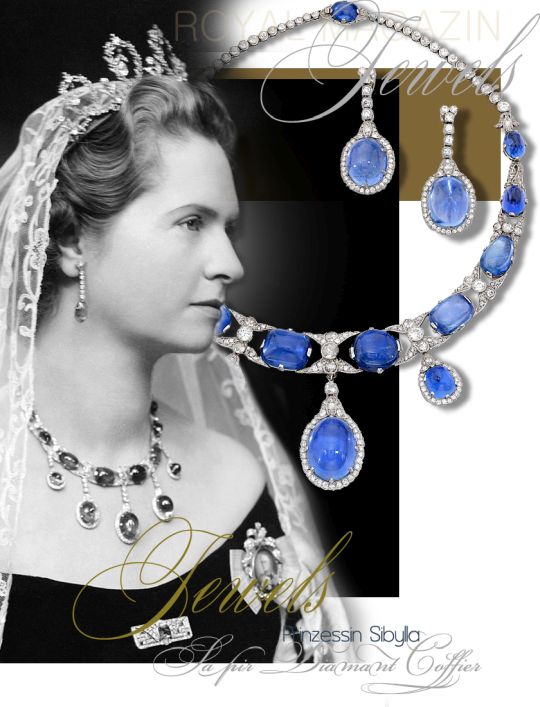
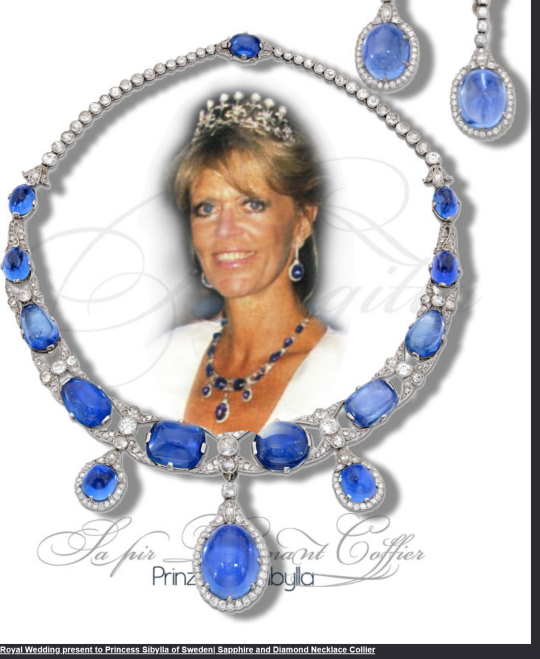
  Royal Wedding present to Princess Sibylla of Sweden| Sapphire and Diamond Necklace Collier

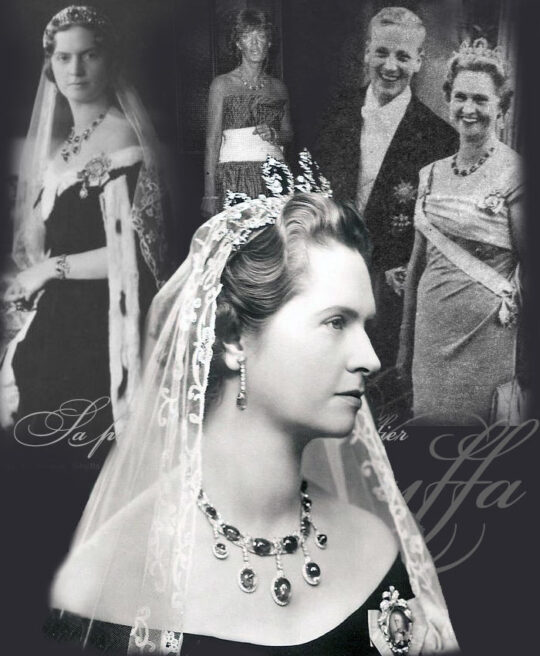
In the dominant photograph, Princess Sibylla is wearing the classic diamond and oval cabochon sapphire necklace. The high quality sapphires are surrounded by diamonds and set in gold. There are five pendants which can be removed and worn as earrings. The earrings that the Princess is wearing may have been additional pendants on the necklace.

The sapphires for this wonderful necklace were a wedding gift from her uncle, Ferdinand (from the house of Saxe-Coburg-Gotha), the Tsar of Bulgaria to Princess Sibilla of Saxe-Coburg-Gotha, on the occasion of her wedding in 1932 with the then future crown prince of Sweden Gustaf Adolf.

Tsar Ferdinand was a connoisseur of fine jewels, and the friend and patron of Fabergé. According to family history, "Foxi" (Tsar Ferdinand) is reputed to have bought these gems from the Dowager Empress Marie Alexandrovna. The former Tsarina of Russia, owned the famous Romanov sapphires and had taken that collection with her into exile in Denmark.

Princess Sibylla´s necklace of sapphires and diamonds today belongs to another daughter, Princess Birgitta. Princess Birgitta wore this necklace at the 50th birthday celebrations of her brother the Swedish king on April 30th 1996.

In the photo at the far left, Princess Sibylla, dressed in Swedish court robes, is wearing a diamond and aquamarine tiara which originally belonged to her mother-in-law Crown Princess Margaret. This tiara Princess Sibylla gave to her oldest daughter Princess Margareta, now Mrs Ambler as a wedding gift in 1964. The last time this tiara has been seen was in Munich in June 1998 when it was worn by Sibylla Ambler, the oldest daughter of Princess Margareta, Mrs Ambler, on her wedding day in Kloster Schäfftlarn. The bracelet is also owned by Princess Margaretha.
Royal Wedding present to Princess Sibylla of Sweden| Sapphire and Diamond Necklace Collier

Royal Imperial Sapphir and Diamond Necklace -Jewels of Princess Birgitta of Sweden Royal Wedding present to Princess Sibylla of Sweden| Sapphire and Diamond Necklace Collier

Princess Sibyllas sapphire collier - princess Impressive Sapphire and Diamond Demi-Parure Comprising a necklace and a pair of pendent earrings featuring a graduated series of cabochon sapphires, framed by millegrain-set old European-cut diamonds, highlighted by single- and rose-cut diamonds, earrings with screwback fittings and security hooks, pendants on necklace detachable, fitted case stamped Rath München, the lid applied with the gilt-metal cypher of Princess Sibylla; early 20th century and later.
Princess Sibyllas sapphire collier – princess Impressive Sapphire and Diamond Demi-Parure


Comprising a necklace and a pair of pendent earrings featuring a graduated series of cabochon sapphires, framed by millegrain-set old European-cut diamonds, highlighted by single- and rose-cut diamonds, earrings with screwback fittings and security hooks, pendants on necklace detachable, fitted case stamped Rath München, the lid applied with the gilt-metal cypher of Princess Sibylla; early 20th century and later.
Princess Birgittas sapphire and diamond Necklace romanov sapphire-Princess Sibylla of Saxe-Coburg and Gotha Duchess of Västerbotten

Jewels of Princess Birgitta of Sweden

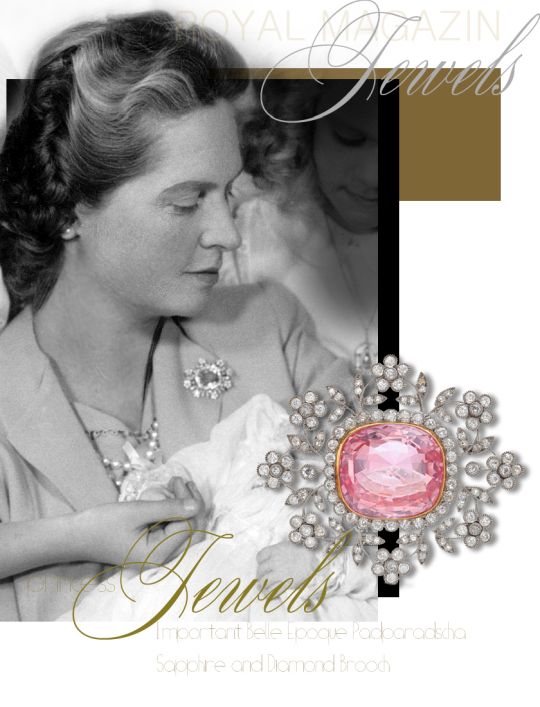
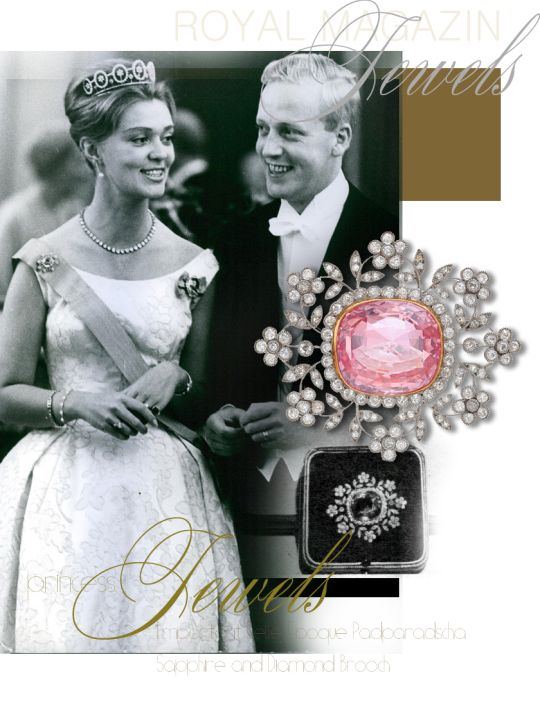
Pink Sapphire Diamond Brooch – Princess Sibylla of Sweden Duchess of Västerbottena

A Royal Wedding Gift from Princess Sibylla

This magnificent Belle Époque brooch, dating from circa 1910, originally belonged to Princess Sibylla of Saxe-Coburg and Gotha, Duchess of Västerbotten (1908–1972), who presented it to her daughter, Princess Birgitta of Sweden (1937–2024), as a wedding gift on the occasion of her marriage to Prince Johann Georg of Hohenzollern in 1961.
First seen after the birth of Princess Christina of Sweden in the year 1943 - see below in the picture - worn by Princess Sibylla of Sachsen-Coburg und Gotha, then Duchess of Vasterbotten.

Princess Birgitta wore the remarkable pink sapphire brooch at her bridal soirée at Drottningholm Palace, during the celebrations surrounding her royal wedding.

Princess Sibylla had frequently worn the brooch together with her magnificent five-strand pearl necklace, featuring a large cabochon sapphire clasp surrounded by 17 diamonds. The necklace, comprising 294 pearls, had previously belonged to Queen Victoria of Sweden and was presented to Princess Sibylla by King Gustaf V on her 40th birthday.

Princess Birgitta continued to wear the brooch on important royal occasions, including the celebrations of her brother King Carl XVI Gustaf’s 40th birthday at Drottningholm Palace in 1986.
A Royal Wedding Gift from Princess Sibylla

This magnificent Belle Époque brooch, dating from circa 1910, originally belonged to Princess Sibylla of Saxe-Coburg and Gotha, Duchess of Västerbotten (1908–1972), who presented it to her daughter, Princess Birgitta of Sweden (1937–2024), as a wedding gift on the occasion of her marriage to Prince Johann Georg of Hohenzollern in 1961.
First seen after the birth of Princess Christina of Sweden in the year 1943 – see in the picture – worn by Princess Sibylla of Sachsen-Coburg und Gotha, then Duchess of Vasterbotten.

Princess Birgitta wore the remarkable pink sapphire brooch at her bridal soirée at Drottningholm Palace, during the celebrations surrounding her royal wedding.

 Wedding present to Princess Birgitta of Sweden| Royal Wedding Present Tiara with Pearls

This pearl circlet tiara was worn by Princess Birgitta of Sweden on the evening befor her civil wedding with Prince Hans-Georg of Hohenzollern in 1961, Stockholm. The Church-wedding was at Sigmaringen 30 May 1961.

It was the wedding gift of her grandfather the King of Sweden and made by the court jewellers Carlman in Stockholm.
It’s now in the possession of Desiree von Bohlen und Halbach, nee Countess of Ortenburg, nee Princess of Hohenzollern, the daughter of Princess Birgitta.
A Royal Wedding Gift from Princess Sibylla

This magnificent Belle Époque brooch, dating from circa 1910, originally belonged to Princess Sibylla of Saxe-Coburg and Gotha, Duchess of Västerbotten (1908–1972), who presented it to her daughter, Princess Birgitta of Sweden (1937–2024), as a wedding gift on the occasion of her marriage to Prince Johann Georg of Hohenzollern in 1961.
First seen after the birth of Princess Christina of Sweden in the year 1943 - see below in the picture - worn by Princess Sibylla of Sachsen-Coburg und Gotha, then Duchess of Vasterbotten.

Princess Birgitta wore the remarkable pink sapphire brooch at her bridal soirée at Drottningholm Palace, during the celebrations surrounding her royal wedding.

Princess Sibylla had frequently worn the brooch together with her magnificent five-strand pearl necklace, featuring a large cabochon sapphire clasp surrounded by 17 diamonds. The necklace, comprising 294 pearls, had previously belonged to Queen Victoria of Sweden and was presented to Princess Sibylla by King Gustaf V on her 40th birthday.

Princess Birgitta continued to wear the brooch on important royal occasions, including the celebrations of her brother King Carl XVI Gustaf’s 40th birthday at Drottningholm Palace in 1986.
Wedding present to Princess Birgitta of Sweden| Royal Wedding Present Tiara with Pearls

This pearl circlet tiara was worn by Princess Birgitta of Sweden on the evening befor her civil wedding with Prince Hans-Georg of Hohenzollern in 1961, Stockholm. The Church-wedding was at Sigmaringen 30 May 1961.

It was the wedding gift of her grandfather the King of Sweden and made by the court jewellers Carlman in Stockholm.

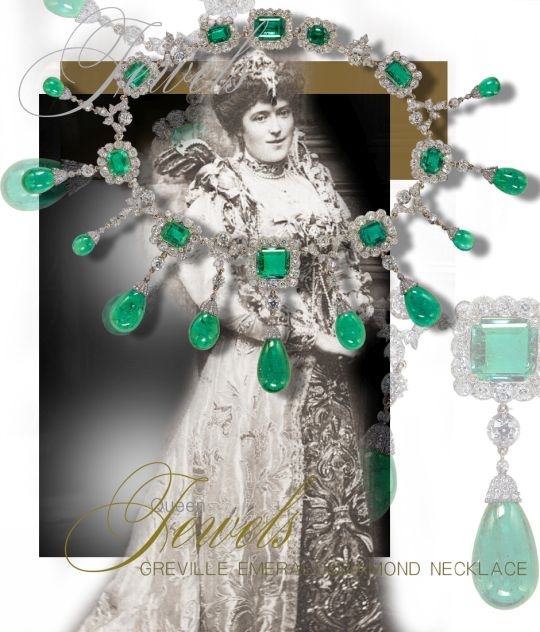
The Greville emerald and diamond necklace

The Greville emerald and diamond necklace

The Greville emerald and diamond necklace british royal jewels - royal emerald necklace - greville emerald collier, queen mother queen elizabeth - royal emerald necklace
The Greville emerald and diamond necklace british royal jewels – royal emerald necklace –

The Greville emerald and diamond necklace

Die Smaragde Ihrer Majestät

Der jährliche Empfang des diplomatischen Corps am britischen Königshof zählt zu den glanzvollsten Veranstaltungen des Jahres. Diademe, lange Abendkleider, Uniformen und Orden prägen diesen festlichen Anlass.

Bei einem dieser Empfänge überraschte Königin Elizabeth II. mit einer außergewöhnlichen Kombination aus Smaragden und Diamanten, die zuvor in dieser Form nicht öffentlich zu sehen gewesen war.

Die Königin trug das berühmte Wladimir-Diadem, dessen Diamantringe mit hängenden Smaragdtropfen besetzt waren. Dieses ursprünglich der russischen Großfürstin Maria Pawlowna gehörende Diadem wurde 1920 von Queen Mary erworben, der Großmutter Elizabeths II. Das Diadem konnte sowohl mit Perlenanhängern als auch mit Smaragdtropfen getragen werden.

Dazu kombinierte Elizabeth II. einen prachtvollen Smaragd- und Diamantschmuck aus dem Nachlass von Dame Margaret Greville (1863–1942).

Margaret Greville war die Tochter des wohlhabenden Unternehmers William McEwan. Sie heiratete 1891 Ronald Greville, einen Offizier der Life Guards, der 1908 starb. Als vermögende Witwe wurde sie zu einer bekannten Gastgeberin der Londoner Gesellschaft. In ihrem Haus Polesden Lacey empfing sie regelmäßig Mitglieder der königlichen Familie.

Ihre bedeutende Juwelensammlung umfasste Arbeiten renommierter Häuser wie Boucheron, Cartier, Fabergé und Garrard.

On display at the exhibition «Royal Jewellery: From Coronations to Keepsakes» will be shown at the King’s Gallery in London from 25 June 2027 to 19 March 2028.

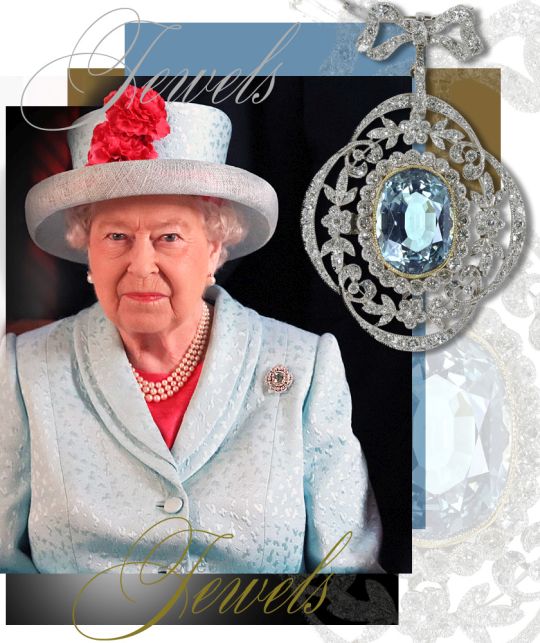
Queen Elizabeth II|Diamond Aquamarine Pendant Brooch Gift from King George V to Queen Mary| Fabergé aquamarine and diamond pendant 1909 Royal Jewels Great Britain and Irland

royalmagazinProfil bearbeiten

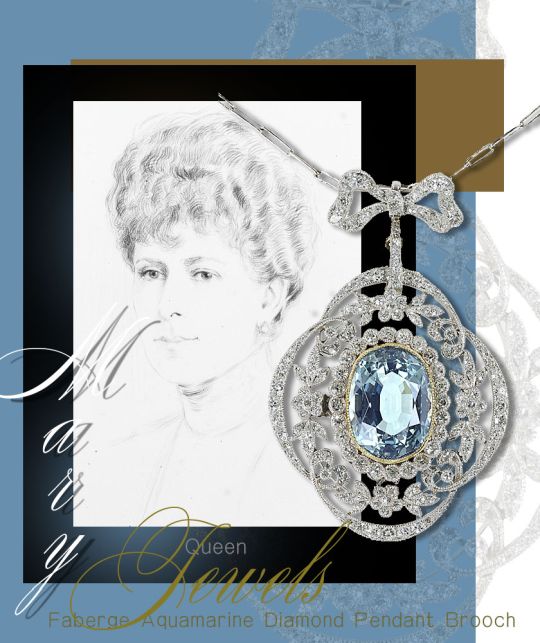
Queen Elizabeth II|Diamond Aquamarine Pendant Brooch Gift from King George V to Queen Mary| Fabergé aquamarine and diamond pendant 1909 Royal Jewels Great Britain and Irland A sparkling oval cutted aquamarine, surrounded by diamonds, and a royal love story spanning more than a century. Created by Fabergé in 1909, this exquisite aquamarine and diamond pendant was a gift from King George V to his wife, Queen Mary.
Queen Elizabeth II|Diamond Aquamarine Pendant Brooch Gift from King George V to Queen Mary| Fabergé aquamarine and diamond pendant 1909 Royal Jewels Great Britain and Irland

On display at the exhibition «Royal Jewellery: From Coronations to Keepsakes» will be shown at the King’s Gallery in London from 25 June 2027 to 19 March 2028.

Diamond Aquamarine Pendant Brooch Gift from King George V to Queen Mary| Fabergé aquamarine and diamond pendant 1909 Royal Jewels Great Britain and Irland

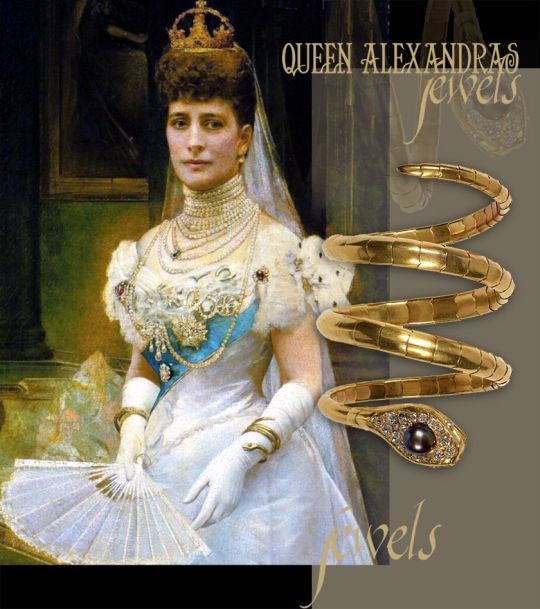
Queen Alexandra’s Serpent Diamond and Black Pearl Bracelet | Gold Snake Cuff Queen Alexandra| British Royal Jewels History

Queen Alexandra’s articulated serpent bracelet, c. 1870 Jewels of Queen Alexandra

Queen Alexandra's Serpent Diamond and Black Pearl Bracelet | Gold Snake Cuff Queen Alexandra| British Royal Jewels History
Queen Alexandra’s articulated serpent bracelet, c. 1870 Jewels of Queen Alexandra

The Princess of Wales, later Queen Alexandra, owned an extraordinary articulated serpent bracelet set with diamonds and a black pearl. One of her signature jewels, it was frequently worn throughout her lifetime.

Serpent jewellery held a special significance in the Victorian era. Far from being regarded simply as a symbol of danger or temptation, the snake represented eternal love, devotion, protection and renewal. Its symbolism drew upon ancient mythology, in which the serpent was associated with wisdom, healing, rebirth and immortality. The shedding of its skin suggested regeneration, while a serpent forming a circle and biting its own tail, known as the ouroboros, symbolised eternity and the endless cycle of life.

In nineteenth-century jewellery, serpents became particularly fashionable as tokens of love and fidelity. Their sinuous bodies were ideally suited to bracelets, rings and necklaces, often embellished with precious gemstones. Queen Victoria helped popularise the fashion when Prince Albert presented her with a serpent-shaped engagement ring in 1839, traditionally described as having an emerald-set head.

For Victorian women, a serpent jewel could therefore convey a deeply personal message of enduring affection, attachment and protection. Queen Alexandra’s diamond and black pearl bracelet belongs to this fascinating tradition of symbolic jewellery, although its precise personal significance to the Queen remains undocumented.
Queen Alexandra’s Serpent Diamond and Black Pearl Bracelet | Gold Snake Cuff Queen Alexandra| British Royal Jewels History
Queen Alexandra’s articulated serpent bracelet, c. 1870 Jewels of Queen Alexandra

Queen Alexandra’s Serpent Diamond and Black Pearl Bracelet | Gold Snake Cuff Queen Alexandra| British Royal Jewels History

On display at the exhibition «Royal Jewellery: From Coronations to Keepsakes» will be shown at the King’s Gallery in London from 25 June 2027 to 19 March 2028.