Gestern Nacht ist der Präsident und das Gründungsmitglied der Konzertgesellschaft
München, Dr. Johann Georg Prinz von Hohenzollern im Alter von 83 Jahren
verstorben ist. Wir sind alle tief betroffen und erschüttert über diese
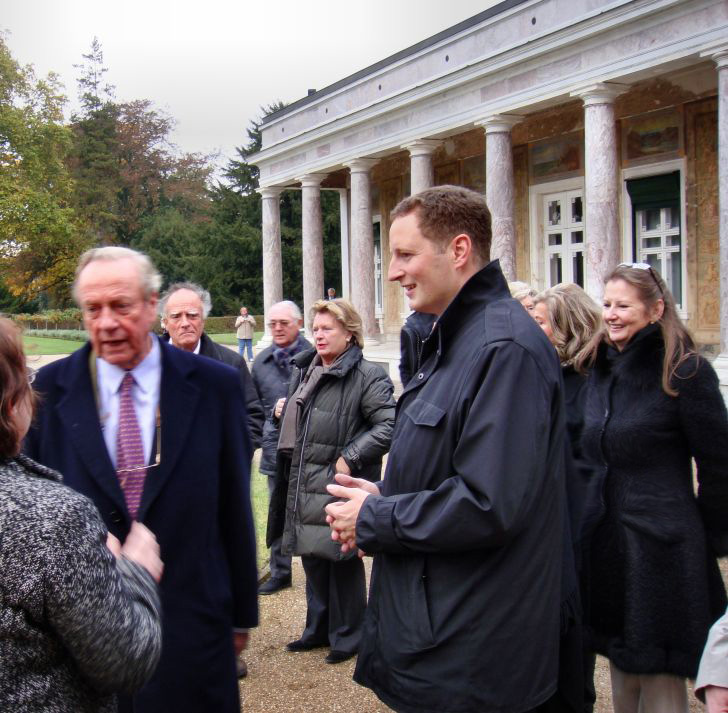
Nachricht. Wir haben dem Prinzen unendlich viel zu verdanken. Unten im Bild auf unserer Reise nach Potsdam
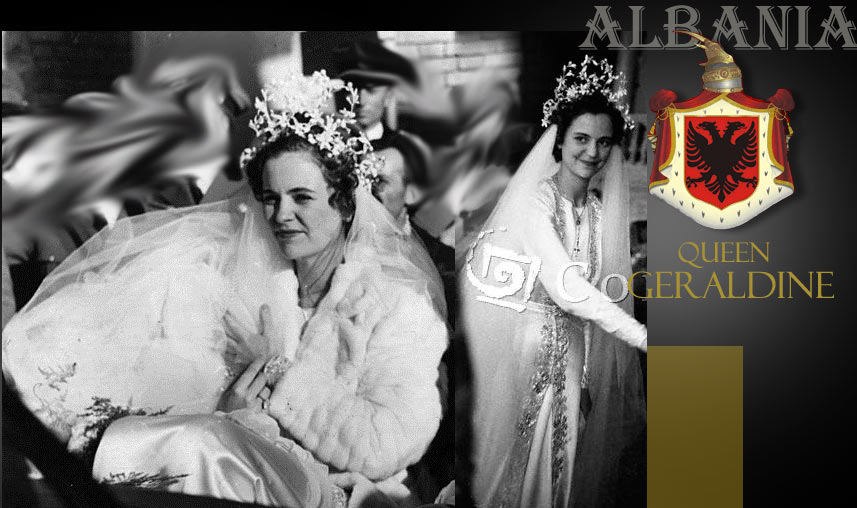
Albanian Wildflower – Diamond Tiara |Queen Geraldine of Albania | Crown Jewels | Royal Jewels History The Queen’s wedding coronation tiara, made of diamonds and platinum, shows the royal crest of the „Ram of Skanderbeg“ mounted on a bandeau of white roses and Albanian wildflowers. The ram was the symbol of AlbaniaQueen Geraldine of Albania | Royal Diamond Jewels | Schmuck und Juwelen der Königin von Albanien | Jewels Ostier Marianne Ostier Jewels of Her Majesty The Queen Geraldine Of Albania on display in April 1959, in New York City, together with the jewels of the royal Albanian princesses, Most of the jewels were made between 1930-1939 by the firm of Österreicher now known as Ostier
The Royal Jewels of Queen Geraldine of the Albanians and her jewelry with diamonds, presents from the King and Royal Family the jewel history and the story behind:
As Countess Geraldine Apponyi, referred to as „The White Rose of Hungary“ before her marriage to the 42-year old King in 1938, she was one of Europe’s great aristocratic beauties.
Geraldine Apponyi wrote to accept the invitation, and straight after Christmas 1937 she set off. The visit was a complete success; King Zog proposed marriage on New Year’s Day and, after a decent interval, on January 10 Geraldine accepted. Her guardian, Count Charles Apponyi, gave his consent to the match, and Geraldine was given the rank of Princess of Albania.
The marriage – a civil ceremony (King Zog was a Muslim, his bride a Roman Catholic) – took place in April of 1938. Geraldine wore a pearl and diamante wedding dress which the King had ordered from Worth, in Paris, and orange blossom in her hair. She had six bridesmaids and the wedding cake, which she cut with her husband’s sabre, was 10 ft wide.
The wedding presents included a phaeton and four Lippizzaner horses from Admiral Horthy, the Regent of Hungary, and a scarlet supercharged Mercedes from Adolf Hitler. King Victor Emmanuel of Italy sent a bronze equestrian statue of a dragoon; Mussolini sent some copper vases.
A very interesting, story of Cartier and the Albanian Royal Wedding
In 1938 Jacques Cartier and the salesman Marcel Marson made a business trip to Albania, where the marriage of King Zog I and his Hungarian Queen, née Geraldine Apponyi, was being celebrated. They were startled by the contrast between the brilliant receptions in the Durazzo palace and the ‚unimaginable poverty in Tirana‘. The bride selected a few pieces of jewelry, while the King appraised the ‚Cumberland‘ [diamond] and waved a diamond magnifying glass about, but bought nothing. The trip would have ended in tragedy had Cartier and Marson flown back with five carefully packed jewel chests, for the plane crashed between Tirana and Brindisi. A large part of the jewels were burnt; the remainder turned up later on the black market in Rome and Naples. The accident, however, did not deter Cartier’s from returning to Albania in the autumn of the same year for the jubilee celebrations of the tenth year of the King’s reign. Marson took more than a hundred pieces, including the ‚Cumberland‘ again and a pair of diamond drops of 35.57 carats, on this new expedition.
Oak leave – Diamond Tiara | Princesses of Albania | Crown | Royal Jewels The Princesses‘ tiaras are of platinum and diamonds. The centre motif is the helmet of Skanderbeg, while the sides represent Albanian oaks. Designed by Marianne Ostier in 1938 for Österreicher, the predecessor of Ostier Inc., New York. The Royal Princesses were the sisters of King Zog of the Albanians. Above Princess Ruhije (left), Princess Myzeyen (in black satin) and Princess Senije (right) who wed Prince Mehmet Abid of Turkey (1905-1973), son of Sultan Abdulhamid II of Turkey, in 1936
The temperature in Tirana was 38 ºC, it was unthinkable to telephone Paris, and the telegraphic connection was constantly interrupted, with the result that the code devised expressly for this journey was quite useless: ANTELOPE = King Zog; EAGLE = the King wants; BEE = the king is favourably inclined; WEASEL = the King’s sister; PLUM = tiara; BANANA = gold; DATE = diamond ring; FIG = emerald ring. The King, who was urgently awaiting credits from Rome, changed his mind every day and finally made such a risible offer for the important stones that Marson turned his back on Albania with the philosophical comment“ ‚Cartier does not go a-begging. Nadelhoffer, Hans. Cartier. Chronicle Books, 2007. pages 324-325
Geraldine of Albania Marriage |Royal wedding gown
Die Hochzeit Königs Zog von Albanien Besonders Tirana war festlich beflaggt, ein Triumpfbogen wurde errichtet und ganz Albanien bereitete sich begeistert für die Hochzeit des Königs mit der Gräfin Geraldine Apponyi, vor. Am 25. April 1938 begannen die Festlichkeiten. Abends fand ein Festbankett, dem ein Empfang im Offizierskasino folgte und grosses Feuerwerk, statt.
Der König Zog lud abends die Hochzeitsgäste zu einer großen Soiree in das kgl Schloss ein.
Gräfin Apponyi trug ein herrliches azurblaues Abendkleid und als Kopfschmuck ein Diadem aus Brillanten mit der Zeichen der Skanderbegs, siehe oben. Der König in der Uniform eines Oberbefehlshabers der albanischen Armee eröffnete sodann mit seiner Braut den Tanz, der bis in die späte Nacht dauerte. Die Braut des Königs hat bekannt gegeben, dass alle Personen oder Vereinigungen, die beabsichten dem Königspaare Geschenke zu widmen, die hierfür vorgesehnen Beträge einem Fonds zur Errichtung einer Altersversorungsanstalt zu widmen. Trotzdem gab es natürlich Geschenke, wie des ungarischen Reichsverwesers, der einen komletten Lipizzaner Viererzug mit prachtvollem Wagen und Geschirren und ein Porzellanservice von Herend für 24 Personen überreichte. 200 000 Franken in Gold war die Morgengabe des albanischen Volkes, die sie dem wohltätigen Zweck bestimmte, davon wurden auch die 200 Paare ausgestattet, die am gleichen Tag wie das Herrscherpaar den Bund fürs Leben schlossen.
Der Hochzeitszug mit 200 Personen, nach der Ziviltrauung am 27. April mit dem König als erster und die Königin in einem prachtvollen silberweissen Brautkleid mit Tüllschleiern und einer acht Meter langen Schleppe, einem Kunstwerk aus Paris, Worth bzw Chanel wurden zitiert. Einem weissen hohen Blütenkranz in Diademform aus Orangenblüten auf dem Kopf. Hinter ihnen schritten die Abordnungen und Vertreter verschiedener Länder und Königshäuser. Sowie Prinzessin Senije, die Gemahlin des Prinzen Mehemed Abid und Min Conte Ciano. Hinter ihnen die Brautjungfern – Schwestern des Königs Prinzessinnen Myzeyen, Ruhije und Maxhide.
Sapphires – Diamond Tiara| Ram of Skanderbeg | Geraldine of Albania | Crown | Royal Jewels
The Queen’s sapphire tiara, made of diamonds and sapphires, shows the royal crest of the „Ram of Skanderbeg“. This small tiara was worn in later years by Queen Geraldine of Albania
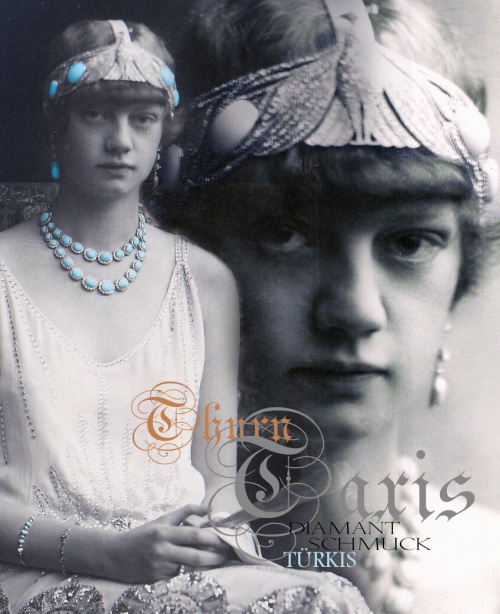
Peacock Turquoise Tiara Bandeau with Diamonds Eulalia’s bandeau was designed as a peacock with large cabochon turquoise set in it’s wings Pfauen Diadem mit Türkisen und Diamanten
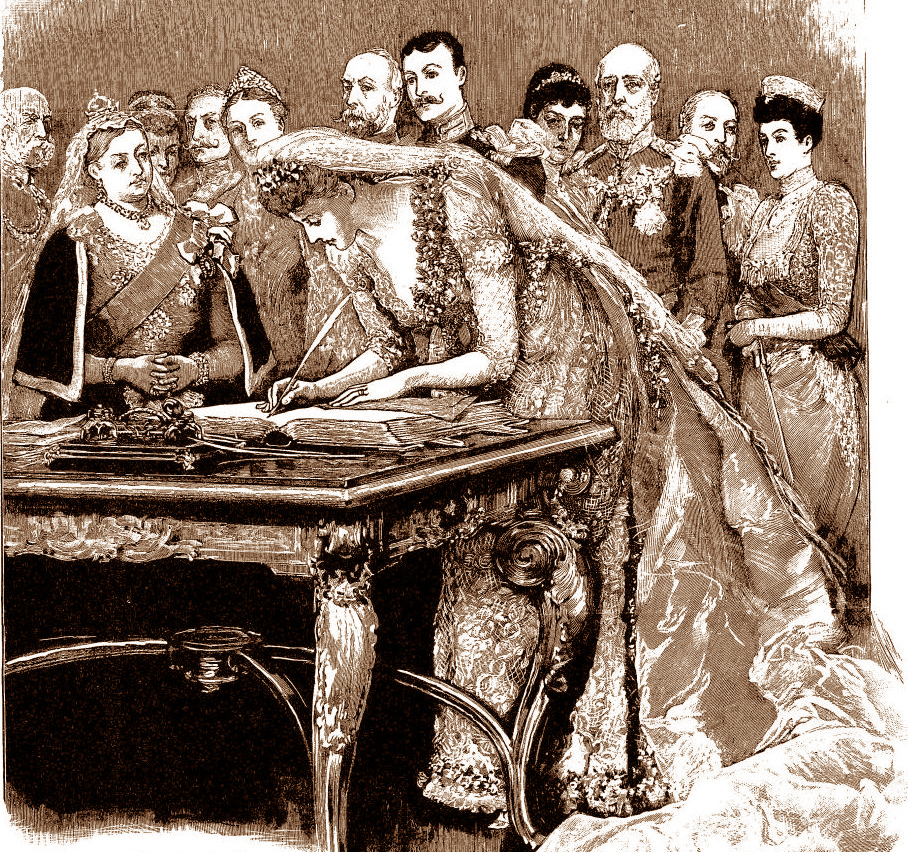
The Royal Wedding 1891 | Princess Louise signing the register in the green drawing room.
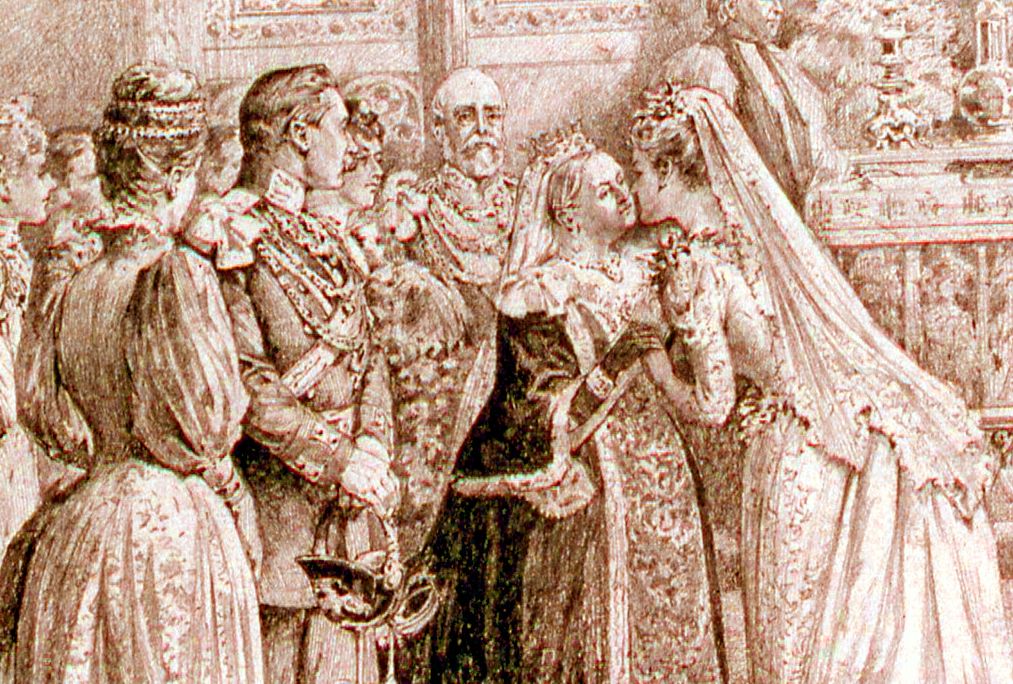
When the great State ceremony was over in St. Georg’s Chapel, Windsor, the blessing having been invoked by the Archbishop of Canterbury, Princess Aribert passed to the Queen and knelt before her.
Her Majesty raised the bride and affectionatly kissed her, as did the Princess Christian and the Duke and Duchess of Anhalt.
Royal Marriage of Princess Marie Louise of Schleswig- Holstein
Then giving his hand to his wife, Prince Arbibert led her down the aisle to the strains of Mendelsohns Wedding March and a hearty cheer greeted the as the passed out of the west door on their way to the castle.
The Queen the German Emperor and Empress, the Prince and Princess of Wales and the other Royal guests left the the Chapel immediately after the bride and bridgegroom.
Thte fomality to sign in the register was transacted in the Green Drawing-room.
Shortly after six o’clock the Prince and Princess Aribert left for Cliveden, the Duke of Westminster having lent them his beautiful house ther, the grounds attached to which are unrivalled for their woodland and river scenery. They soon reched the charming residence where they are to spend the first part of the honeymoon.
In the evening a Venetian Fete, with a procession of illuminated boats, was held upon the Thames at Windsor. The town, too was full of life and animation, there was a display of fireworks and a performance by the Queen’s privat ban.
More about the marriage, presents and gifts to the royal bride:
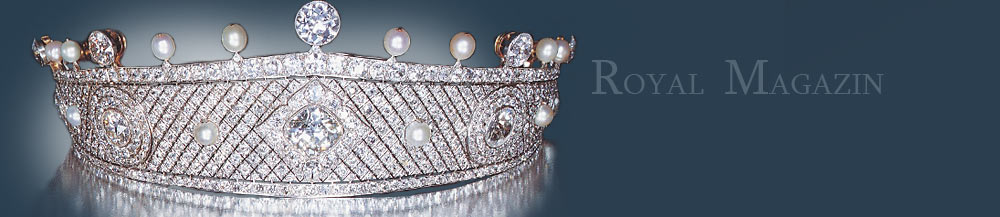
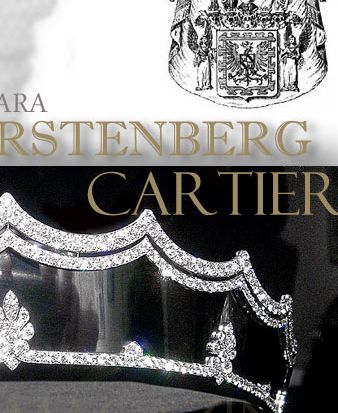
Stahl Diamant Diadem | Tiara der Erbprinzessin von Fürstenberg | CARTIER | Steel and Diamond Tiara
The curved blackened steel band of the tiara, bordered at the top with two rows of circular-cut diamonds, the bottom decorated with a line of similarly cut stones and palmette motifs set with circular- and single-cut diamonds, both ends of scroll design similarly set, history:
Kent Festoon Diamond and Pearl Tiara Necklace | Royal Marriage Present Princess Louise, Duchess of Argylls bequests-
Princess Louise’s bequests to favourite Royal pairs
The DUCHESS often wears diamond stars in her hair as on this occasion. Her new jewels include diamond daisies which she will probably wear the same way.
The Duke of Kent is known to be the chief beneficiary under the will. The extent of the Kents‘ legacy is unknown, for Royal wills are secret, and not filed at Somerset House.
The Duke of Kent, one of the greatest favorites within the Royal Family, is doted on by his elder relatives. He was the favorite nephew of the late Princess Victoria, who bequeathed to him the lovely home, Coppins.
The Duchess was also a favorite for her own charm, because she was the wife of the Princess‘ favorite, and partly because her family went through vicissitudes of which Princess Louise had seen so much.
Princess Louise Duchess of Argyll
Princess Louiselived so frugally at Kensington Palace during her last years that she must have used only a fraction of the £6000 she received annually through the Civil list pension.
Wealthy Princess She inherited the bulk of lier has band’s £619,000 and also inherited largely from her mother, Queen Victoria. She was therefore one of the wealthiest of the Royal Family.
The Duchess‘ jewellegacy is a magnificent one. When princess Louise married the ninth Duke of Argyle (sic), Marquess of Lorne in 1871 at the end of the Franco-Prussian war, there followed one of the most brilliant periods.
She was the centre of a great social season, and her jewels were the cynosure of all eyes. These have not been worn for years and are mostly in the antique settings, which are again becoming first favorites in modern taste.
The Princess‘ jewel box contains a particularly fine collection of diamonds, pearls and opals. One beautiful necklace is of five large opals set around with brilliants, connected by a diamond chain.
The Duchess of Kent wearing the type of pearl necklace and earrings she is rarely seen without. She now inherits some superb jewels from the late Princess Louise.
Particularly lovely are the diamond daisies mounted as hairpins, which are understood to be included in the Duchess‘ Inheritance. She will probably wear these In her hair as diamond clips, for she is fond of wearing stars in her hair.
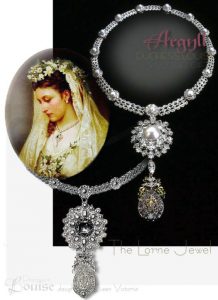
From one necklace of pearls and diamonds is suspended an oval locket, the centre of which is a large Oriental pearl surrounded by closely-set, large diamonds of great brilliancy.
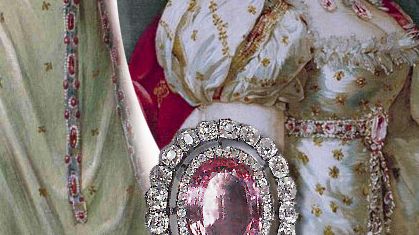
Princess Louise, fourth daughter of Queen Victoria. She had received the London-made jewels on 23 August 1871 as a gift from the Clan Campbell Marquis of Lorne, later the 9th Duke of Argyll as wedding gift.
Other lovely pieces include a two string pearl necklace valued at about £1000, a chased necklace with links of diamonds joined with pearls, and a beautiful bracelet in the shape of a coronet, centre of which is a large diamond surrounded by eight smaller diamonds. This is set in silver instead of gold, and would thus be mast fashionable to-day.
Princess Louise also had some beautiful silver and gold services, including a richly chased silver-gilt dessert set, a chased silver-gilt tea and coffee service, and a complete silver-gilt toilet set.
Diamonds for her birthday The Duke of Kent’s gift to the Duchess of Kent on her 33rd birthday was a flat bracelet of flexible platinum links studded with large diamonds. From the Australian Women’s Weekly 6 Jan 1940, p2
Nun ist sie wieder zu bewundern, die Pfälzische Perle. Nach einer Auszeit ist sie wieder in der Schatzkammer der Residenz München ausgestellt.
Le Palatinate | Die Pfaelzer Perle || Wittelsbacher Hausschatz Schatzkammer Residenz
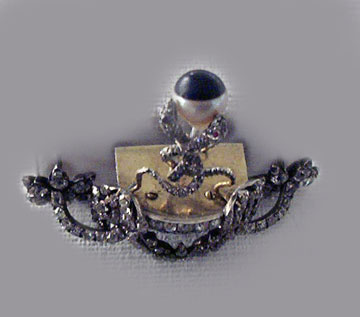
Die Pfälzische Perle auch Pfälzisches Aug oder la perle Palatine genannt, wäre allein schon wegen ihrer Grösse von 12 x 13 mm und 12 Karat ein Kleinod. Aber das besondere ist ihre Farbgebung, die schwarze Kappe trägt sie wie ein Bischof seinen Pileolus -als Zeichen des Einzigartigen.
Der kristalline Körper zeigt zu gut Dreiviertel zartweißen Perlmuttschimmer, der Perlengrund jedoch ist ein schwarzes Rund wie mit einem Zirkel gezogen.
Röntgenuntersuchen haben bewiesen, dass die ungewöhnliche Perle von Natur aus so gewachsen ist und nicht gefärbt wurde.
La perle Palatine war schon im Besitz des Kurfürsten Johann Wilhelm von der Pfalz 1568-1716, der sie vermutlich mittels des Amsterdamer Juweliers Jan Walrawn ankaufte.
Die schöne filigrane Fassung, in der sie sich jetzt befindet, wurde im Auftrag von Karl Theoder 1724-1799 vom Nürnberger Goldschmied Caspar Mayr 1794 angefertigt.
Elegant winden sich drei Schlangen mit Rubinaugen und tragen die birnenförmige Perle.
Dicht besetzt mit Diamanten sind Laub und Blüten, die ihr Postament schmücken. So präsentiert sie sich vortan im Schatz der bayrischen Herzöge und Könige.
Lord Twining der das bedeutende Buch über die Europäischen Kronjuwelen schrieb, stellte die Perle an den 2. Platz an bedeutenden Schmuckstücken in der Schatzkammer, nach dem Blaue Wittelsbacher Diamant
The second jewel of importance in the Wittelsbach Tresury is a black and white pearl known as the „Pearl of the Palatinate“ and also called the „Eye of Palatinate“
Pfaelzer Perle Schatzkammer Residenz München
It was first appears in the Düsseldorf inventory of 1711 where it is described as decorating the cover of a box. It was known to have been in the possession of the Elector John William 1690-1716 and possibly it was bought by the Elector himself through the jeweller Jan Walrawn, who was much thought of by the Düsseldorfer court. It was brought from the Palatine Treasury in 1782.
The pearl is drop-shaped and weighs 12carats. It is set in a diamond ornamet pedestal of which is in the form of garland, on which rest three interwoven snakes, their heads making a cup-like setting for the pearl.
The pearl itself is an abromality, its rounded top beeing quite black but with good lustre. Black pearls are not uncommon.
Quelle:Lord Twining- Crown Jewels of Europe 1960;
Schmuck und Juwelen der Deutsche Fürstenhäuser | Royal Jewels – Historical Jewerly and Treasure of Royals and Aristocracy | bijoux historiques| исторические драгоценности