England Great Britain U.K. United Kingdom of England Scotland Wales and Ireland English history Royal Jewellery & Aristocratic Jewels antique jewellery historian, Mountbatten, the Queen, crown jewels, Princess, windsor, house of windsor,
royal royalty royalfamily royaljewels diamond tiara queenvictoria duchess of york history england uk britain monarchy britishmonarchy britishroyals britishroyalfamily
The Queen’s jewellery to feature in Platinum Jubilee displays at the Official Royal Residences
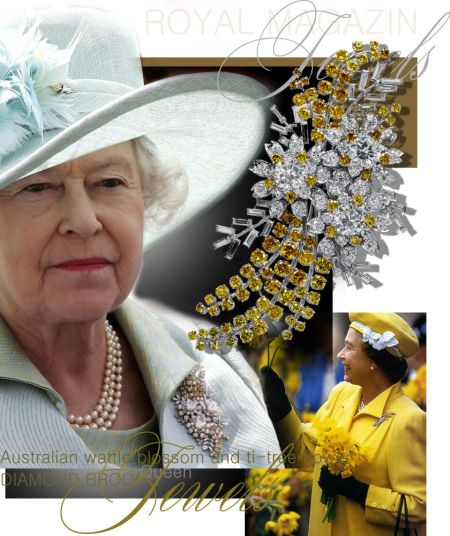
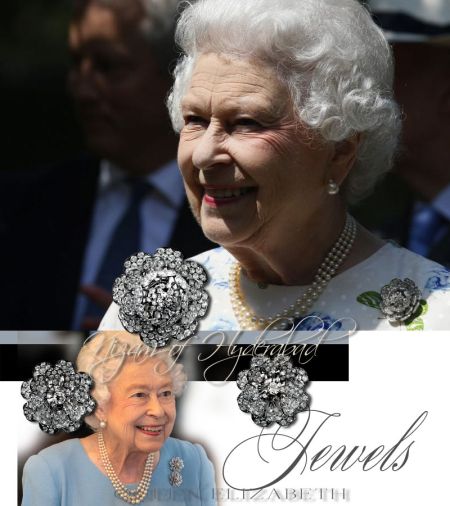
The Queen often wears brooches that represent the emblems of Commonwealth countries while visiting or meeting their representatives.
Queen Elizabeth II’s Australian Wattle Brooch
Queen Elizabeth II |The Queen’s Australian Wattle brooch |Royal Jewels of Great Britain and Ireland, presented on Her Majesty’s first visit to Australia in 1954
theCanadian Maple-leaf Brooch, worn by Her Majesty (then Princess Elizabeth) on her first visit to Canada in 1951;
theFlame-Lily Brooch, the emblem of Zimbabwe, which was pinned to The Queen’s mourning clothes when she returned to Britain from Kenya after the death of her father in 1952;
Platinum Jubilee 2022 – Queen Elizabeth II Diamond Diadem This spectacular piece of jewellery was worn by The Queen on her Coronation day @royalcollectiontrust
Magnificent jewels from Her Majesty The Queen’s personal collection will go on display this summer as part of special displays celebrating the Platinum Jubilee at Buckingham Palace, Windsor Castle and the Palace of Holyroodhouse in Edinburgh. Each display explores a historic occasion in Her Majesty’s 70-year reign – the Accession, the Coronation and previous Jubilees – through photographs, paintings, works of art, and items of The Queen’s dress and jewellery.
The Platinum Queen | Coronation Jubilee 2022 Queen Elizabeth II – @Royal Collection Trust
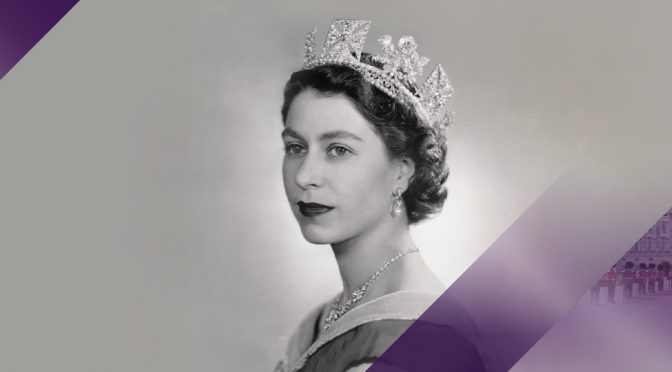
In the State Rooms at Buckingham Palace, which can be visited as part of the annual Summer Opening for the first time since 2019, official portraits of The Queen taken by photographer Dorothy Wilding just weeks after the Accession will be shown alongside items of jewellery worn for the portrait sittings. These include the Diamond Diadem, one of Her Majesty’s most widely recognised pieces of jewellery.
The Diamond Diadem was created for the famously extravagant coronation of George IV in 1821. It is set with 1,333 brilliant-cut diamonds and consists of a band with two rows of pearls either side of a row of diamonds, above which are diamonds set in the form of a rose, a thistle and two shamrocks, the national emblems of England, Scotland and Ireland. The Diadem was inherited in 1837 by Queen Victoria, who was frequently painted and photographed wearing it, including on several early postage stamps such as the Penny Black. The Diadem passed to Queen Alexandra, Queen Mary, Queen Elizabeth The Queen Mother and then to Her Majesty The Queen, who wore it on the day of her Coronation and has worn it on her journey to and from the State Opening of Parliament since the first year of her reign.
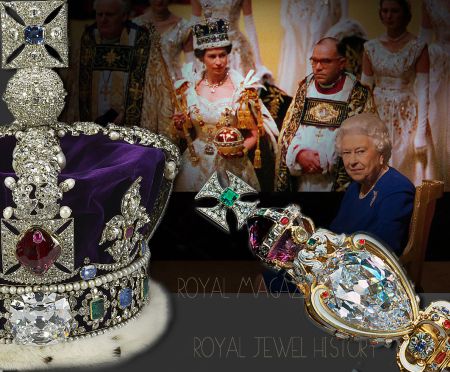
The spectacular Delhi Durbar necklace will also be on display at Buckingham Palace. The necklace incorporates nine emeralds originally owned by Queen Mary’s grandmother, the Duchess of Cambridge, as well as an 8.8 carat diamond pendant cut from the Cullinan diamond – the largest diamond ever found. The necklace was made for Queen Mary as part of a suite of jewellery created for the Delhi Durbar in 1911. Her Majesty The Queen inherited the necklace in 1953 and wore it in a portrait sitting for Dorothy Wilding in 1956 – thought to have been their last sitting together before Wilding’s retirement in 1958.
At Windsor Castle, the Coronation Dress and Robe of Estate worn by The Queen for her Coronation at Westminster Abbey on 2 June 1953 will be displayed. To recognise the importance of her role as Head of the Commonwealth Nations, Her Majesty asked for the emblems of the seven independent states of which she was monarch to be incorporated into the design of her Coronation Dress, together with those of England, Scotland, Ireland and Wales. The emblems were embroidered in gold and silver thread and pastel-coloured silks, encrusted with seed pearls, sequins and crystals.
Queens Coronation – Emblems of the seven independent states of which she was monarch to be incorporated into the design of her Coronation Dress, together with those of England, Scotland, Ireland and Wales. The emblems were embroidered in gold and silver thread and pastel-coloured silks, encrusted with seed pearls, sequins and crystals.
At the Palace of Holyroodhouse, visitors will see a display of outfits worn by Her Majesty on occasions to celebrate the Silver, Golden and Diamond Jubilees. In 1977 for The Queen’s Silver Jubilee, the royal couturier Sir Hardy Amies designed a striking ensemble of dress, coat and stole in pink silk crêpe and chiffon with a matching hat designed by Frederick Fox with flowerheads hanging from silk stems. The ensemble was worn at the National Service of Thanksgiving at St Paul’s Cathedral on 7 June 1977 marking the 25th anniversary of The Queen’s Accession.
On display for the first time will be Her Majesty’s Diamond Jubilee ensemble, worn to the National Service of Thanksgiving at St Paul’s Cathedral and a luncheon at Guildhall, City of London, as part of the celebrations on 5 June 2012. The ensemble was designed by Angela Kelly, Personal Adviser to The Queen (Wardrobe) and consists of a pale turquoise dress and coat embroidered with scattered silver flowers, with a coordinating hat.
Alongside the ensembles worn by The Queen will be a selection of gifts presented during official engagements in Scotland, as well as a group of works relating to Her Majesty’s first official visit to Edinburgh in 1953, soon after her Coronation. Examples include a silver model of a miner’s Davy lamp, presented in 1958 when The Queen made her first descent into a working coal mine on the opening of the Rothes Colliery in Fife, and the ceremonial key to the Palace of Holyroodhouse, which is presented to Her Majesty at the start of Royal Week at the Palace each summer. @RCT
„Two sprays of mixed flowers, entirely pavéd with diamonds, meet at the large, open wild rose in the center. The sprays can also be worn as brooches. The diamonds, set in flowers, are recorded in the Heathcote inventory of 1786and have descended in the same family since
Ancaster Heathcote Diamond Tiara | Jewellery | Willoughby d’Eresby Two sprays of mixed flowersAncaster Heathcote Diamond Tiara | Jewellery | Lady Willoughby d’Eresby
The Sunray Diamond Tiara | The Starbust Brooches and Halfmoons – from the the golden casket a gift of the Amir of Afghanistan Royal Jewel History, Queen Victoria Duchess of Connaught star diadem – lent by the queen for the coronation of Tsar Nikolas and Empress Alexandra, The Sunray Diamond Tiara | The Star bust brooches and diamond Half moons – from the golden casket a gift of the Amir of Afghanistan Royal Jewel History,
Battenberg Pearls Pearl Necklace Pearl String| Romanov Princess Nadejda Mikhailovna de Torby Countess Milford Haven|Princess Battenberg|Mountbatten Historic Royal Jewels History
Coronation Gown in 1936 – with Battenberg Pearls Pearl Necklace|Romanov Ruby Coronation jewels | Romanov Princess Nadejda Mikhailovna de Torby Countess Milford Haven|Princess Battenberg|Mountbatten Historic Royal Jewels History
From the Family Mountbatten of Burma| Royal Jewelry
Battenberg Pearls Pearl Necklace Pearl String| Princess Victoria of Hesse, Princess of Battenberg| Countess Milford Haven Historic Royal Jewels History
Coronation Day, 9 August 1902. Coronation, Alexandra made an unequivocal declaration of intent: ‘I know better than all the milliners and antiquaries. I shall wear exactly what I like and so shall my ladies – basta!’ On the day itself, she dispensed with the customary maids of honour in favour of a bevy of adolescent peers, who carried velvet robes dyed what one observer described as ‘petunia’. They were worn over a shimmering gown of gold silk, itself veiled by a diaphanous overdress intricately embroidered, through the offices of the American-born Vicereine, Mary Curzon, by Indian craftswomen.
After four decades of mourning under Queen Victoria, the coronation of King Edward VII and Queen Alexandra was envisioned as a dazzling public spectacle, symbolizing a new era of glamour for the monarchy. However, just three days before the scheduled ceremony, Edward underwent emergency surgery for appendicitis, postponing the event by six weeks. When the coronation finally took place on August 9, 1902, it became one of the most opulent royal celebrations in British history.
Traditionally, coronation gowns were simple white or cream robes, inspired by ecclesiastical attire. Yet Alexandra, a global fashion icon, defied convention with a striking gold dress designed by the Parisian fashion house Morin Blossier, led by women. The gown was adorned with thousands of tiny gold spangles, meticulously crafted to shimmer under the newly installed electric lights in Westminster Abbey—a first for such an event.
At Alexandra’s suggestion, her coronation dress became the first royal ensemble to incorporate Britain’s national emblems—the rose, thistle, and shamrock—a tradition upheld in every subsequent coronation dress, including those of Queen Elizabeth II and Queen Camilla. The intricate gold net of the gown was embroidered over five months by forty artisans in Delhi before being sent to Paris, where it was layered over cloth of gold to create the final masterpiece. Now exceedingly fragile, the rarely exhibited dress required over 100 hours of meticulous conservation work to prepare for display.
Alexandra adorned herself with an array of jewels and pearls for the coronation, including a diamond necklace and earrings—a wedding gift from Edward—displayed here for the first time, alongside the Dagmar necklace, a present from the King of Denmark. Also featured is her ostrich feather fan, its handle embellished with a diamond crown, an ‘A,’ and the national emblems.
The choice of a radiant gold fabric would have been breathtaking at the time, with contemporary accounts describing moments during the ceremony when the Queen appeared bathed in a golden glow, her dress illuminated by the Abbey’s electric lights. This shimmering vision epitomized Edward and Alexandra’s delicate balance of tradition and modernity as they ushered in the 20th century—a fleeting moment of splendor before the world descended into war.
Hannover pearls – Queen of Hanover, Thyra of Hanover, Duchess Thyra of Hannover-Braunschweig. Marie Antoinette grey pearl necklace, Hanover grey pearl necklace, Beaugrant Paris design, Duchess of Sutherland pearl necklace, Welfenschmuck.
Schmuck und Juwelen der Deutsche Fürstenhäuser | Royal Jewels – Historical Jewerly and Treasure of Royals and Aristocracy | bijoux historiques| исторические драгоценности