Kategoriearchiv: England | Great Britain

England Great Britain U.K. United Kingdom of England Scotland Wales and Ireland English history Royal Jewellery & Aristocratic Jewels antique jewellery historian, Mountbatten, the Queen, crown jewels, Princess, windsor, house of windsor,
royal royalty royalfamily royaljewels diamond tiara queenvictoria duchess of york history england uk britain monarchy britishmonarchy britishroyals britishroyalfamily

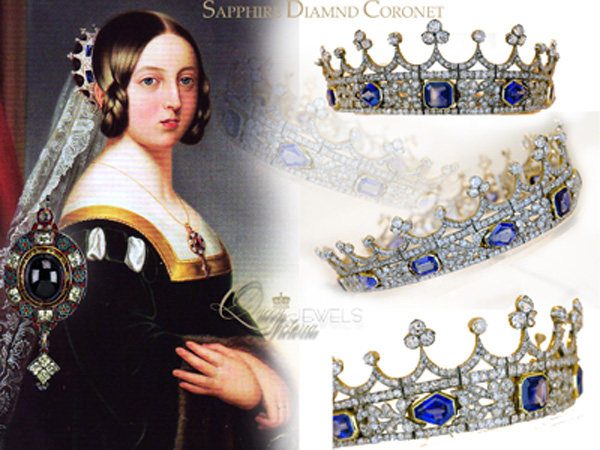
Queen Victoria’s Sapphire and Diamond Coronet | Royal Jewel History

Queen Victoria's Sapphire and Diamond Coronet
Queen Victoria’s Sapphire and Diamond Coronet

Export bar to save Queen Victoria’s Coronet

Culture Minister steps in to prevent Queen Victoria’s coronet from export

Culture Minister Matt Hancock has placed a temporary export bar on Queen Victoria’s sapphire and diamond coronet to keep it in the country.

Queen Victoria’s sapphire and diamond coronet designed by Prince Albert is at risk of being exported from the UK unless a buyer can be found to match the asking price of £5 million (plus £1m VAT).

The coronet is considered one of the most important jewels of Queen Victoria’s reign. It was designed by Prince Albert for her in their wedding year 1840. As a young queen, she loved coloured gemstones, an interest which notably faded following Prince Albert’s death in 1861.

The coronet matched the sapphire and diamond brooch that Albert gave to her the day before their wedding. She even noted in her journal “My dear Albert has such good taste and arranges everything for me about my jewellery.” Most of the stones came from jewellery given to Victoria by King William IV and Queen Adelaide. The goldsmith behind the coronet was Joseph Kitching, who made it for £415.

Following Albert’s death in 1861, Queen Victoria refused to attend the State Opening of Parliament until 1866 when she wore the coronet, likely as a reminder of her husband, instead of her coronation crown, which she noted had hurt her a great deal during her coronation.

The coronet and the brooch also feature in one of the most famous official portraits of the young Queen Victoria. In 1842, Franz Xaver Winterhalter painted his first portrait of the Queen, in which she wears the coronet wrapped around her hair. This painting became one of the defining images of the Queen not only in Europe and the Empire, but throughout the world

Culture Minister Matt Hancock said:

Queen Victoria’s coronet is stunning. It is one of the most iconic jewels from a pivotal period in our history and symbolises one of our nation’s most famous love stories. I hope that we are able to keep the coronet in the UK and on display for the public to enjoy for years to come.

The coronet was given by King George V and Queen Mary to Princess Mary, Countess of Harewood on her marriage to Viscount Lascelles in 1922.
As personal property of the Lascelles family it  passed on to her son and heir, the 7th Earl of Harewood (George Lascelles) and eventually the 8th Earl. It was sold 2011-2012 to an dealer, mostly likely to raise money to pay for inheritance tax , who sold it to the export licence applicant. The Coronet in video

The decision to defer the export licence follows a recommendation by the Reviewing Committee on the Export of Works of Art and Objects of Cultural Interest (RCEWA), administered by The Arts Council.

The RCEWA made its recommendation on the grounds of the coronet’s close connection with our history and national life and its outstanding significance for the study of the young Queen Victoria.

RCEWA member Philippa Glanville said:

Key to the self-image of the young Victoria, this exquisite coronet was designed by her husband Prince Albert. Worn in her popular state portrait by Winterhalter of 1842, the year it was made, its combination of personal meaning and formality explains why she chose to wear it in 1866, emerging from mourning for the State Opening of Parliament. It evokes vividly the shared romantic taste of the time, and its form has become familiar through many reproductions. Its departure would be a great loss, given its beauty, its associations and its history.

The decision on the export licence application for the coronet will be deferred until 27 December 2016. This may be extended until 27 June 2017 if a serious intention to raise funds to purchase it is made at the recommended price of £5 million (plus £1m VAT).

Organisations or individuals interested in purchasing the coronet should contact the RCEWA on 0845 300 6200.

27.July 2017 – After one year of battle – the coronet are sold to William Bollinger an Irish-American hedge fund tycoon, who donated the historc piece to the Victoria and Albert Museum.


This jewel tells a very special story

– history of the Sapphire and Diamond Coronet in details from the Royal Magazin:

Queen Victoria’s Sapphire and Diamond  Coronet

and with new pictures  of the Sapphire and Diamond Coronet and  Holbein Locket

Victoria small sapphire crown Queen Victoria's Sapphire Coronet The Princess Royal's Sapphires - Queen Victoria's Sapphire and Diamond tiara| Important Sapphires | British royal jewels history | Sapphire Tiara, Sapphire Diadem Harewood heirloom The Princess Royal's Sapphires - Queen Victoria's Sapphire and Diamond tiara| Important Sapphires
Queen Victoria's tiara was designed by Prince Albert as a gift in 1842
Queen Victoria’s Sapphire Coronet|Victoria small sapphire crown| The Princess Royal’s Sapphires
Queen Victoria’s tiara was designed by Prince Albert as a gift in 1842

The Princess Royal’s Sapphires – Queen Victoria’s Sapphire and Diamond tiara>>

The Princess Royal’s Sapphires – The King George V Sapphire Parure, Necklace and Pendant>>
 

Merken

Merken

Merken

Merken

Merken

Merken

Merken

Merken

Merken

Merken

Merken

Merken

Merken

Merken

Merken

Merken

Queen Victoria’s Turquoise Sévignés | Royal Jewels

The story of Queen Victoria’s private royal jewels:

Queen Victoria’s Turquoise Sévignés | Royal Jewels

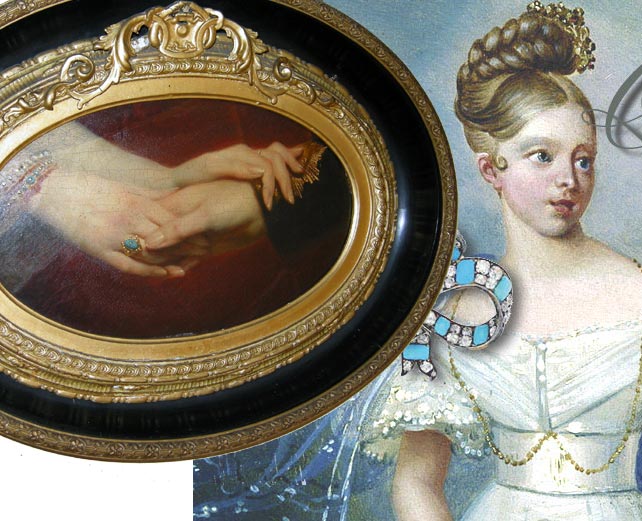
Below the jeweled linked hands of Queen Victoria and Prince Albert is typical of the type of ‚love-token‘ painting created at this time, especially of the Royal pair.  The Queen wore a ring with an oval tourquoise and an bangle setted with round tourquoises.

Queen Victoria's Turquoise Sévignés | Royal Jewels | Love Token
Queen Victoria’s Turquoise Sévignés | Royal Jewels | Love Token


Carved Ruby,Gold and Diamond Brooch | Andrew Grima |Gift from the Duke of Edinburgh | Queen Elizabeth II. Diamonds Queens Jewels

Carved Ruby, Gold and Diamond Brooch | Grima |Gift from the Duke of Edinburgh

Carved Ruby,Gold and Diamond Brooch | Andrew Grima |Gift from the Duke of Edinburgh | Queen Elizabeth II. Diamonds Queens Jewels


Exhibition opens today  at the Palace of Holyroodhouse on Her Majesty The Queen’s 90th birthday

 This brooch will be on display at the first of three special exhibitions, Fashioning a Reign: 90 Years of Style from The Queen’s Wardrobe, opens today (Thursday, 21 April) at the Palace of Holyroodhouse on the 90th birthday of Her Majesty The Queen.

The group of outfits, which chart Her Majesty’s life and reign from childhood to the present day, and represent family, official and ceremonial occasions, is the largest display of The Queen’s dress ever shown in Scotland.

For public appearances during childhood, Princess Elizabeth and her sister Princess Margaret often wore formal dress, such as the pink, princess-line coats and matching bonnets in the exhibition.  These outfits were worn by the Princesses, aged nine and five respectively, for a Service of Thanksgiving for the Silver Jubilee of their grandparents, King George V and Queen Mary, at St Paul’s Cathedral on 6 May 1935. Princess Elizabeth also wore the coat for an official visit to the Palace of Holyroodhouse with their parents King George VI and Queen Elizabeth in 1937.

The largest exhibition of The Queen’s dress and accessories ever shown in Scotland,  at the Palace of Holyroodhouse will be followed by exhibitions at the Summer Opening of the State Rooms at Buckingham Palace from 23 July 2016 and at Windsor Castle from 17 September 2016.  In total, around 150 outfits worn by The Queen will be presented across the three Palaces, many chosen because of their close association with the location>>.


Greville Ivy Leaf Clips Brooches| Royal Gifts for Princess Elizabeth| The Birthday Present

Queen of England Personal Jewels

the history of her  :

Royal Birthday gift | jewel presents | Queen Elizabeth II Jewels Ivy leaf brooches
Ivy Leaf Brooches -Royal Birthday gift | jewel presents | Queen Elizabeth II Jewels

The Sapphire and Diamond 18th Birthday Bracelet |Princess birthday gifts 

Greville Ivy Leaf Clips Brooch | Princess Birthday Gift

 earlier owned and worne by Queen Mother Elizabeth, the

Duchess of York | Art deco leaf brooch with Sapphire, diamond, emerald, amethyst and ruby | Princess Birthday Gift

This photograph has been released to mark Accession Day 2022: the 70th anniversary of Her Majesty’s reign and the start of her Platinum Jubilee year.

Her Majesty is seen with one of her famous red boxes. Over the past 70 years, The Queen has received daily papers from her Private Secretaries, in person or via a red despatch box. The boxes hold documents updating Her Majesty on events in Parliament as well as overseas and Commonwealth matters, and State papers requiring her signature and Royal assent.

This photograph has been released to mark Accession Day 2022: the 70th anniversary of Her Majesty’s reign and the start of her Platinum Jubilee year.

Her Majesty is seen with one of her famous red boxes. Over the past 70 years, The Queen has received daily papers from her Private Secretaries, in person or via a red despatch box. The boxes hold documents updating Her Majesty on events in Parliament as well as overseas and Commonwealth matters, and State papers requiring her signature and Royal assent.

The Queen is wearing two diamond ivy leaf clips, which were a gift from The Queen Mother for the then Princess Elizabeth’s 21st birthday.
This photograph has been released to mark Accession Day 2022 the 70th anniversary of Her Majesty’s reign and the start of her Platinum Jubilee year.
The Queen is wearing two diamond ivy leaf clips, which were a gift from The Queen Mother for the then Princess Elizabeth’s 21st birthday.@chrisjacksongetty


The Queen is wearing two diamond ivy leaf clips, which were a gift from The Queen Mother for the then Princess Elizabeth’s 21st birthday.

The clips were made for Mrs. Greville by Cartier – one in 1930 and the other in 1937. They were bequeathed to The Queen Mother in 1942 and given to The Queen as a 21st birthday present by her parents.

Greville Ivy Leaf Clips Brooches Cartier |Royal Jewel History Queen Elizabeth II|Princess Birthday Gift

Diamond Spray Brooch from the Royal staffs in England | Princess 21st Birthday Gift

Diamond Spray Brooch from the Royal staffs in England | Princess 21st Birthday Gift

Queen of England Personal Jewels

Royal Gifts for Princess Elizabeth | The Birthday Presents….More about the jewel history: Designed as a spray of a wildrose as brooch

Diamond Spray Brooch from the Royal staffs in England | Princess 21st Birthday Gift>>

Graving Dock Diamond Brooch | Gift from the South African Railways and Harbour Administration| Royal Jewels History

Graving Dock Diamond Brooch | Gift from the South African Railways and Harbour Administration
above – on the Graving Dock Diamond Brooch | Gift from the South African Railways and Harbour Administration Queen’s Personal Jewels

To honour the Queen’s 90th birthday I had add some new websites about her personal jewels. Which Queen Elizabeth got as present or gift to her 18th and 21th birthday and between:

Graving Dock Diamond Brooch | Gift from the South African Railways and Harbour Administration >>

While the Royal Family was on tour in South Africa, the South African Railways and Harbour Administration presented a gift to Princess Elizabeth after she opened the then new East London Graving dock on 3 March 1947. 
The present was "five large diamonds from Government mines on the Orange River, flawless stones exquisitely cut" (two half-moon and three emerald-cut diamonds), valued at £3700 for mounting in a bar brooch. See the picture above for the brooch and the casket on display. 
At first in the newspapers was reported to build a bracelet or bangle with the diamonds.
The brooch with two half-moon and three emerald-cut diamonds valued at £3700 for mounting in a bar brooch. See the picture above for the brooch and the casket on display.
Queen Elizabeth II Diamond Bar Brooch - first seen in 2019 worn, later worn by Queen Camilla in 2023, Queen Elizabeth's Bar Brooches
Queen Elizabeth II Diamond Bar Brooch first seen when she met the High Commissioner of Grenada at Buckingham Palace, October 2019

Diamonds from South Africa | Birthday gift for the future Queen of England and Royal Family

Diamond Gifts for the royal birthday child and the Royal Family
Diamond Gifts for the Royal Family | 21 Diamonds - The Birthday Present of the People of South Africa

In 1947, the Royal Family were presented with a selection of diamonds as a gift of the people of South Africa, after an two-month-tour.
The picture below, show  the unset diamonds mounted in wax in the form of a springbok, the symbol of South Africa, presented to the King.

Diamonds to the Royal Family.
Diamonds Gifts to the Royal Family
…..an magnificent unset diamond presented to Queen Elizabeth.
Middle – Princess Margaret received a bracelet, also of 17 brillants and 18 diamond

Russian Sapphire Diamond Brooch | Duchess of Kent | Royal Jewels – Romanovbrooch

Russian Sapphire Diamond Brooch |Katherine & Marina Duchess of Kent | Royal Jewels
Russian Sapphire Diamond Brooch |Katherine & Marina Duchesses of Kent

Marina Duchess of Kent | Royal Jewels

Russian Sapphire Diamond Brooch | Marina Duchess of Kent

Hochzeit und Trauung| Royal Wedding, the royal bride

Hochzeitsgeschenke | Royal Wedding and the Gifts

Marina Herzogin von Kent| The Engagement Ring and Weddingrings

Grossen Perlentropfen | Pearshaped Pearls of Grand Duchess Vladimir

Margeriten Blumenbroschen | The Diamond Daisy Brooches

Smaragd-Brosche | The Argyll -Emeraldbrooch

Diamantsterne | The Diamond Stars

Smaragd der Herzogin von Agryll | Princess Louise Duchess of Argyl

Katherine Duchess of Kent | Royal Jewels


Die Kent Aquamarine |
The Aquamarines

Russian Sapphire Diamond Brooch | Katherine Duchess of Kent | Saphir Herzogin Marina von Kent

Diamond Bracelet Marriage presented f. Town of Windsor |Duchess of Argyll | Jewels Duchess of Kent

Smaragd-Brosche Herzogin von Kent| Katherine Duchess of Kent |The Argyll -Emeraldbrooch

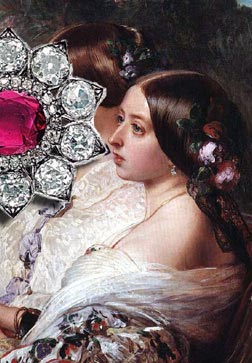
Queen Victoria of England |Ruby Parure Brooch | Royal Jewel History

Queen Victoria | The Ruby Parure with the Ferroniere >>

Queen Victoria of England | Ruby Jewels History

Strawberry Leaf Coronet | Tiara with Rubies Queen Victoria | Königin Victoria mit dem Orginal Rubin-Diamant Diadem>>

Strawberry Leaf Coronet | Tiara Queen Victoria Eugenia | Königin Victoria Eugenia mit dem Rubin – Diamant Diadem >>

Strawberry Leaf Coronet | Tiara Princess Beatrice | Prinzessin Beatrice von Battenberg mit dem Diamant-Diadem>>

Strawberry Leaf Coronet |Tiara | Marchioness von Carisbrooke mit dem Diamant-Diadem>>

Die Rubin Parure der Königin Victoria von England

Die Rubin Parure wurde noch von ihrem abgöttisch geliebten Ehemann Prinz Albert, ein Jahr vor seinem Tod entworfen und Königin Victoria von England zum Geschenk gemacht. Sie trug aber 10 Jahre nach seinem Tod keine Juwelen oder bunte Kleider. Erst bei der Hochzeit ihrer Tochter Louise liess sie sich dazu überreden und trug die Rubine.
Danach schenkte sie sie 1885 ihrer Tochter Prinzessin Beatrice von Battenberg zur Hochzeit. Und dann „beginnt“ das Geheimnis.
Ena, Königin Victoria Eugenie von Spanien– die Enkeltochter der Queen, wurde in den 1920igern mit den Rubinen abgebildet. 1937 war zwar Prinzessin Beatrice noch am Leben, aber nahm wegen  ihres hohen Alters nicht an der Krönung von König Georg VI teil.
Dafür aber ihre Schwiegertochter Irene Marchioness of Carisbrooke, die wiederum die Rubine von Schwiegermutter Prinzessin Beatrice zur Hochzeit bekam.
Aber 1933 entfernte sie die Rubine. Seither wurde das Erdbeerblatt Diadem nicht mehr gesehen – und auch das Collier „verschwand“ um diese Zeit.

1990 tauchte das Armband bei einer Versteigerung von Christies in St. Moritz auf und jetzt die dazugehörende Brosche mit einem ovalen Burma Rubin als Mittelpunkt, ein schmaler Rahmen aus Diamanten und einer grösseren mit 10 grossen Altschliffdiamanten eingefasst. Detailierte Beschreibung des Rubinschmucks – aus Erdbeerblättern ist oben über die Verlinkungen zu erfahren.


Merken

Merken

Merken

Jewels of Queen Alexandra Diamond Butterfly of the Freemasons|Diamond Brooch Royal Jewel History

Jewels of Queen Alexandra
Diamond Butterfly of the Freemasons|Diamond Brooch Royal Jewel History

Jewels of Queen Alexandra Diamond Butterfly of the Freemasons|Diamond Brooch Royal Jewel History