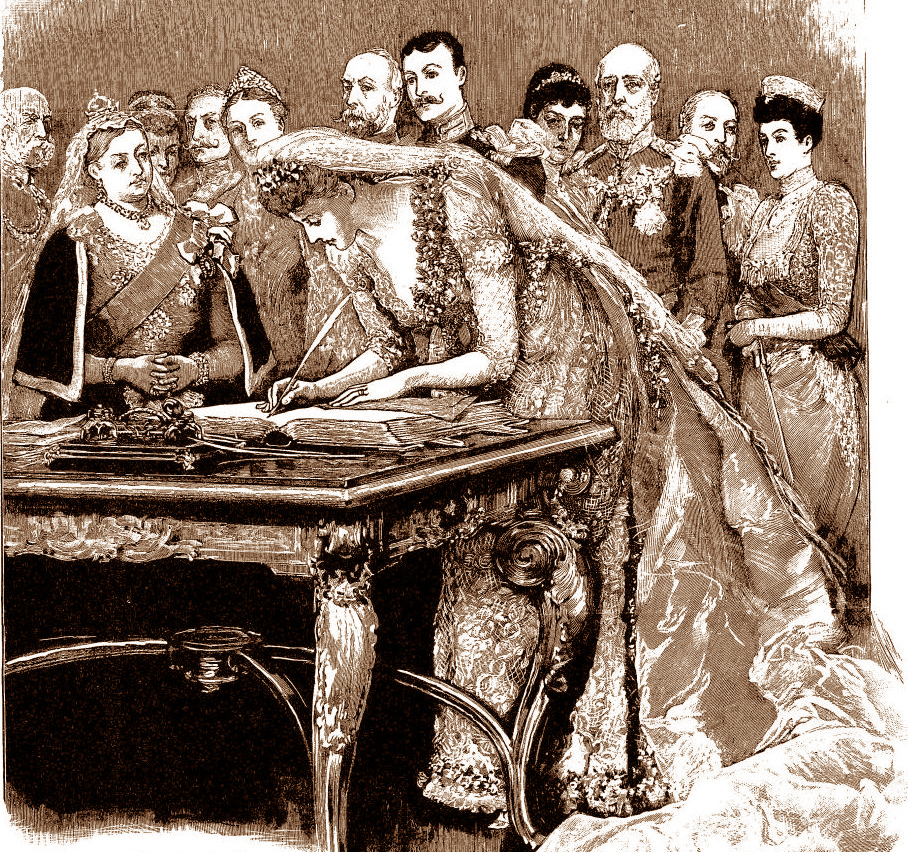
The Royal Wedding 1891 | Princess Louise signing the register in the green drawing room.
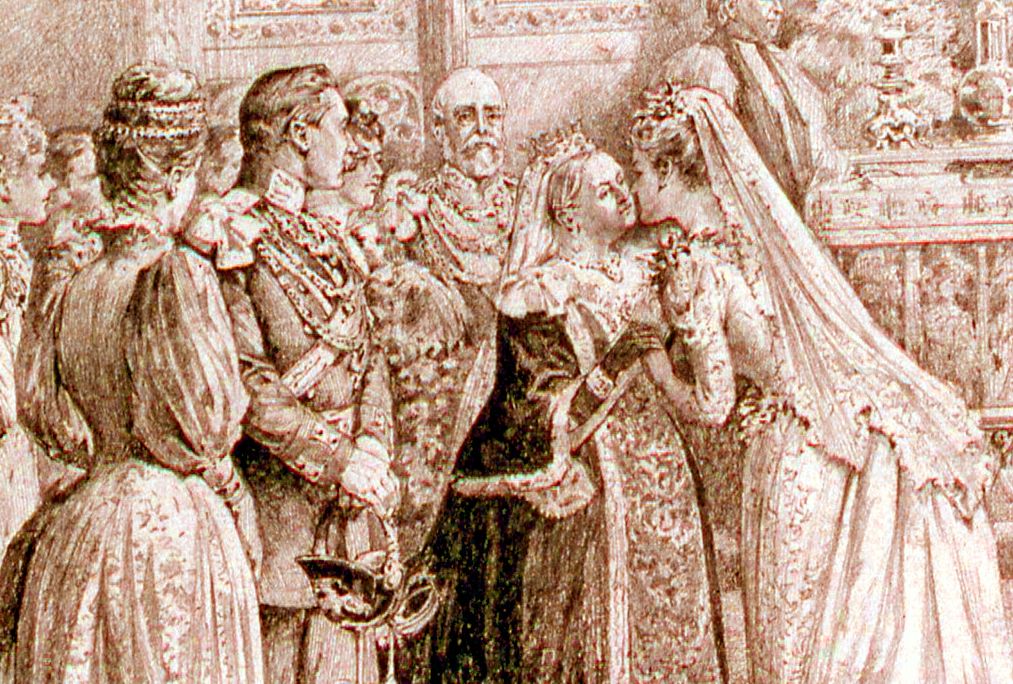
When the great State ceremony was over in St. Georg’s Chapel, Windsor, the blessing having been invoked by the Archbishop of Canterbury, Princess Aribert passed to the Queen and knelt before her.
Her Majesty raised the bride and affectionatly kissed her, as did the Princess Christian and the Duke and Duchess of Anhalt.
Royal Marriage of Princess Marie Louise of Schleswig- Holstein
Then giving his hand to his wife, Prince Arbibert led her down the aisle to the strains of Mendelsohns Wedding March and a hearty cheer greeted the as the passed out of the west door on their way to the castle.
The Queen the German Emperor and Empress, the Prince and Princess of Wales and the other Royal guests left the the Chapel immediately after the bride and bridgegroom.
Thte fomality to sign in the register was transacted in the Green Drawing-room.
Shortly after six o’clock the Prince and Princess Aribert left for Cliveden, the Duke of Westminster having lent them his beautiful house ther, the grounds attached to which are unrivalled for their woodland and river scenery. They soon reched the charming residence where they are to spend the first part of the honeymoon.
In the evening a Venetian Fete, with a procession of illuminated boats, was held upon the Thames at Windsor. The town, too was full of life and animation, there was a display of fireworks and a performance by the Queen’s privat ban.
More about the marriage, presents and gifts to the royal bride:
Nun ist sie wieder zu bewundern, die Pfälzische Perle. Nach einer Auszeit ist sie wieder in der Schatzkammer der Residenz München ausgestellt.
Le Palatinate | Die Pfaelzer Perle || Wittelsbacher Hausschatz Schatzkammer Residenz
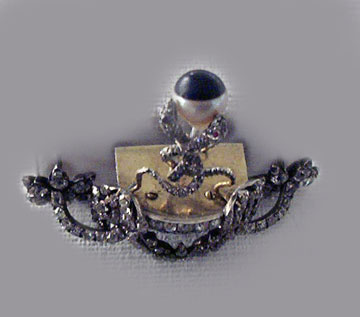
Die Pfälzische Perle auch Pfälzisches Aug oder la perle Palatine genannt, wäre allein schon wegen ihrer Grösse von 12 x 13 mm und 12 Karat ein Kleinod. Aber das besondere ist ihre Farbgebung, die schwarze Kappe trägt sie wie ein Bischof seinen Pileolus -als Zeichen des Einzigartigen.
Der kristalline Körper zeigt zu gut Dreiviertel zartweißen Perlmuttschimmer, der Perlengrund jedoch ist ein schwarzes Rund wie mit einem Zirkel gezogen.
Röntgenuntersuchen haben bewiesen, dass die ungewöhnliche Perle von Natur aus so gewachsen ist und nicht gefärbt wurde.
La perle Palatine war schon im Besitz des Kurfürsten Johann Wilhelm von der Pfalz 1568-1716, der sie vermutlich mittels des Amsterdamer Juweliers Jan Walrawn ankaufte.
Die schöne filigrane Fassung, in der sie sich jetzt befindet, wurde im Auftrag von Karl Theoder 1724-1799 vom Nürnberger Goldschmied Caspar Mayr 1794 angefertigt.
Elegant winden sich drei Schlangen mit Rubinaugen und tragen die birnenförmige Perle.
Dicht besetzt mit Diamanten sind Laub und Blüten, die ihr Postament schmücken. So präsentiert sie sich vortan im Schatz der bayrischen Herzöge und Könige.
Lord Twining der das bedeutende Buch über die Europäischen Kronjuwelen schrieb, stellte die Perle an den 2. Platz an bedeutenden Schmuckstücken in der Schatzkammer, nach dem Blaue Wittelsbacher Diamant
The second jewel of importance in the Wittelsbach Tresury is a black and white pearl known as the „Pearl of the Palatinate“ and also called the „Eye of Palatinate“
Pfaelzer Perle Schatzkammer Residenz München
It was first appears in the Düsseldorf inventory of 1711 where it is described as decorating the cover of a box. It was known to have been in the possession of the Elector John William 1690-1716 and possibly it was bought by the Elector himself through the jeweller Jan Walrawn, who was much thought of by the Düsseldorfer court. It was brought from the Palatine Treasury in 1782.
The pearl is drop-shaped and weighs 12carats. It is set in a diamond ornamet pedestal of which is in the form of garland, on which rest three interwoven snakes, their heads making a cup-like setting for the pearl.
The pearl itself is an abromality, its rounded top beeing quite black but with good lustre. Black pearls are not uncommon.
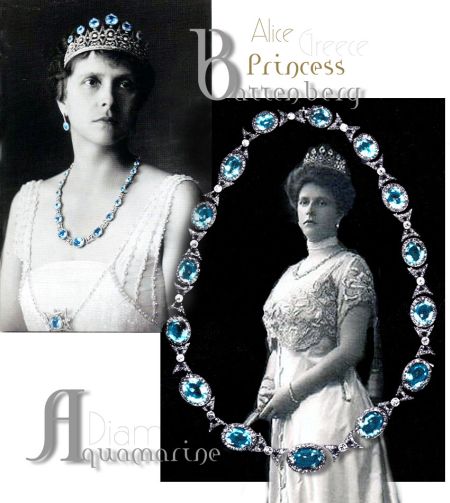
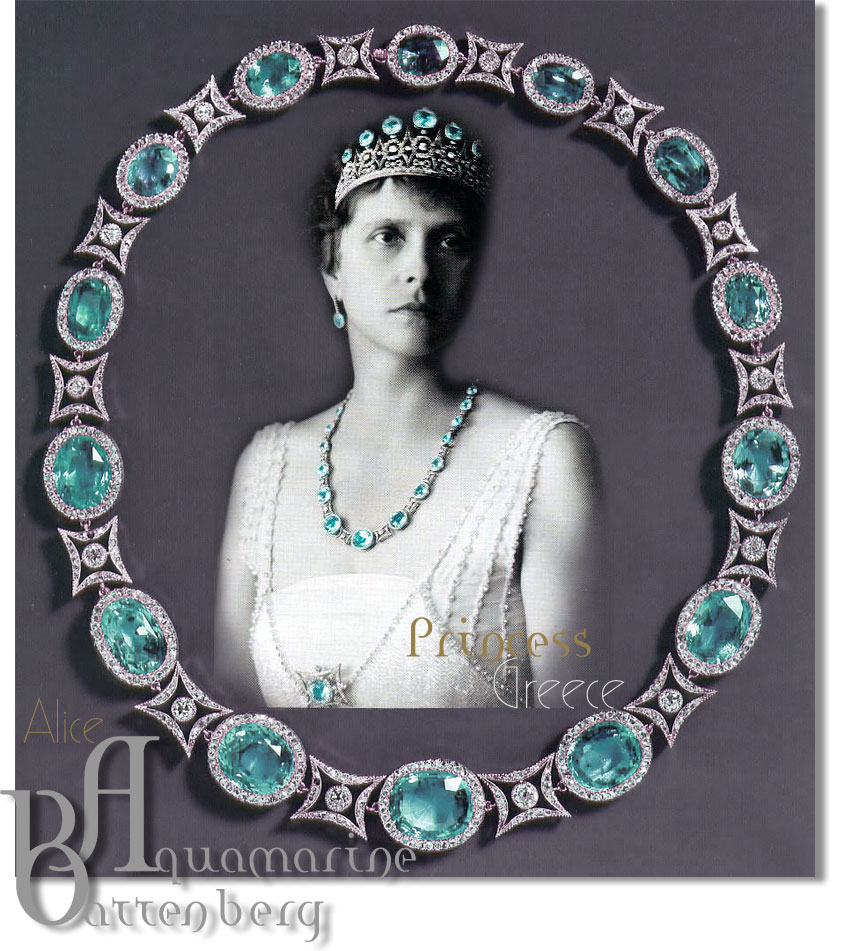
Prinzessin Alice von Battenberg | Aquamarin Parure Schmuck | Zarengeschenk Faberge Die Vermählung des Prinzen Andreas von Griechenland mit Prinzessin Alice von Battenberg.
Princess Alice of Greece | Imperial Aquamarine Parure |Romanov Jewels Marriage Princess Alice of Battenberg | Royal Greece | Aquamarine Parure| Wedding Gift Czar |Jewel History
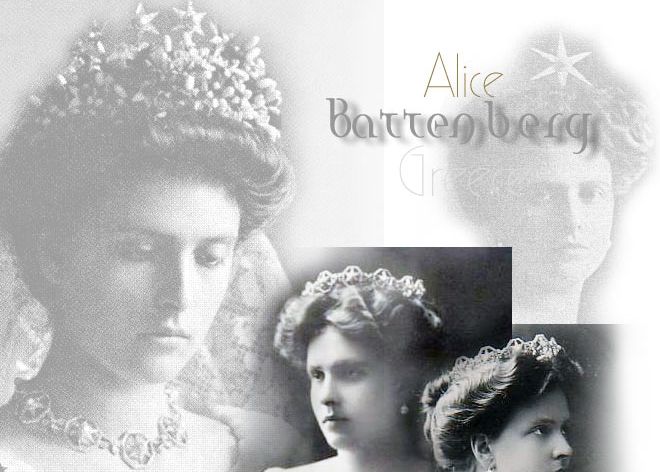
Mountbatten Battenberg Sterne Diadem Prinzessin Alice von Battenberg als Braut mit dem Diadem Ihrer Mutter, Prinzessin Victoria von Battenberg
Dem „Temps“ wird aus Petersburg über die Reisepläne des Kaisers Nikolaus berichtet: Am 14. oder 15. September 1903 gedenkt der Zar, der gegenwärtig jagt, nach Darmstadt zu dem gewohnten Aufenthalte bei den Verwandten der Kaiserin zu fahren. Diesmal gibt es für seine Anwesenheit in Darmstadt noch einen besonderen Grund: Die bevorstehende Vermählung des Prinzen AndreasvonGriechenland, des jüngsten Sohnes des Königs Georg, mit einer Prinzessin von Battenberg. Gegen Ende des Monats, wahrscheinlich am 24., begiebt der Zar sich in die Steiermark, um mit dem Kaiser von Oesterreich zu jagen. Doch begleitet Graf Lemsdorff seinen Gebieter dorthin, woraus man schliessen darf, dass die beiden Kaiser sich nicht blos dem Jagdvergnügen widmen, sondern sich ernstlich mit den orientalischen Angelegenheiten beschäftigen werden. Nach dem Aufenthalt in Oesterreich wird der Zar nach Darmstadt zurückkehren und bis Ende October, 1903 bis zur Reise nach Italien (-wurde später abgesagt-), dort bleiben. Während der Anwesenheit des Zarenpaares findet die Einweihung der auf der Mathildenhöhe erbauten Russischen Kapelle statt, in welcher am 7. October Prinz Andreas von Griechenland und die Prinzessin Alice von Battenberg den Bund für das Leben schließen werden. Die Trauung findet, wie wir bereits meldeten, auch nach protestantischen Ritus statt.
Ein sehr grosszügiges Geschenk brachte der Zar zur Hochzeit mit. Prinzessin Alice erhielt ein wahrlich imperiales Hochzeitsgeschenk von Ihrer Tante Alexandra, der Schwester Ihrer Mutter Victoria – der Tsarin von Russland und deren Mann, dem Zar. Die Historie und weitere Details zum Brautgeschenk ausführlich in deutsch:
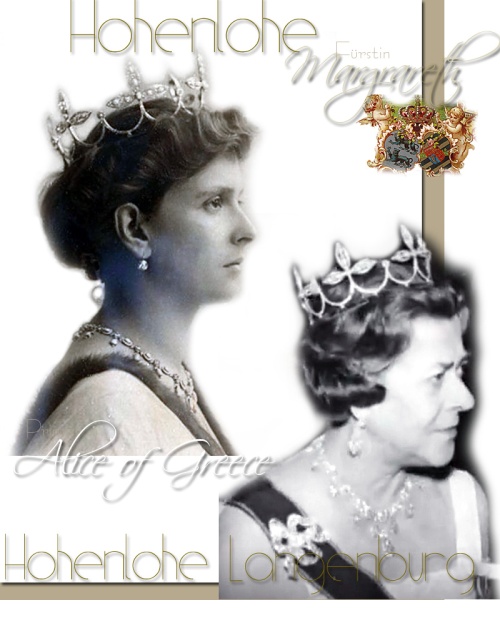
Fleur de Lys tiara Princess Alice of Battenberg, the esteemed Princess of Greece, was pictured adorned in a magnificent gilded Fleur de Lys tiara, embellished with exquisite turquoise stones. This was complemented by a matching necklace and sizable diamond earrings in 1914. Her daughter, Princess Margarethe of Greece, Fürstin Hohenlohe-Langenburg is later pictured with her mothers fleur de Lys.|Workshop Friedrich Kreuter & Co Hanau
Diamonds from the Crown Jewels of France | Bequest of J.S. Morgan to his Granddaughter, the late Viscountess Harcourt
The grandfather’s legacy!
In 1856 the crown jeweler Bapst created a comb for Empress Eugenie using diamonds from the French crown jewels. The head ornament had nine long diamond pendants called pampilles or aiquillettes.
At the auction of the French crown jewels in 1887, Tiffany’s bought four pampilles and sold two of them to Junius Spencer Morgan, the wealthy patriarch of the renowned merchant banking family.
He put these 2 pampilles in the safe with this order:
June 30/88
The contents of this box „2 diamond pendants from the Crown Jewels of France“ as described in the papers which accompany them are the property of my daughter Mary Ethel Burns.
They were handed to me by her Grandfather on the 29th June 20/88 to be held in Trust for her.
Walter H. Burns.
It was an exquisite and amazing present to his granddaughter May Burns.
She remounted the pampilles and the twenty-eight diamonds into a fringe necklace. It is said that the old-mine cut diamonds are I to J in colour, SI to I1 clarity in lively brilliance.
NEW updated!
The historic Dowager Viscountess Harcourt Diamond Necklace went to Tiffany & Co., on auction in October 2015, who first purchased the 28 diamonds on the necklace at the 1887 French Crown Jewels auction in Paris. US$1,548,718 / CHF 1,505,959 Source:Sotheby’s;
Empress Eugenie of France Imperial large Comb with Fringes of Diamonds and the Hortense Diamond of the French Crown Jewels the story behind the historic jewelry:
Jewel history in the older part of the Royal Magazin, with some updates:
Habsburg Fleur de Lys – Tiara – Marie-Louise of Habsburg Sapphires Parure with Diamonds, Fleur de Lys Brooches, Stomacher, Necklace | Imperial Austrian Bourbon Piacenza Tiara Royal Jewels – Sapphire and diamond necklace that belonged to Empress Marie-Louise of France (1791-1847), the second wife of Napoleon I important sapphires
Sapphire Parure of the Marie-Louise Empress of France, Archduchess of Austria | Imperial Habsburg
Habsburg Sapphires Parure with Diamonds, Fleur de Lys Brooches, Stomacher, Necklace | Imperial Austrian Bourbon Piacenza TiaraRoyal Jewels – Sapphire and diamond necklace that belonged to Empress Marie-Louise of France (1791-1847), the second wife of Napoleon I important sapphires
Sapphire Parure for the Imperial and Royal Court | Chaumet:
Schmuck | Aquamarin Ohrringe | Cecilie Kronprinzessin von Preussen
Die Eheschließung zwischen Dorothea von Salviati (1907-1972), links im Bild, und Prinz Wilhelm von Preussen, im Jahre 1933 war nach dem hohenzollerischen Hausgesetz zufolge nicht ebenbürtig. In Folge dessen musste Prinz Wilhelm als ältester Enkel Kaiser Wilhelms II. auf seine Erstgeburtsrechte verzichten. Sein Bruder Prinz Louis Ferdinand (1907-1994) trat an seine Stelle.
Im Jahr 1940 fiel er in Frankreich, bei den Kämpfen um Valenciennes. Seine Beisetzung im Potsdamer Antikentempel fand unter größter Anteilnahme der Bevölkerung statt und löste dadurch, den von Hitler verkündeten „Prinzen-Erlass“ aus, der ab 1943 alle Mitglieder ehemals regierender Häuser aus der Wehrmacht ausschloss.
Nach dem Dekret des Kaisers war es der Preussen-Familie untersagt an der Trauung teilzunehmen, jedoch auf dem Weg zu den Flitterwochen in Norderney, machten die Brautleute einen Zwischenstopp und fuhren nach Schloss Oels in die die Nähe von Breslau, wo Wilhelm seine neue Frau den Eltern vorstellte. Die Kronprinzessin brach das Eis, als Sie die Braut in den Arm nahm. Als eine Versöhnungsgeste übergab ihr Cecilie ein Hochzeitsgeschenk, grosse Aquamarine, die sie von Kaiser Wilhelm und Kaiserin Auguste Victoria zur Geburt, von Prinz Wilhelm 1906, geschenkt bekommen hatte.
Kronprinzessin Cecilie schenkte Ihrer Schwiegertochter unter anderem dieses Paar Aquamarin Diamant Ohrringe. Prinzessin Dorothea trug die Ohrringe oben auf einem Foto, aus den 1940ern, sowie eine grosse Clusterbrosche gut sichtbar.
Die facettierten Aquamarine sind in einer offen gearbeitet Fassung aus Diamanten und Gold aus dem frühen 20.Jdt und die Aufhängung wurde später angebracht. Kronprinzessin Cecilie hatte die Ohrläppchen nicht durchstochen, sondern trug nur Ohr-Schrauben. Der Ohrschmuck wird nicht durch das am Ohr gestochene Ohrringloch durchgesteckt, sondern mittels Klemmschrauben gehalten.
Prinzessin Dorothea hat die Ohrhänger später ihrer Tochter Felicitas vermacht, sie wurde am 7. Juni 1934 in der Villa Salviati in Bonn als älteste von zwei Töchtern des Prinzen Wilhelm (1906-1940) geboren. Ein besonders enges Verhältnis hatte Felicitas, zu ihrer Großmutter Kronprinzessin Cecilie, die sie anfangs in Bad Kissingen, später in ihrem neuen Wohnsitz in Stuttgart regelmäßig besuchte.
Prinzessin Felicitas war zweimal verheiratet. Aus ihrer 1958 mit Dinnies von der Osten (*1929) geschlossenen Ehe gingen vier Kinder hervor. Aus ihrer zweiten Ehe mit Jörg von Nostitz-Wallwitz (*1937) entstammt eine weitere Tochter.
Am 1. August 2009 verstarb Prinzessin Felicitas von Preussen, Frau von Nostiz-Wallwitz im Alter von 75 Jahren.
Ein Paar weitere Aquamarin Ohrringe sind vom Hausschmuck der Preussen bekannt und erhalten, sie gehörten der Königin Luise von Preussen und waren Bestand des Familienschmucks, nicht der Kronjuwelen. Die Aquamarine der Königin Luise waren zur freien Verfügung des Königs und Kaisers, es kann sein, dass ein Teil dieser Aquamarine an Kronprinzessin Cecilie, bzw dann an Prinzessin Dorothea gelangten.
Crown Princess Cecilie| Prussian Royal Jewels | Aquamarines
In 1933, the marriage of Dorothea von Salviati (1907-1972), pictured above, and Prince Wilhelm of Prussia was not equal, according to Hohenzollern House Law. As a consequence of his morganatic marriage, Prince Wilhelm had to give up his primogeniture as the eldest grandson of Kaiser Wilhelm II. His place in the line of succession was taken by his brother Prince Louis Ferdinand (1907-1994). A decree of the Emperor prohibited the Prussian royal family from attending the wedding ceremony; consequently the groom’s parents were not present.
Despite the obstacles that had been placed in the young couple’s way, the bride wrote to Count Hans Juergen von Blumenthal, who was best man at their wedding, that „life is getting to be nicer every day.“
From Bonn, the scene of their marriage, the couple went for a honeymoon to Norderney. Stopping at the Mecklenburg estate of Count Blumenthal, they talked over possibilities and incidents that might occur when they arrived at Oels castle, near Breslau, where Wilhelm was to introduce his wife to his parents.
With some fear and trepidation, Dorothea afterwards confided, she unpacked her trunk in the room to which the young couple was ushered and wondered just how the first meeting would be, when in came the Crown Princess, who threw her arms about her, kissed her fondly, and told her to call her mother. That broke the ice.
As an outward sign of reconciliation, Cecile handed her as a belated wedding gift the costly jewels–huge aquamarines–given her by the former Kaiser Wilhelm II and the late Kaiserin Auguste Viktoria when she bore her first son, Wilhelm, now Dorothea’s husband.
The Crown Prince, entering a few moments later, also embraced his young daughter-in-law affectionately.
Kronprinz Wilhelm of Prussia and his daughter-in-law Princess Dorothea | Aquamarine of Queen Luise
Princess Dorothea gave the earrings to her eldest daughter Princess Felicitas who was born 7 June 1932 in the Villa Salviati in Bonn. Princess Dorothea wears the aquamarine and diamond drop earrings and a large cluster brooch in the picture on top.
And at the christening of Felicitas with her father-in-law, seen on the right, she wore a large cluster brooch, very similar to the Aquamarine clusters (worn as brooches, bracelet and choker) of Queen Luise of Prussia – but this is not solved. These jewels were the heritage of the famous Queen Luise, not part of the crown jewels, as well as part of the House Jewels, with which the King and Kaiser could do what he wanted.
As Crown Princess Cecile did not have pierced ears she wore the earrings with screw fittings, which explains the later modifications to the earrings as indicated in the auction catalogue.
A pair of aquamarine and diamond earrings, early 20th century; each open work pendant set with a mixed-cut aquamarine, within a frame of rose diamonds, later hinged post fittings, six rose diamonds deficient.
The German Crown Princess Cecile, Duchess zu Mecklenburg-Schwerin (1886-1954), Princess Dorothea of Prussia (1907-1972), her daughter-in-law and thence by descent. Sold at auction in 2015 for £8,125.
Quellen: Preussen.de;Morgenpost 1933; The TIMES;Washington Post;Sotheby’s;
Schmuck und Juwelen der Deutsche Fürstenhäuser | Royal Jewels – Historical Jewerly and Treasure of Royals and Aristocracy | bijoux historiques| исторические драгоценности