England Great Britain U.K. United Kingdom of England Scotland Wales and Ireland English history Royal Jewellery & Aristocratic Jewels antique jewellery historian, Mountbatten, the Queen, crown jewels, Princess, windsor, house of windsor,
royal royalty royalfamily royaljewels diamond tiara queenvictoria duchess of york history england uk britain monarchy britishmonarchy britishroyals britishroyalfamily
In 1897 the grandchildren of Queen Victoria, all daughters and the son, from Princess Alice of Hesse:
Czar & Czaritsa of Russia , Grand Duke Louis & Grand Duchess
Victoria Melita of Hesse, Grand Duke Serge & Grand Duchess Elizabeth, Prince & Princess Louis of Battenberg
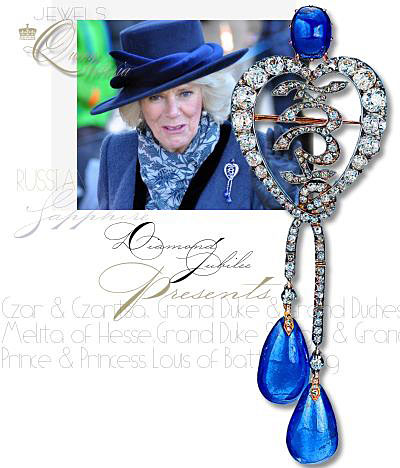
Russian Diamond and Sapphire Brooch | Presented to Queen Victoria on her diamond jubilee
This brooch will be on public at the exhibition Russia, Royalty & the Romanovs at The Queen’s Gallery, Buckingham Palace from Friday, 9 Nov 2018 – Sunday, 28 Apr 2019
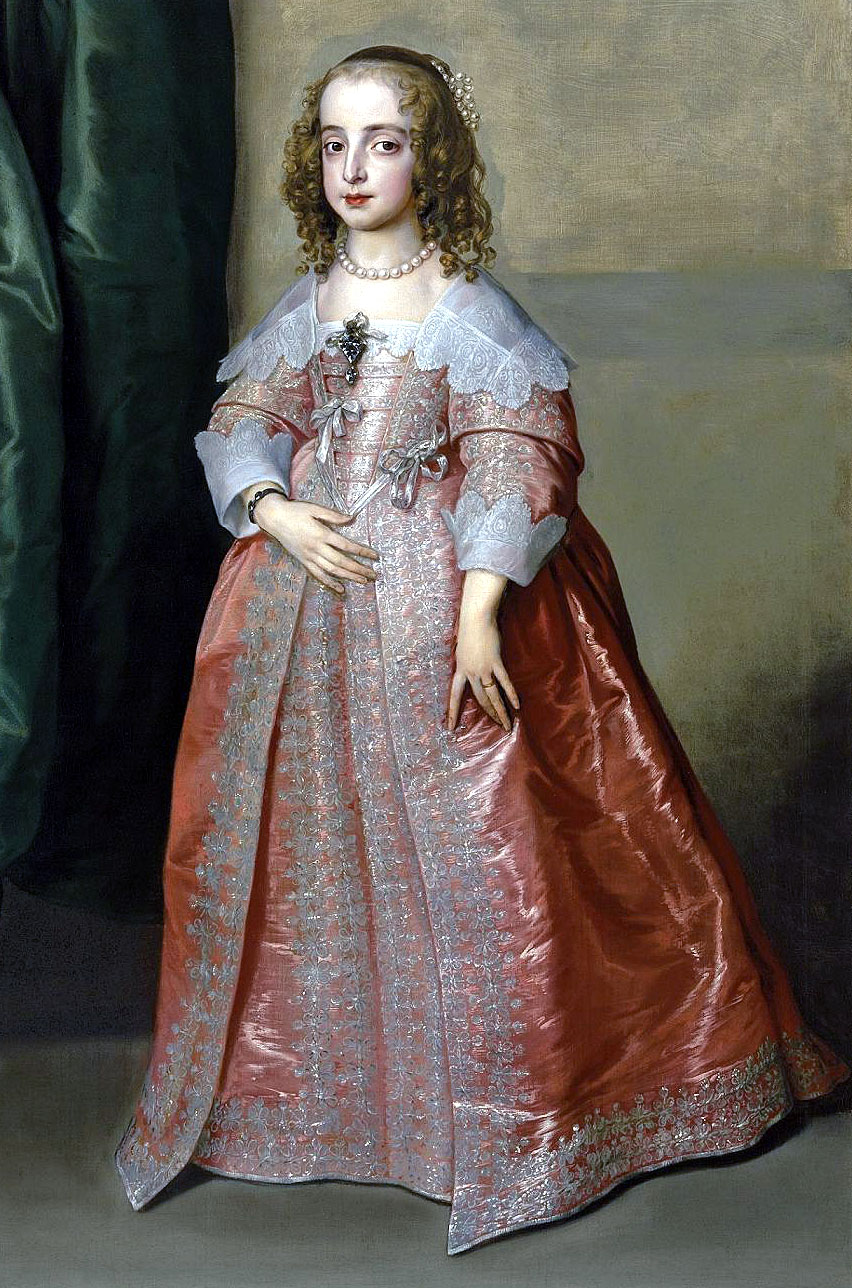
Mary Princess of Orange | England | Princess Mary’s Diamond Brooch
Princess Mary was born on 4 November 1631 at St. James’s Palace, the eldest daughter of King Charles I and Queen Henrietta Maria.
On 2 May 1641, at the age of nine, the kings daughter was married to William II, son of Frederick Henry, Prince of Orange and Amalia von Solms, at the Chapel Royal, Whitehall Palace.
Mary is shown wearing her wedding ring and the large diamond brooch given to her by her husband on 3 May 1641, the day after their marriage. A large pearl necklace and costly pearls in her hair, like a ribbon. A gem setted bracelet on the left.
Look at her spectacular coral gown, decorated with silver thread trim along its border, is thought to be similar to that worn for her wedding, rather than the cloth of silver-gold she wears. The apparent weight of the fabric, falling in broad, heavy folds, along with the bright highlights along the creases, suggest the fabric may have been cloth of silver. Shimmering highlights, applied in swift, cross-hatched strokes, were used as a form of shorthand by artists, mimicking the lustre of metallic threads as the textile caught the light. In accordance with the fashion of the period, her gown is open down the front, revealing a stiffened stomacher across the chest and a matching skirt beneath.
The ribbons, which would at one time have been functional, lacing the skirt and stomacher to the bodice, were applied purely as adornment. One ribbon, however has been pinned or stitched flat to disguise the seam between the bodice and skirt. The Princess’s brooch, the string of pearls and ribbons on her shimmering dress are rendered with remarkable precision and delicacy, characteristics that defined the artist’s finest late works.
She was baptized on the same day by William Laud, Bishop of London. Mary remained in England for a year after the marriage, eventually following her husband to Holland in 1642, accompanied by her mother and a train of four hundred courtiers. In March 1647, William II succeeded his father as Stadholder of the Dutch Republic and Mary became Princess of Orange. Her new position at court, however, caused conflict with her mother-in-law. The ill health which Frederick Henry had suffered between 1640 and his death in 1647 had meant that Amalia had effectively ruled as Regent and Stadtholder during this time. Mary’s appearance at court seems to have represented something of a challenge to her mother-in-law, with one of Mary’s ladies allegedly saying that ‘it was time the princess should run the country’, since Amalia had done so for so long. Source: christie’s
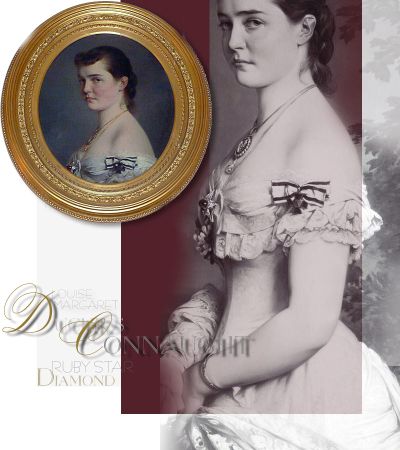
When Prince Arthur, son of Queen Victoria, Duke of Connaught saw the original portrait of his bride, in November 1878 he wrote to Queen Victoria to describe it: ‘It is really lovely, so like and yet so pretty and natural – She is taken three quarters face in a low gown of a creamy colour, her hair quite plain, my locket round her neck on a thin gold chain(probably his engagement gift), and that ruby and diamond star left her by her Grandmama* on her breast…
Which grandmother of Princess Luise Margarethe of Prussia, Duchess of Connaught, left her the large star brooch with ruby?
We know both of the Grandmamas……
Imperial Royal Jewelry | Duchess of Connaught Rubin Diamant Stern | Romanov Preussen |Königlicher Schmuck von Luise Margarete Prinzessin von Preussen, Herzogin von Connaught
Maternal grandmother:
*Grand Duchess of Saxe-Weimar-Eisenach and Grand Duchess Maria Pavlovna of Russia 16 February 1786 [OS 5 February] – 23 June 1859
Paternal grandmother:
*Princess Frederica Wilhelmina Louise Amalia of Prussia (30 September 1796 – 1 January 1850) was a daughter of Prince Louis Carl of Prussia and Frederica of Meklenburg-Strelitz. She was a member of the House of Hohenzollern. By her marriage to Leopold IV, Duke of Anhalt-Dessau, she would become Duchess of Anhalt-Dessau.
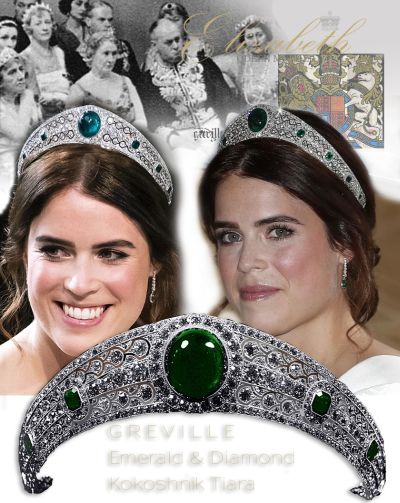
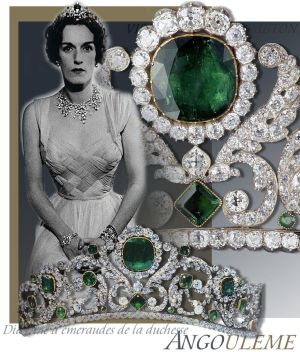
Smaragd Diamant Tiara | Imperialer Schmuck Frankreich |Herzogin von Angouleme
Die Tiara aus Smaragden und Diamanten ist ein Meisterwerk des Schmucks aus der Zeit der „Restauration der Bourbonen“.
Es bereicherte die Sammlung des Schmuck der Französischen Krone ungemein, die 1887 versteigert wurde.
Im Auftrag von Louis XVIII wurde es für seine Nichte der Herzogin von Angouleme, von Christophe-Frédéric Bapst und Jacques Evrard Bapst, Juweliere Krone bis zum Zweiten Reich, ausgeführt.
Ein prächtiges Diadem für eine königliche Prinzessin Marie Therese, die Herzogin von Angouleme (1778-1851), Tochter von Ludwig XVI. und Nichte Ludwigs XVIII., erhielt dieses Schmuckstück von ihrem Onkel.
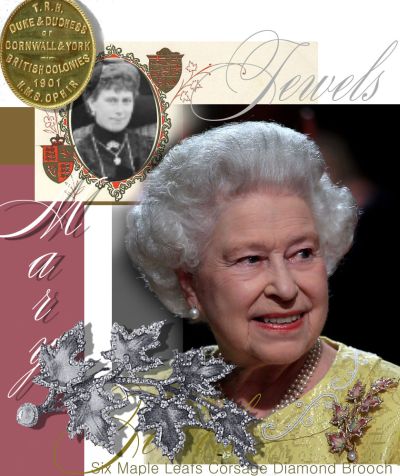
Royal presents – Showered with costly gifts to Mary Duchess of Cambridge later Queen Mary, in 1901 on the Royal Tour, special from the Canadians – Montreal presented an extraordinary six maple leaf and diamond brooch autumn colored (survived in her enormous trinkets collection and left to Queen Elizabeth).
Duchess of Cornwall and York, later Queen Mary| Montreal six maple leaf brooch corsages with diamonds
A mink fur cape, lined with ermine, trimmed with sable tails, the gift
of the ladies of Ottawa. The fur cape was fastened with a gold clasp fashioned into maple leaves, the gift of New Brunswick.
In the small picture, we could see the Duchess wearing the spray of maple leaves wrought in gold and enamel set with diamonds and pearls, on the tour.
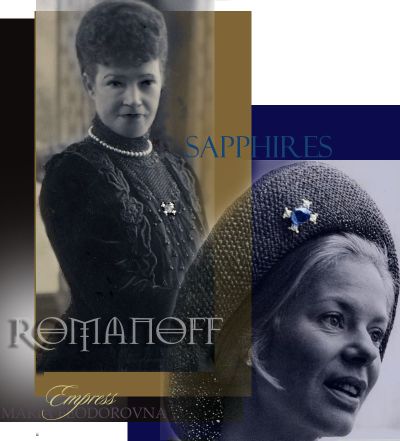
Dowager Empress Maria Feodorovna | Romanov Sapphire Cabochon Brooch with four Diamonds
über Königlichen Schmuck und deren Geschichte!
Als ich 2016 die ersten Bilder der Herzogin von Kent entdeckte und die erste Magazinseite entstand, wusste ich noch nicht, dass es sich um eine der wichtigen Schmuckstücke der Liste aus dem Verkauf der Romanov Juwelen von Zarinwitwe Maria Alexandrovna handelt.
1928, wurden sie nach einer Schätzung des Juweliers Hennell London von ihrer Tochter Grossfürstin Xenia, zum Verkauf angeboten. Es war eines der kostbaren Juwelenbroschen von Maria Feodorovna, der privaten Romanov Juwelen, keine Kronjuwelen. Ein weiters Schmuck-Rätsel ist gelöst.
When I discovered the first pictures of the Duchess of Kent in 2016 and the first magazine page was created, I did not yet know that this was one of the important jewels on the list from the sale of the Romanov jewels by Dowager Empress Maria Alexandrovna.
In 1928, according to an estimate by the jeweller Hennell London, they were offered for sale by their daughter Grand Duchess Xenia. It was one of the precious jewel brooches of Maria Feodorovna, the private Romanov jewels, not crown jewels. Another jewelry puzzle is solved.
Russia: Royalty & the Romanovs
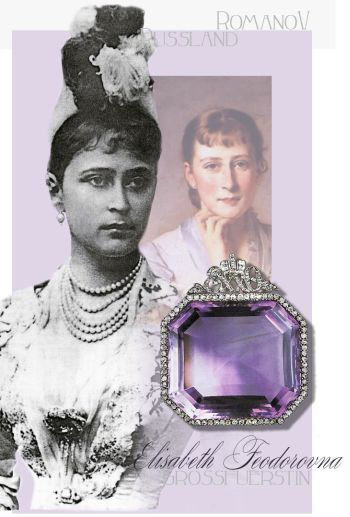
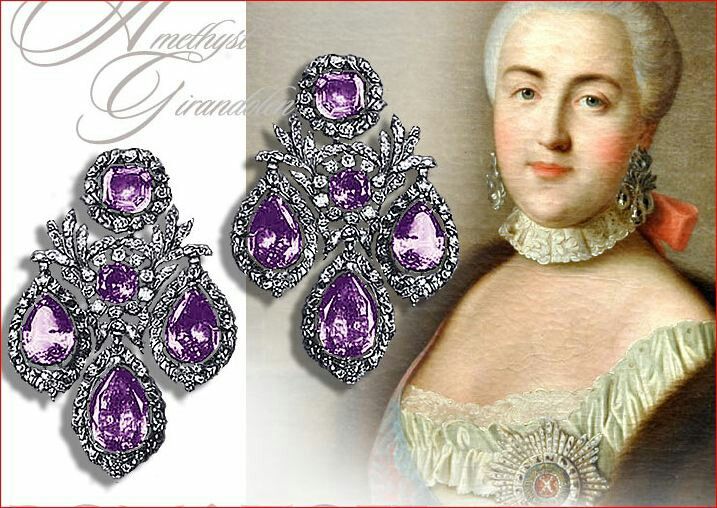
Siberian Amethyst diamond brooch pendant made by Fabergé | Romanov Jewels| Imperial Present of the Czar.
Siberian Amethyst diamond brooch pendant made by Faberge | Romanov Jewels| Imperial Present of the Czar.
In August 1909, Tsar Nicholas II and his family made their last visit to England. They attended the annual regatta at Cowes on the Isle of Wight, and the royal families dined together on each other’s yachts. A local photographer was commissioned to record the occasion and produced a double portrait of the Prince of Wales (later King George V) and his cousin Emperor Nicholas, which shows the strong family resemblance.
During the visit the Princess of Wales (later Queen Mary) was given a jewel as present, see above in the picture, a diamond-setFabergé brooch made from a Siberian amethyst, a stone famous for its intense purple hue.
More details and impressions of the the Czars visit in 1909 at Cowes click
This and other imperial gifts and royal presents are on display at
Russia: Royalty & the Romanovs
The Queen’s Gallery, Buckingham Palace 9 November 2018 – 28 April 2019
Romanov Tsar Amethysts| Twentieth wedding anniversary Brooch Faberge|Grand Duchess Ella, Elisabeth Feodorowna – Elizabeth Fyodorovna
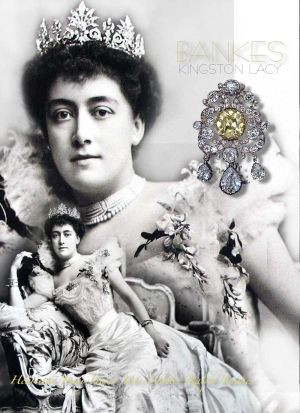
Henrietta Jenny Fraser |Mrs Walter Ralph Bankes after her marriage, with her palmetten ornament tiara, spray brooch, pearl necklaces and the large Benkes stomacher brooch.
The Bankes family have lived in Dorset since the 17th century and owned land in east Dorset and Purbeck, including Studland. During this time the Bankes were often considered one of the most powerful families in England, owning both the estates of Corfe Castle and Kingston Lacy. In 1981, when her son, John Ralph Bankes died, he left the 16,000 acre estate to the National Trust.
She wore it in the picture on the right side, in the early years when she was Duchess of York.
He presented the delicate jewel to Princess May of Teck in the week before the royalwedding . Another jewel was presented to the Princess by the Countess and the Lady Fitzwilliam, a diamond bracelet.
Queen Mary | Diamond Brooch Wedding Gift of the County of Lincoln | Royal Marriage Present This brooch was given as a present to the then Princess Mary in 1893 by the County of Lincoln on her marriage to Prince George, Duke of York.
Schmuck und Juwelen der Deutsche Fürstenhäuser | Royal Jewels – Historical Jewerly and Treasure of Royals and Aristocracy | bijoux historiques| исторические драгоценности