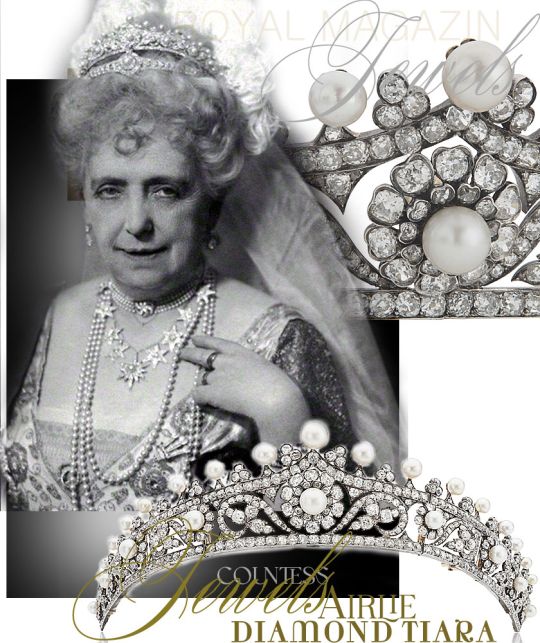
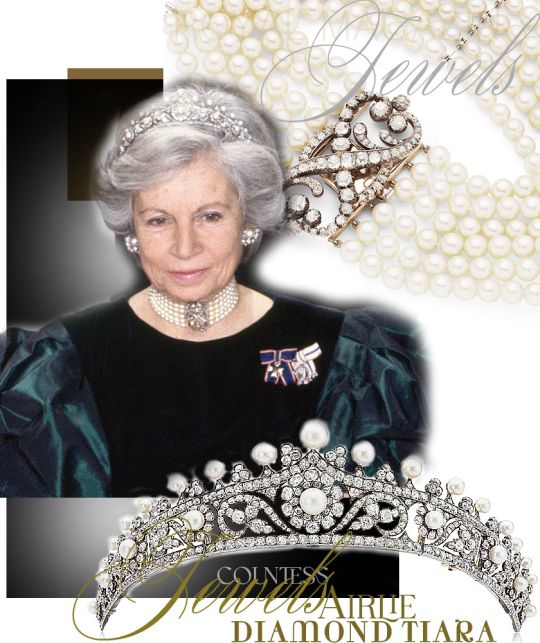
The Pearl and Diamond Tiara of The Late Dowager Countess of Airlie
AMERICAN BRIDE FOR LORD OGILVY • 1952 The crowd seen at a society wedding since the War gathered in Parliament Square Iondon, on Thursday, far the wedding of Lord Ogilvy, eldest son of the Earl and Countess of his American bride. The wedding was the Queen Mother, Princess Margaret and the Duke and Duchess of Gloucester. The 86-year-old Dowager Countess Airlie, who has been Lady of the Bedchamber to Queen Mary for 50 years, travelled south from Angus for the wedding. The thousands of guests included a number of Americans and also tenants and employees from Cortachy.
The 19-year-old bride, Miss Virginia Ryan, daughter of Mr J. B. Ryan. Newport. Rhode Island, the American industrialist, and granddaughter Mr Otto Kahn, the millionaire banker, wore gown of ivory satin and her matching Juliet cap had bunches of real orange blossom Her kilted page was the groom’s nephew, young Mark Tennent and among the eight bridesmaids in full-skirted white tulle frocks with Ogilvy tartan sashes, headdresses and bouquets of lilies of the valley and gentians, was Miss Davinia Lloyd, niece of the groom. The Hon. Angus Ogilvy was best man to his brother. The Royal guests were received by the Earl of Airlie Pipers of the 2nd Battalion Scots Guards which the bridegroom has served, played “The Bonnie Hooso Airlie.” The honeymoon being spent in Paris and America. A bonfire was lit at Corlachy as part of the wedding celebrations.
Record crowd greets Lord Ogilvy’s bride Looking very young and petite in her voluminous gown of white satin, Miss Virginia Ryan, the 19-year-old American bride of Lord Ogilvy, met a vociferous welcome from the crowds lining Parliament Square when she arrived at St Margaret’s, Westminster, yesterday in soft October sunshine. Some of the sightseers had been waiting for seven hours. The police estimated it was the largest gathering seen at a society wedding since pre-war days. The bride paused for a moment, and then with a smile made her way into the church on the arm of her father, Mr John Barry Ryan, Newport, Rhode Island, U.S.A. KISS FOR PAGE Just inside the church door waited her page and train bearer, Master Mark Tennant, in a kilt of the Ogilvy tartan. She stooped to give him a quick kiss before taking her position in the bridal retinue. A few minutes previously the Queen Mother, in black velvet, accompanied by Princess Margaret, had arrived. They and the Duke and Duchess of Gloucester and the Earl and Countess of Athlone were received by the bridegroom’s parents, the Earl and Countess of Airlie. Princess Margaret wore a tightly-waisted and full-skirted coat of ruby velvet. Her little cap of deep blue velvet matched her dress. The Duchess Gloucester had chosen ashpink with a mink tie.
BRIDE’S DRESS The bride’s four-yard train swept out from a wide skirt. A tiny bud bodice had an off the-shoulder fichu neckline, and tucked into its folds was a diamond brooch in the form of the Scots Guards badge, a gift from the bridegroom. I Round her neck was a strand of pearls, once her grandmother’s, and lent for the occasion.
The bride’s long white tulle and Brussels lace veil fell from a white satin Juliet cap, with clusters of orange blossoms the sides Her bouquet was of lilies-of-the-valley and “ snowflakes “ made from petals of white carnations mounted on slender white stems. It was an all-white wedding, relieved with touches of blue and the Ogilvy tartan. BUSTLE BOWS Two grown-up bridesmaids, Miss Elizabeth Crew-Pole and Miss Romana von Hofmannstahl, wore dresses of tulle. Their billowing skirts fell from white moire bodices finished with swathed hip draperies and enormous bustle bows at the back. They carried bouquets of lilies-of-thevalley and deep blue gentian. Four little girls, Misses Davina Lloyd, the 1 groom’s niece; Caroline Little from America, Arabella von Hofmannstahl, and Juliet Harvey, were in ground-length full-skirted dresses of tulle sashed with tartan. All had wreath headdresses of • tightlyl packed white blossoms, and wore the groom’s gift, gold link bracelets. Each link being a letter to spell the wearer’s name. GROOM’S GRANDMOTHER The Dowager Countess of Airlie, grandmother of the groom, and one of Queen Mary’s closest friends, made the journey to London to attend the wedding. She had been Lady of the Bed-Chamber to Queen Mary for 50 years. Among those who attended were members of the staff and tenant farmers from the bridegroom’s home in Angus, and the two Misses Bruce, Kirriemuir, who sit on welfare committees with his mother. A party from Dundee included Lord Provost Black and the Provost (Mrs R. H. Botsford) and Sir Garnet Wilson. Lord Provost Sir John Ure Primrose, Perth, also was there. NINE USHERS In the church masses of white chrysanthemums and the first arum lilies of the season stood at the ends of the pews. The ceremony was by Canon Smythe, St Margaret’s, and Rev. R. Whiteford, padre the 2nd Scots Guards, in which the bridegroom served. His brother, the Hon. Angus Ogilvy, was best man. Another brother, the Hon. James Ogilvy, was an usher, with the bride’s brother, Mr John Barry Rvan. Lloyd, Mr John Marriott, Mr Donald Ryari, Major the Hon. Bruce Ogilvy, Mr lan Tennant, Commander the Hon. Roger Coke, and Major Peter Balfour. PIPED OUT The ceremony over, the bride and groom, both rather pale, clutched each other’s hands and made their way slowly to the pavement to the crash of the wedding bells and the strains of Scots Guards pipers, who played The Bonnie Hoose o‘ Airlie.“ Then came the Royal guests escorted by the Earl and Countess of Airlie, followed by the bride’s parents. The. bride’s mother held the wedding reception at the Hill Street house of her sister, Lady Macriott. The honeymoon is being spent in Paris. For her going-awav costume the bride chose an ensemble of roval blue.