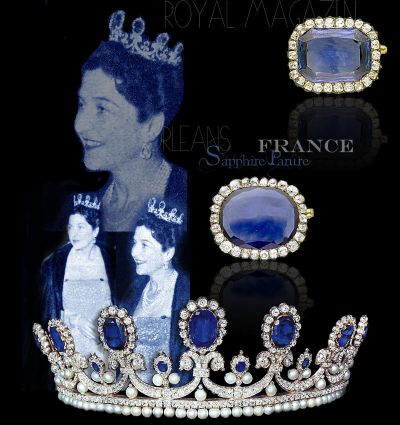
In der Gallerie D’Apollon des Pariser Louvre befindet sich seit 1985 eine Kollektion von historischen Saphiren, die eine vielseitige Verbindung zur Krone Frankreichs haben. Der vordergründige Anlass des Louvre für den Ankauf, dürfte sicher gewesen sein, dass sich diese Saphire im ehemaligen Besitz des Hauses Orléans befanden.
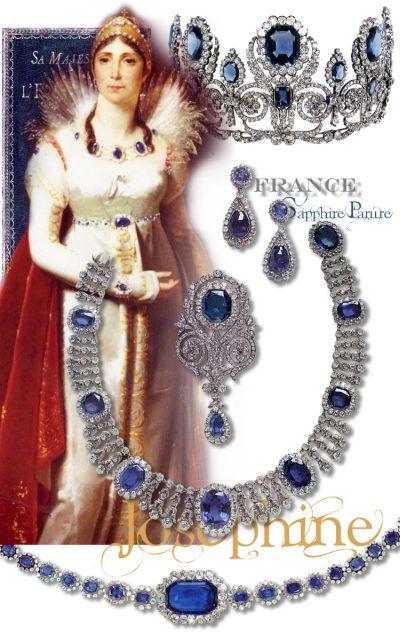
Saphir Diamant Parure- Schmuck der Kaiserin Josephine von Frankreich
1821 bot sich für König Louis-Philippe die Gelegenheit des Ankaufs eines Diadems, eines Colliers, einem Paar Ohrgehängen und einer Brosche für seine Gemahlin Marie-Amélie, in deren Familie diese Saphire weiter vererbt worden sind, bis sie dann direkt an den Louvre gingen. Diese tadellose Provenienz legitimiert die Steine dazu, als nationales Kulturgut Frankreichs anerkannt worden zu sein.
Aber nicht nur das Haus Orléans ist im Besitz dieser Saphire gewesen, zuvor wurden sie schon von Hortense de Beauharnais getragen, die diese Steine bis zum Verkauf 1821 ihr Eigen nannte.
The ORLÉANS SAPPHIRE PARURE | Imperial and Royal Sapphire Queen Marie Amelie of France | Marie Amelie Reine des Français
Saphire Orleans | Imperial and Royal Sapphire Queen Marie Amelie of France | Marie Amelie Reine des Français Above, a painting attributed to Hersent from the late 30s of the 19th century, shows Queen Marie-Amélie with the original parure before reworking. Sewn onto her dress, you can see the nine detachable diadem elements and the ‚Peigne-Couronne‘ in their original condition. The smaller brooch by Hortense de Beuharnais, which is stuck on a silk bow, as well as a necklace and earrings by Queen Hortense. The „Peigne-Couronne“ is attached to her headdress together with a beautiful Sévigné-style brooch more about the history>>
Königlicher Schmuck und die Geschichte der Juwelen von Königin Marie Amelie….
The ORLÉANS SAPPHIRE PARURE| Imperial and Royal Sapphire Queen Marie Amelie of France | Marie Amelie Reine des Français Orleans Saphir Diamant Parure- Schmuck der Königin Marie Amelie von Frankreich|Königlicher Schmuck und die Geschichte
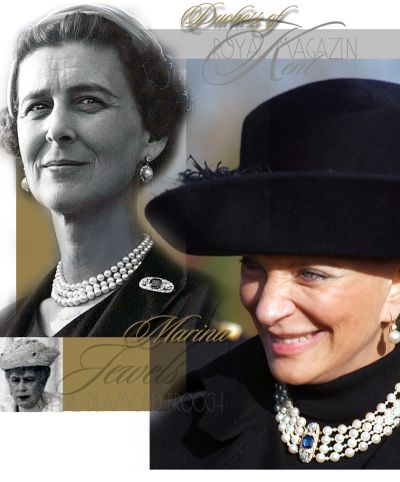
Queen Mary Sapphire Diamond Brooch |Marina Duchess of Kent rectangular sapphire and two diamonds sapphire brooch. The jewel was later altered and now used as sapphire clasp pearl necklace by Princess Michael.
Tsarina Maria Feodorovna Sapphire Brooch | Empress of Russia’s oval-brooch octaconal sapphire diamonds Queen Mary Sapphire Diamond Brooch |Marina Duchess of Kent rectangular sapphire and two diamonds sapphire brooch |Sapphire clasp pearl necklace Princess Michael
Queen Mary’s Sapphire Diamond Cluster Brooch |Large Sapphire in four bows setting 1911 Royal Jewels History| British Royal Jewels Queen Mary England later owned by Princess Margret, Countess of Snowdon
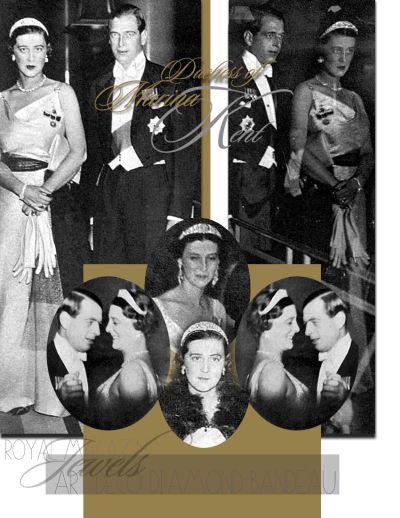
Art Deco Diamond Bandeau Tiara Duchess Marina of Kent
An all diamond scroll pattern tiara with brilliant custer centre and entourage of baquette diamonds, was one of the wedding gifts of the Duke of Kent to his bride. It was noted in the royal wedding gift list.
The Duchess of Kent wore the diamond tiara in her earlier times on some occassion, see the picture below.
Duchess of Ratibor Corvey Honeysuckle Diamond Tiara| Marie Herzogin von Ratibor-Corvey Palmetten Diamant Diadem | Royal Jewel History Jewels Historic Jewellery Marie Herzogin von Ratibor-Corvey Palmetten Diamant Diadem | Historischer Schmuck und Juwelen der Herzöge Ratibor-Corvey
The history about the historic tiara of the Duchess of Ratibor-Corvey :
Heart shaped diamond Ornament Tiara Marie Duchess of Ratibor-Corvey Large diadem with palmette in heart-shaped elements with diamonds. As base a double diamond hoop with large solitaires, in between leaf-shaped small motifs, lily-shaped, between the large elements. The gallery set in gold. All motifs are wearable as brooches Jeweler Kobert Vienna 1860.
Princess Marie of Edinburg | Queen of Romania| Royal Jewel Boucheron Diamond hair ornament Misteltoe
Translated from Romanian to E,nglish by Google Translator.
The Jewels of Queen Marie of Romania.
The jewels of Queen Marie of Romania hidden in a villa in Moscow.
Before 102 years, on 14 (27) December 1916, the treasury of the National Bank of Romania was packed in 1738 boxes and sent to Russia.
Besides treasury bills, values belonging to various Romanian private banks, commercial companies, private persons, art collections, documents and money, valued at 314,580,456, 84 lei gold, the Romanian officials decided to put in conditions safe and jewelry of Queen Maria, valued at 7,000,000 gold. The latter were stored in 2 boxes.
The fate of the Queen’s jewels has been the subject of many journalistic investigations in the interwar period. Lastny Novosti, the newspaper of Russian emigrants in Paris, makes an interesting account of the subject in 1933. The royal family’s jewels were handed over to Mr. Constantin Dimandy, then the plenipotentiary minister at Petrograd.
In the spring of 1918, after the departure of ambassadors and foreign ministers from Soviet Russia, Diamandy gave precious objects to the American consul in Moscow. This, in turn, before leaving Russia, handed them over to the Norwegian Consul. The Norwegian Consulate occupied at that time a villa on Charitonov Street no. 15.
At the end of 1918, Norwegian Consulate staff had to leave Russia. To save the treasure entrusted to him, the consul hid the boxes in a wall of the villa in the greatest mystery and hoping that later, Queen Marie’s jewelry boxes would be taken out of the secret hiding place and, of course, from Soviet Russia. One man in Moscow knew about the treasure of the villa, a former servant of the Russian submissive consulate who could not leave with the rest of his staff in Norway. After a while, this servant died. But before closing his eyes, he told a German citizen, a certain K., about the existence of treasure, indicating exactly the place in the wall where the boxes were built. In 1923, K., a refugee in Germany, contacted the Soviet Embassy in Berlin. This individual, K., the secretary of the Soviet Embassy, Iakubovici, and the second secretary, Mirov, concluded a verbal agreement under which K., as a reward for his denunciation, guaranteed a certain percentage of the value of the treasury. The agreement was confirmed in the presence of the representative of the Soviet State Bank, Sergheev-Romm, specially sent to Berlin for this purpose. It seems that German K, born and raised in Moscow, recognized Sergheev-Romm as an old high school colleague. Among friends, the business has settled without difficulty. The formalities were resolved quickly, and K. left for Moscow. Here he was directed to a certain Stein who was given the representative of the Soviet Ministry of Finance. Stein confirmed his understanding between K. and the Soviet Embassy in Berlin through the representatives of Iakubovici and Mirov on the one hand and the bank through its representative, Sergeyev-Romm. The villa on Charitonov Street was at that time occupied by the Czechoslovak Mission. For this reason, he was told by K., coming from Germany, that he can not start looking for the treasure, because the matter is too delicate and he must for now give up. Incidentally or not, in three months, Soviet officials found the treasure.
In the Czechoslovak Mission’s building the guilds appeared, under the pretext that they are workers from the water pipes. They showed a Soviet order in Moscow that had the immediate repair of the upper pipes, otherwise the building would have been threatened to collapse. The treasure was built in a wall on the first floor. During the repairs, the Czechoslovak Mission moved to the second floor. Within a few days, in September 1923, the jewels were discovered and transported to the Soviet warehouse.
In 1928, K. learned, by chance, that the treasure was found and that he was practically pulled on the string. Consequently, he addresses a Berlin lawyer, Bruno Marwitz, asking him to sue a Soviet trial. Marwitz, before commencing the action, addresses the Soviet Embassy in Berlin to confirm whether there was any agreement between K and the Embassy. Iakubovici admits, in a rather imprudent way, that he really spoke to Mr. K. about the treasure, and that, after this conversation, K. left for Moscow. Yakubovich could no longer remember any formal obligations towards K. The process threatens to become embarrassing for the Soviet government, especially since the intervention of the Romanian government, which until then knew nothing of the fate of Queen Mary’s jewels, was inevitable.
In order to get rid of a lawsuit, the Soviet Embassy in Berlin intervened with the German Foreign Ministry, which took the necessary steps with the Ministry of Justice. Interventions were successful, as the process ended with no result: censuses could not be handed over to Ban.
In the year 1903 Grand Duchess Marie, Duchess of Edinburgh, the mother of Queen Marie held a Charity exhibition at Coburg, of her famous jewels, as well with the jewels of her daughters. Some of the missing jewels are on display in 1903.
The Romanov Sapphire and Diamond Tiara stood out as one of the most versatile creations of imperial jewel design. Commissioned in the Russian court tradition, it was composed of magnificent sapphire and diamond clusters that could be worn interchangeably as a regal tiara, brooches, pendants, or even transformed into an Art Deco bandeau in the 1920s.
Pectoral Badge of Yanhuitlan | The wedding gift of the citizens of Mexico was sent by Dr Miguel Alemán Valdés , President of Mexico, on the occasion on the marriage of Princess Elizabeth II in 1947.
Never seen worne in public, by the Queen, but one of the costly presents to her marriage.
Schmuck und Juwelen der Deutsche Fürstenhäuser | Royal Jewels – Historical Jewerly and Treasure of Royals and Aristocracy | bijoux historiques| исторические драгоценности