England Great Britain U.K. United Kingdom of England Scotland Wales and Ireland English history Royal Jewellery & Aristocratic Jewels antique jewellery historian, Mountbatten, the Queen, crown jewels, Princess, windsor, house of windsor,
royal royalty royalfamily royaljewels diamond tiara queenvictoria duchess of york history england uk britain monarchy britishmonarchy britishroyals britishroyalfamily
Turquoise jewels – royal family Duchess of Gloucester 2025 –
Also from the Teck Turquoise Parure, two of the bow brooches with turquoises and diamonds. The Turquoise Diamond Parure and die Turquoise Diamond Cluster Necklace and matching earrings with Turquoise and Diamonds
The coronation was the most spectacular moment of George’s life and came at a cost of more than £240,000.
The King himself oversaw the design of his coronation robes, including the crimson velvet surcoat and a stole made from cloth of silver, gold thread and silk, embroidered with the national flowers of the United Kingdom. Sir Thomas Lawrence’s coronation portrait shows the King in his ceremonial clothing with the Imperial State Crown, traditionally remade for the coronation of each new monarch, placed on a table to his right.
The crown, see below in the picture, was set with more than 12,300 diamonds that had been hired for the occasion.
George IV: Art & Spectacle King George of Great Britain Coronation
George wanted to keep the crown after the ceremony, but Parliament refused to support the cost. The King therefore commissioned a gilt-bronze cast of the Imperial State Crown, which is on public display for the first time.
The Diamond Diadem, designed for George IV’s coronation by the jewellers Rundell Bridge & Rundell, is set with 1,333 diamonds, including a four-carat pale yellow brilliant.
Openwork silver frame lined with gold and set transparent with diamonds; narrow band edged with pearls, surmounted by four crosses-pattée, the front cross set with a pale yellow brilliant, and four sprays representing the national emblems of the United Kingdom, incorporating the national emblems of England, Scotland and Ireland,Rose – Shamrock-Thistle – Daffodil.
This feminine association belies its origin, since it was made for George IV’s use at his famously extravagant coronation in 1821. On that occasion, he wore it on top of a large velvet ‚Spanish‘ hat surmounted by ostrich feathers, with a curled wig beneath, at the ceremonies in Westminster Hall and during the walking procession to Westminster Abbey.
The order for the diadem was placed with Rundells in 1820 and work was complete by May of that year.
The design, probably by Rundells‘ chief designer Philip Liebart, reflects something of the discarded plan for George IV’s Imperial State Crown, which was drawn up by Liebart in the same period and was to have included the national emblems in place of the traditional fleurs-de-lis.
Together with a diamond-studded loop (which was broken up to help make Queen Victoria’s Garter armlet) the bill for the diadem amounted to the large sum of £8,216.
This included an £800 hire charge for the diamonds – stones were regularly hired for use at coronations up to 1837 – computed on a percentage of the value of the stones.
When the coronation had to be postponed for a year on account of Queen Caroline’s trial, a further hire charge was levied. Normally the stones would have been returned to Rundells after the coronation, but in this case there is no sign that the delicately worked diamond sprays and crosses, a masterpiece of the new transparent style of setting, have been disturbed. Equally, there is no evidence that the King purchased the stones outright, so it could be that the bill was met by a discreet barter of old stones from George IV’s extensive collection.
Today the diadem is worn by Her Majesty The Queen when travelling to and from the State Opening of Parliament.
At the coronation banquet, works were displayed from the Grand Service, an unrivalled 4,000-piece collection of dining and buffet silver-gilt that George first commissioned when Prince of Wales and is still used today at State Banquets, see below.
coronation silver tray Georg IV
A spectacular silver-gilt tray by goldsmith Paul Storr for Rundell, Bridge & Rundell, weighing over 9kg and engraved with the Royal Arms and the Prince of Wales’s coronet, was put on show prominently behind the King, In the picture above.
George acquired works of art with abandon to decorate his residences, and these remain some of the greatest items in the Royal Collection.
As Prince of Wales, he lived at Carlton House on London’s Pall Mall. Within ten years of taking possession of the mansion in 1783, he had run up debts of around £400,000, furnishing the rooms with paintings, the finest French furniture and decorative arts, and creating a series of interiors that were widely regarded as among the most handsome in Europe.
One of the highlights of his Kunstkammer is the Nautilus cup and cover by Nikolaus Schmidt, which stands at more than half a metre in height. This unusually large shell is elaborately mounted with silver-gilt figures of Jupiter, Neptune, a mythical sea creature called a hippocamp and four double-tailed mermaids playing instruments. In his library at Carlton House, George read voraciously on topics ranging from geography and military history to the work of Jane Austen.
The Times wrote, ‘there never was an individual less regretted by his fellow creatures than this deceased King’, while the Duke of Wellington called him ‘the most munificent patron of the fine arts’ and ‘the most accomplished man of his age’. On the one hand, George was a recklessly profligate showman, who had little regard for the hardships suffered by the rest of the country, and on the other, he was a connoisseur with intellectual interests, whose passion for collecting left a great artistic legacy.
Through more than 300 works from the Royal Collection,
George IV: Art & Spectacle sheds new light on this monarch of extreme contrasts.
George IV: Art & Spectacle is at The Queen’s Gallery, Buckingham Palace, 15 November 2019 – 3 May 2020.
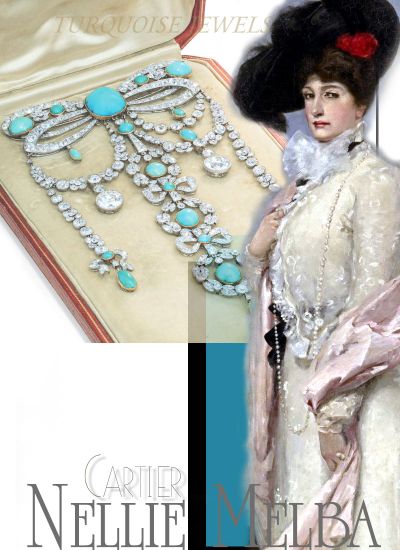
Dame Nellie Melba | BELLE EPOQUE TURQUOISE AND DIAMOND BROOCH| Noble Jewel History
From the collection of 1861-1931 Nellie Melba:
Belle époque TURQUOISE AND DIAMOND BROOCH
Cabochon turquoises, rose and old-cut diamonds, platinum and gold, 1910s, 16.0 cm, red Cartier case offered on auction at Geneve Nov 2019 by Christie’s Est. $250,000-350,000
BELLE EPOQUE TURQUOISE AND DIAMOND BROOCHES
Cabochon turquoises, rose and old-cut diamonds, detachable brooch fttings, with interchangeable central collets and additional half-pearl fittings , 1910s, 11.0 cm and 5.2 cm, red Cartier case
Christie’s will be offered in Geneve Nov 2019 this jewelry $150,000-200,000
Grosser Kokoshnik Cartier Diamant Tiara | Granard Juwelen Schmuck| Beatrice Ogden Mills| Forbes Familien Juwelen|Countess of Granard Large Kokoshnik Cartier Diamond Tiara | Granard Jewels | Beatrice Ogden Mills|Forbes Family Jewel|Countess of Granard
Oben abgebildet, Beatrice Mills, Countess Granard mit ihrem großen Diamant Kokoshnik, aus dem Jahr 1937.
Einem wahrhaft prächtigen Diadem mit orientalischer Inspiration, der für sie, bei CARTIER angefertigt wurde. Seine geschwungene Linie wird durch parallele Reihen betont. Brillanten, Diamanten und birnenförmige Steine von hohem Wert sind in das Design integriert; einige sind Altschliff, sowie alte grosse Diamanten, die müssen aus der Sammlung der Familie Granard stammen. Sie war Stammkundin von Cartier London und eine der letzten großen Käuferinnen eines Kokoshniks. Sie bestellte einen Kokoshnik im Jahr 1922, einen anderen 1923 und einen dritten Kokoshnik 1937 – den letzten, oben im Bild, für die Krönung von König Georg. Beatrice Countess von Granard 1883-1972, geboren als Beatrice Mills, Tochter des großen amerikanischen Financier und Bankiers Ogden Mills.
Eine berühmte Gastgeberin, Rennstallbesitzerin und Pferde-Züchterin, die als erste Frau den Grand Prix gewann, Sie heiratete 1909 den 8. Earl of Granard. Sie lebte zwischen London, Paris und Castle Forbes in Irland.
Sapphire Cabochon and diamond curb chain bracelet presented by the Emperor and Empress of Imperial Russia Wedding gift of the Czar| Sapphire Cabochon and diamond brooch| Romanov Present Royal Gifts| Royal Jewels Queen Mary England
Duchess of Connaught, the third son of Queen Victoria married Princess Louise of Prussia. The Queen gave a magnificent diamond tiara, brilliants hanging down in sparkling peaks from a central wreath of brilliants of pure water in Indian style with emeralds.
On 2 March 1879 Queen Victoria recorded in her journal that she had told her son, Arthur, Duke of Connaught, she would give his wife to be, an Indian diadem. Then on 12 March 1879 Queen Victoria described showing her gifts to the bride and others, again referring to an Indian diadem.
The Duchess was pictured, with the royal tiara, only one time in 1893, see above, and give it later to her daughter Princess Patricia of Connaught.
In 1911, the Duke was appointed Governor General of Canada. Princess Patricia accompanied her parents to Canada, and she became popular there, on those occasion she wore her mothers wedding gift, the Indian diamond tiara as stomacher, without the center, of a movable ornament like a sarpech on top, with hanging emerald drop.
Sarpech, also known as an aigrette is a turban ornament that was worn by significant Hindu and Muslim princes.
Princess Patricia of Connaught | Indian Diadem of Diamonds and Emeralds | Stomacher Brooch Royal Jewel | Wedding Gift from Queen Victoria
She had her own jewels and tiaras for royal events, because , her mother’s precarious health meant the unmarried Patricia often step in for her mother, as vice-regal hostess, especially during the Duke of Connaught’s tenure as Canada’s governor general from 1911 to 1916.
Schmuck und Juwelen der Deutsche Fürstenhäuser | Royal Jewels – Historical Jewerly and Treasure of Royals and Aristocracy | bijoux historiques| исторические драгоценности