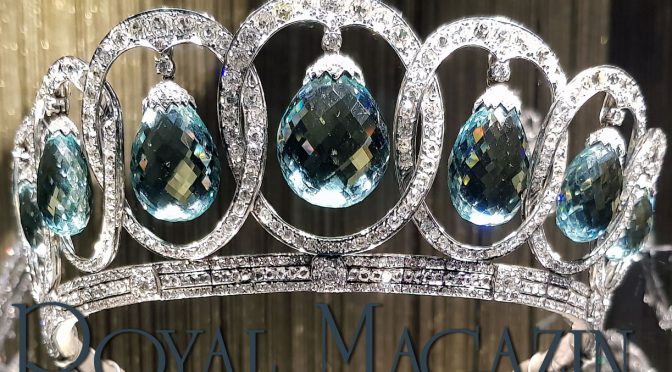
Diamond Tiara Francesca Somerset Lady Caroline Georgina Somerset Wedding Diamond Diadem English Nobel Jewel History Duke of Beaufort

Diamond Tiara Francesca Somerset | Lady Caroline Georgina Somerset Diamond wedding Diadem

England Great Britain U.K. United Kingdom of England Scotland Wales and Ireland English history Royal Jewellery & Aristocratic Jewels antique jewellery historian, Mountbatten, the Queen, crown jewels, Princess, windsor, house of windsor,
royal royalty royalfamily royaljewels diamond tiara queenvictoria duchess of york history england uk britain monarchy britishmonarchy britishroyals britishroyalfamily
Diamond Tiara Francesca Somerset Lady Caroline Georgina Somerset Wedding Diamond Diadem English Nobel Jewel History Duke of Beaufort
Duchess Louise of Sachsen-Coburg-Saalfeld, Mother of Prince Albert the consort of Queen Victoria, in her silver wedding gown, when she married in 1817.
„……this afternoon there was great court and dinner.
During the festivities the bridal jewelry of the Duchess Louise was also on public display…. and a poem was written about it. … The princess’s bridal trousseau, whose value is estimated at 100 000 Thlr., was on public display in the castle on the 16th and 17th. Of rare beauty was the massive silver toilet with its golden contents, the velvet and silk richly embroidered dresses, the linen etc………….“

„The magnificent bridal jewelry, which was recently added by the princess aunt Grand Duchess Anna Feodorovna with a splendid brilliant necklace, was particularly outstanding.“
It could be the diamond belt and the border of diamond loops along the neckline. One counts, 17 entwined diamond rings and the other with 15 entwined smaller diamond ornaments.
An example of this, in the picture the link band of seven intertwined rings, set with approx. 722 diamonds in different historical cuts, as Peruzzi cut diamonds, Mazarin, pear shaped. Originally probably part of a tiara, which is also indicated by the mounting holes in the setting, which was sold a few years ago from a German ducal estate.
We see on the portrait of the Duchess Louise:
a diamond necklace with 9 drop pearls is still remarkable, as are the diamond and pearl earrings each with 3 large drop pearls. In addition, a diamond diadem of 14 visibly upright diamond ears and a diamond and pearl comb, behind it.
More history:
Shortly before her death in August 1997, Diana requested that the dress be sold in a charity auction. Florida-based businesswoman Maureen Dunkel bought it for £100,000 in New York in June 1997, along with nine other dresses formerly owned by the Princess.
The Travolta dress was the most expensive one sold at the auction. When she went bankrupt in 2011, Dunkel was forced to put them up for auction, but the Travolta dress was one of six that were not sold It was finally auctioned off by Kerry Taylor in London on 19 March 2013, fetching £240,000 ($362,424) and again being the most expensive auctioned dress. It was bought by „a British gentleman as a surprise to cheer up his wife“.
In 2019, it sold for £264,000 ($325,317) to Historic Royal Palaces a charity which looks after royal memorabilia including clothing and artifacts. The dress has joined the Royal Ceremonial Dress Collection and belongs to the palace.

Designed for the Princess by fashion designer Victor Edelstein, this striking midnight blue dress is now on public display at Kensington Palace to celebrate the reopening of the palace this summer.
The midnight blue velvet gown became legendary when the Princess wore it to a White House Gala in 1985 and took to the dancefloor with John Travolta. Images of the Princess and the Hollywood actor dancing together made headlines around the world, securing a place in fashion history for the stunning gown
Following over four months of closure during lockdown, Kensington Palace will be reopening its doors once more to welcome visitors from Thursday, 30 July. To celebrate the re-opening, the famous ‘Travolta dress’, worn by the late Diana, Princess of Wales, will go on display at the palace for the first time since it was acquired by Historic Royal Palaces at auction in 2019.
The midnight blue velvet gown, designed by Victor Edelstein, became legendary when the Princess wore it to a White House Gala in 1985 and took to the dance floor with John Travolta. Images of the Princess and the Hollywood actor dancing together made headlines around the world, securing a place in fashion history for the stunning gown. In 2019, it was acquired by independent charity Historic Royal Palaces and has somewhat fittingly been in conservation ‘quarantine’ ever since, to protect it for posterity. Like Kensington Palace itself, the dress is now coming out of isolation, and will be on display at the Princess’s former home this Summer for visitors to enjoy.
Famously the birthplace of Queen Victoria, Kensington Palace has been a royal residence for over 300 years. Lavish Georgian parties were held within its spectacular state apartments in the eighteenth century. A hundred years later, in 1837, a young Princess Victoria woke up at the palace to the news of her accession to the throne. In recent years the palace has been home to Princess Margaret – sister of HM Queen Elizabeth II – and Diana, Princess of Wales. It is currently the London home of TRH The Duke and Duchess of Cambridge.
The palace closed in March 2020 in response to the Covid-19 pandemic and has since been quiet, with the shutters of its famous galleries closed to protect the remarkable collections on display. Palaces staff have returned to Kensington this week to gradually ‘reawaken’ the palace and install and array of new measures to ensure returning visitors feel safe. Hand sanitiser dispensers and social distancing signage have been installed across the site. Visitors are asked to book in advance, to help Historic Royal Palaces manage capacity, so visitors can enjoy their time at court with plenty of space. The State Apartments and the rooms Queen Victoria grew up in will both be open, with visitors asked to follow a one-way route through the palace.
Historic Royal Palaces, the independent charity that cares for Kensington Palace, is hoping visitors will show their support for its national treasures by returning for a visit this Summer. The charity is dependent on visitor income and facing a £98 million shortfall in its finances following the pandemic. The return of visitors will make a vital contribution to the charity’s work caring for Kensington Palace and sharing its stories with the public.
Sam Owen, Head of Kensington Palace, said,
‘We are delighted to be welcoming visitors back to the palace again this Thursday. Kensington Palace was built to be enjoyed by hundreds of people and it’s been sad to see it so quiet over the past couple of months. Myself and the team can’t wait to welcome visitors back again and give them a suitably royal welcome. We’ve never needed their support more – each visit is an important contribution to help us maintain this wonderful building for generations to come.’
Diana Princess of Wales Sapphire and Diamond Cluster Brooch Choker| Royal Jewels History
The gown both for day and evening wear depend on for their effect their perfect cut, rather than on costliness of material. The trousseau includes several useful tailor-built gowns, one of navy serge with open jacket worn over a fawn-coloured Tattersall vest; another of gendarme blue home-spun, and third of brown-fleoked Scotch tweed, which is being made near the bride’s Highland home by a lady who enjoys the patronage of Royalty, was specially charmed with Cuttle Russian coat of gendarme blue cloth, with big square collar and revers sable and quaint strap fastenings on the bodice. The basque was attached to a ribbon belt fastened with buckle of oxidized silver. Cozy wrap of fawnooloured serge was lined through with gray squirrel fur and bordered with soft brown bear fur. The high collar was cut in one with the cloak.
Quaint Spanish buttons of old silver were used on the bodice of useful little gown black diagonal with bands of crimson velvet the skirt and a crimson velvet vest.
For her wedding journey tho Isle of Wight the future Lady Bathurst has selected dress and coat of brown hopsack tweed. The skirt has border of mink and a band petunia-coloured mirror velvet covered with brown passementerie. The bodice has square yoke back and front of the petunia velvet, edged with passementerie. Both coat and skirt are lined with petunia-red shot silk. A large picture hat of brown velvet with plumes of ostrich tips on the left side is to be worn with the dress. Most the future Countess Bathurst’s evening gowns are guiltless of trains, these appendages not being much approved by the sensible and practical young lady.
Among these gowns is a charming dinner dress of white silk, powdered with tiny pink flowers. The hem flounce is run on green and pink baby ribbon, which is knotted here and there, and the bodice and Empire sash are trimmed with gold enamel trimming. A dainty gown of blue moiré has the skirt trimmed with donkey ear bows blue velvet and bands of velvet covered with passementerie of white and colored pearls, the bands forming deep point in front. Another evening dress of de Nil armor silk, with a double flounce of embroidered chiffon arranged pagoda-wise the skirt.
A very pretty Whatteau tea gown in light yellow, has points caught with a rosette on the train and the slight train falls from 8 rosettes between the shoulders. A charming little tea gown in rise pink Lilac silk has full front the silk circled with a quaint chain girdle and clasps of oxidized silver. Dainty dressing gowns, heaps of pretty lingerie, and a variety of headgear were among the wedding finer v displayed in the young bride’s pretty sitting room near the top of Sir Algernon’s high house in Piccadilly, the windows which command magnificent view over the green park.
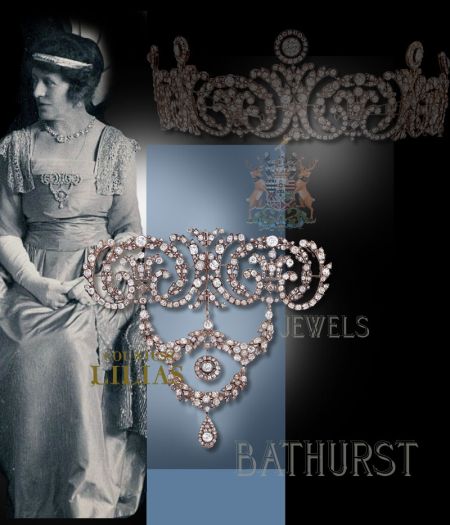
Above in the picture: Lilias, Countess Bathurst
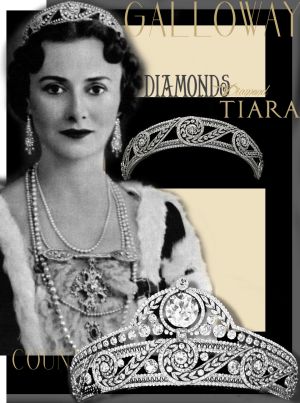
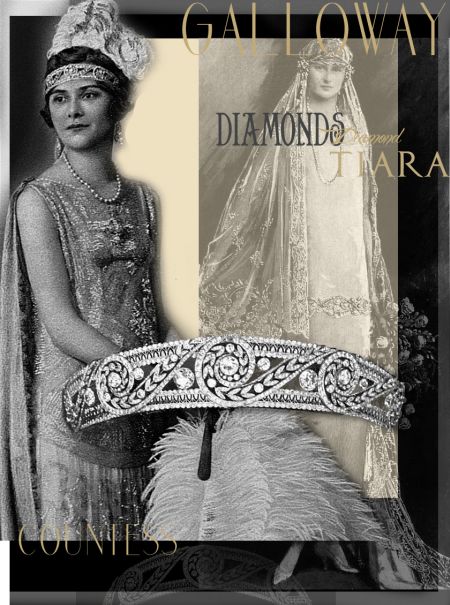
The most valuable piece from the collection of Countess Bathurst, is an early 20th Century Diamond Tiara, commissioned from Cartier by Lilias, Countess Bathurst (1871-1965).
Made from old and rose-cut diamonds, silver and gold, (circa 1910) the stones were taken from two tiaras, Countess Bathurst inherited from her mother Lady Glenesk.
The tiara and the preceding corsage brooch, is the epitome of aristocratic splendor and the delicate Belle Époque scrolling motifs were inspired by 18th century architectural details.
Compared to many Victorian tiaras with their often heavy style of mounting and high surmounts this early 20th century example must have felt comparatively ethereal, and it is not surprising that Gloria Bathurst clearly enjoyed wearing it and was photographed wearing this beautiful head ornament on various grand occasions.
<iframe width=“560″ height=“315″ src=„https://www.youtube.com/embed/gKoHTgpIIOI“ frameborder=“0″ allow=“accelerometer; autoplay; encrypted-media; gyroscope; picture-in-picture“ allowfullscreen></iframe>
Turquoise centre and diamond floral scroll brooch

Turquoise and diamond ornament brooch| Royal Wedding gift from the Prince and Princess of Wales to Princess Mary of Teck.
The jewel was a wedding gift in 1893 from Queen Mary’s in-laws, the Prince and Princess of Wales, later King Edward VII and Queen Alexandra.
The center of the ornament is a large round turquoise cabochon, surrounded from 14 diamonds.
Above on the left in the picture, Queen Mary wearing the Turquoise Diamond Cluster Brooch with a pendant, it looks like one of the „chips“, the smaller parts of the Cullinan Diamonds.
After her death, in 1953 the turquoise brooch, was inherited by her granddaughter, Elizabeth II.
Queen Elizabeth II, wore the Turquoise and Diamond Brooch three times, at least on 5th April in 2020 when she had addresses to the UK and Commonwealth in a special broadcast recorded at Windsor Castle.
More History:
https://royal-magazin.de/england/Queen-mary-wedding-present-POW-turquoise-ornament.htm
Queen Mary |Royal Wedding Gifts and Marriage Presents
.
.

Queen Mary’s Turquoise Brooch, wedding gift of the Prince and Princess of Wales. Worn in 2024 Ascot – Queen Camilla – heirloom of the Queen.
She wore it with a pair of turquoise and diamond earrings, in horseshoe design, with double row of diamonds.

Jewels given to Princess Alice, Duchess of Gloucester as wedding presents:
Queen Mary’s Teck Turquoise Parure
Above the Alice Duchess of Gloucester in 1953 wearing the Resille Diamond Fringe Necklace with Turquoises

Also from the Teck Turquoise Parure, two of the bow brooches with turquoises and diamonds. The Turquoise Diamond Parure and die Turquoise Diamond Cluster Necklace and matching earrings with Turquoise and Diamonds
More history about the Royal Turquoise Jewelry:
The King himself oversaw the design of his coronation robes, including the crimson velvet surcoat and a stole made from cloth of silver, gold thread and silk, embroidered with the national flowers of the United Kingdom. Sir Thomas Lawrence’s coronation portrait shows the King in his ceremonial clothing with the Imperial State Crown, traditionally remade for the coronation of each new monarch, placed on a table to his right.
The crown, see below in the picture, was set with more than 12,300 diamonds that had been hired for the occasion.

George wanted to keep the crown after the ceremony, but Parliament refused to support the cost. The King therefore commissioned a gilt-bronze cast of the Imperial State Crown, which is on public display for the first time.
The Diamond Diadem, designed for George IV’s coronation by the jewellers Rundell Bridge & Rundell, is set with 1,333 diamonds, including a four-carat pale yellow brilliant.
Openwork silver frame lined with gold and set transparent with diamonds; narrow band edged with pearls, surmounted by four crosses-pattée, the front cross set with a pale yellow brilliant, and four sprays representing the national emblems of the United Kingdom, incorporating the national emblems of England, Scotland and Ireland,Rose – Shamrock-Thistle – Daffodil.
This feminine association belies its origin, since it was made for George IV’s use at his famously extravagant coronation in 1821. On that occasion, he wore it on top of a large velvet ‚Spanish‘ hat surmounted by ostrich feathers, with a curled wig beneath, at the ceremonies in Westminster Hall and during the walking procession to Westminster Abbey.
The order for the diadem was placed with Rundells in 1820 and work was complete by May of that year.
The design, probably by Rundells‘ chief designer Philip Liebart, reflects something of the discarded plan for George IV’s Imperial State Crown, which was drawn up by Liebart in the same period and was to have included the national emblems in place of the traditional fleurs-de-lis.
Together with a diamond-studded loop (which was broken up to help make Queen Victoria’s Garter armlet) the bill for the diadem amounted to the large sum of £8,216.
This included an £800 hire charge for the diamonds – stones were regularly hired for use at coronations up to 1837 – computed on a percentage of the value of the stones.
When the coronation had to be postponed for a year on account of Queen Caroline’s trial, a further hire charge was levied. Normally the stones would have been returned to Rundells after the coronation, but in this case there is no sign that the delicately worked diamond sprays and crosses, a masterpiece of the new transparent style of setting, have been disturbed. Equally, there is no evidence that the King purchased the stones outright, so it could be that the bill was met by a discreet barter of old stones from George IV’s extensive collection.
Today the diadem is worn by Her Majesty The Queen when travelling to and from the State Opening of Parliament.
At the coronation banquet, works were displayed from the Grand Service, an unrivalled 4,000-piece collection of dining and buffet silver-gilt that George first commissioned when Prince of Wales and is still used today at State Banquets, see below.

A spectacular silver-gilt tray by goldsmith Paul Storr for Rundell, Bridge & Rundell, weighing over 9kg and engraved with the Royal Arms and the Prince of Wales’s coronet, was put on show prominently behind the King, In the picture above.
George acquired works of art with abandon to decorate his residences, and these remain some of the greatest items in the Royal Collection.
As Prince of Wales, he lived at Carlton House on London’s Pall Mall. Within ten years of taking possession of the mansion in 1783, he had run up debts of around £400,000, furnishing the rooms with paintings, the finest French furniture and decorative arts, and creating a series of interiors that were widely regarded as among the most handsome in Europe.
One of the highlights of his Kunstkammer is the Nautilus cup and cover by Nikolaus Schmidt, which stands at more than half a metre in height. This unusually large shell is elaborately mounted with silver-gilt figures of Jupiter, Neptune, a mythical sea creature called a hippocamp and four double-tailed mermaids playing instruments. In his library at Carlton House, George read voraciously on topics ranging from geography and military history to the work of Jane Austen.
The Times wrote, ‘there never was an individual less regretted by his fellow creatures than this deceased King’, while the Duke of Wellington called him ‘the most munificent patron of the fine arts’ and ‘the most accomplished man of his age’. On the one hand, George was a recklessly profligate showman, who had little regard for the hardships suffered by the rest of the country, and on the other, he was a connoisseur with intellectual interests, whose passion for collecting left a great artistic legacy.
Through more than 300 works from the Royal Collection,
George IV: Art & Spectacle sheds new light on this monarch of extreme contrasts.
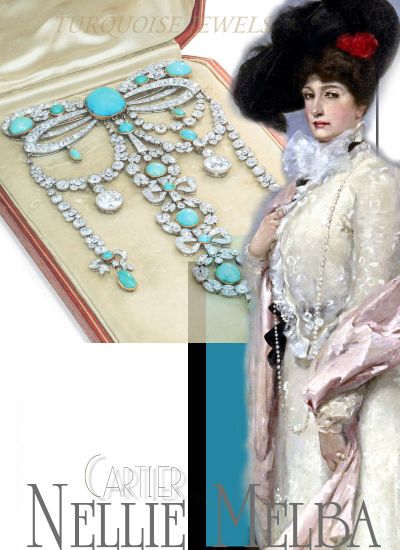
From the collection of 1861-1931 Nellie Melba:
Belle époque TURQUOISE AND DIAMOND BROOCH
Cabochon turquoises, rose and old-cut diamonds, platinum and gold, 1910s, 16.0 cm, red Cartier case offered on auction at Geneve Nov 2019 by Christie’s Est. $250,000-350,000
Click for more history: