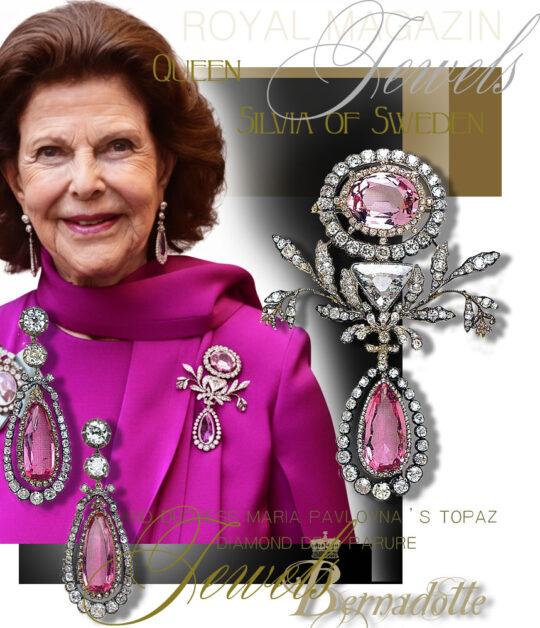
Grand Duchess Maria Pavlovna’s Pink Topaz and Diamond Demi Parure| Queen Silvia of Sweden’s|Bernadotte Royal Jewels

Russia | Imperial Court Russian Families Royal Jewellery & Aristocratic Jewels Jewelry
(basierend auf den historischen Aufzeichnungen, Auktionskatalogen Christie’s/Sotheby’s/Wartski und der üblichen Sekundärliteratur)
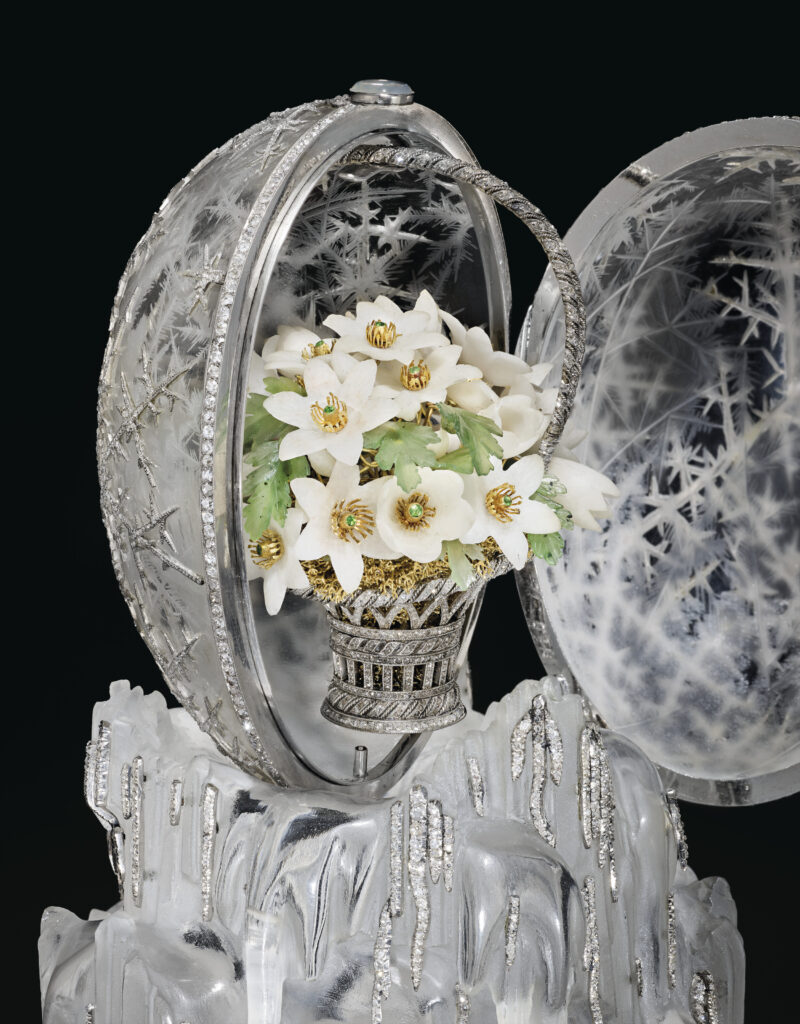
IMPERIAL WINTER EGG
Fabergé, Entwurf Alma Theresia Pihl – Werkstatt Albert Holmström, St. Petersburg, 1913
Das Winterei von 1913 gehört zu den ungewöhnlichsten Kreationen der kaiserlichen Fabergé-Werkstätten. Die Komplexität, die technische Meisterschaft und die poetische Umsetzung des Themas „Schnee, Eis und Frühjahr“ machen es zu einem absoluten Höhepunkt des Hofjuweliers.
Der Innenmechanismus trägt einen zarten, doppelt gebänderter Platin-Korb, vollständig besetzt mit Rosenschliffdiamanten.
Darin:
Der Boden der Überraschung ist graviert: FABERGÉ 1913.
Überraschung: 8,2 cm (3 ¼ in.)
Ei mit Sockel: 14,2 cm (5 ⅝ in.)
1913
Kommissioniert von Kaiser Nikolaus II. als Ostergeschenk für seine Mutter Zarinmutter Maria Fjodorowna.
St. Petersburg, 13. April 1913. Preis 24.600 Rubel.
1913–1917
Privatsammlung der Zarinmutter, Anitschkow-Palast, St. Petersburg.
September 1917
Vom Provisorischen Gouvernement zur Kreml-Waffenkammer überführt.
1922
Durch die Sonderkommission für Schmuckwerte ausgewählt und an Gokhran, Moskau, übergeben.
1929–1933
Von Wartski, London(Snowman der Schwiegersohn, gehörte zu den wenigen Pionieren, die zwischen 1927 und 1933 Einkäufe bei der sowjetischen Regierungsabteilung, dem sogenannten Antiquariat, tätigten), in der sowjetischen Verkaufsperiode erworben (Preis £450).
1934
Erworben von Napier Sturt, 3rd Baron Alington (Preis £1.500).
1934–1948
Sammlung Sir Bernard Eckstein.
1949
Nachfolgerverkauf: Sotheby’s London, 8. Februar 1949, Lot 128 (Preis £1.870).
Erworben für die Sammlung Arthur Bryan Ledbrook.
1974
Nach dessen Tod im Besitz eines Trusts.
1994
Christie’s Genf, 16. November 1994, Lot 464.
Zuschlag CHF 7.263.500 — Weltrekord für Fabergé.
2002
Christie’s New York, 19. April 2002, Lot 150.
Zuschlag $9.579.500 — erneuter Weltrekord.
ab 2002 (inoffiziell)
Zuschlag an Sheikh Saud bin Mohammed Al-Thani (Qatar).
Gerüchte seit Jahren: Werk möglicherweise nie bezahlt und nie abgeholt → Christie’s verbleibt wirtschaftlicher Eigentümer.
2025
Christie’s London, 2. Dez. 2025, Lot 7.
GBP 22,895,000 Verkauf als Teil einer „Princely Collection“ an Wartski nach 100 Jahren ….
A Masterpiece of Alma Theresia Pihl and the Holmström Workshop
St Petersburg, 1913
Commissioned by Emperor Nicholas II as his Easter gift to his mother, the Dowager Empress Maria Feodorovna, the Imperial Winter Egg stands among the most poetic and technically sophisticated creations of Carl Fabergé’s ateliers. Conceived by the young designer Alma Theresia Pihl and executed in the celebrated workshop of Albert Holmström, it is a triumph of imagination, virtuosity and symbolic refinement.
Carved from a single block of rock crystal, the egg reveals a delicately frosted interior, suggesting winter light caught beneath a thin layer of ice. The exterior is adorned with a constellation of platinum snowflakes set with rose-cut diamonds and two vertical diamond-set borders cleverly disguising the hinge. At its apex sits a cabochon moonstone engraved with the date 1913, a subtle reminder of the Romanov tercentenary.
The egg rests upon a sculptural block of melting ice, also carved in rock crystal, its surface enlivened with flowing platinum rivulets set with rose-cut diamonds. A central platinum pin rises from the base to support the egg with absolute precision.
Suspended within is one of the most enchanting surprises in the Fabergé oeuvre:
a double-handled trelliswork basket in platinum, entirely pavé-set with rose-cut diamonds. It overflows with lifelike wood anemones carved from white quartz, each with gold wire stamens and a demantoid garnet at its centre. The leaves, rendered in exquisitely shaped nephrite, emerge from a bed of finely modelled gold moss.
The base of the basket is engraved ‘FABERGÉ 1913’.


The Odyssey of an Important Sapphire: From Imperial Tiara to Royal Sautoir
In 2007 and 2011, I first wrote about the jewels on my website. Now, my research has added important new insights to their history.

The journey begins with a magnificent 311-carat egg-shaped sapphire, originally part of a tiara belonging to Empress Maria Alexandrovna of Russia. This tiara and its sapphires were later in the possession of her son, Grand Duke Vladimir Alexandrovich.

Grand Duchess Vladimir & Cartier’s Introduction (1908-1909):
In 1908, Grand Duchess Maria Pavlovna (née Duchess Marie of Mecklenburg-Schwerin), known as Grand Duchess Vladimir (wife of Grand Duke Vladimir Alexandrovich), discreetly inquired with Cartier in Paris about resetting a suite of these Romanov sapphires, likely mined in Ceylon. The sapphires had come to her husband’s side of the family, specifically from his brother Grand Duke Alexei Alexandrovich who died in 1908 and left the parure to his brothers Grand Duke Paul and Grand Duke Vladimir.

Cartier’s ledgers note discussions about using the sapphires for a sautoir or a modern diadem. The grand 311-carat cabochon sapphire was specifically mentioned.
By June 1909, the original tiara was dismantled, and Cartier received the sapphires. While other sapphires from Grand Duchess Vladimir’s collection were sold, the impressive 311-carat egg-shaped sapphire was retained by Cartier, with a note in their vault inventory about it being held „per Cartier option.“ A minor scratch on its pavilion was noted, to be concealed in any new setting.
Grand Duchess Victoria Melita Commissions the Sautoir (1911):
In March 1911, Grand Duchess Victoria Melita (née Princess Victoria Melita of Saxe-Coburg and Gotha), who was the wife of Grand Duke Kirill Vladimirovich (the son of Grand Duchess Vladimir), placed an urgent order with Cartier.
She commissioned a sautoir to feature the 311-carat sapphire (explicitly noted in Cartier’s ledger as „provenance GDV [Grand Duchess Vladimir] stock 1909“) alongside a newly acquired 35.12-carat Ceylon star sapphire. The design included 18 transitional diamonds and a platinum chain.
This sautoir was intended as a 15th-anniversary gift from her husband, Grand Duke Kirill. Cartier cleverly suspended the 311-carat gem as a pendant, concealing the previously noted scratch. The piece was delivered by May 1911 – learn more, take the link in bottom.
Revolution and a Sister’s Support:
After the Russian Revolution in 1917, Grand Duchess Victoria Melita fled Russia, managing that her maid brought the jewels to her from the vault, while she was in exile.
At some point later, Victoria Melita sold the sautoir to her sister, Queen Marie of Romania.

A Royal Wedding Gift to Princess Elisabeth (1921):
In 1921, Queen Marie of Romania gifted this historic Cartier sautoir, featuring the 311-carat Romanov sapphire, to her daughter, Princess Elisabeth of Romania (Victoria Melita’s niece), for her marriage to Prince George of Greece (who would later become King George II of Greece).
Princess Elisabeth (later Queen of Greece) retained the sautoir even after her separation.
Following her death in 1956, the necklace „vanished into the private market.“
Today, this magnificent sautoir, a testament to Romanov splendor, Cartier’s artistry, and tumultuous royal lives, resides in a Swiss private collection and is occasionally loaned for prestigious exhibitions.

Princess Yusupova sunburst tiara featuring a radiant sun motif made by CHAUMET in 1914

Diadème soleil articulé réalisé par Chaumet en 1914 pour la princesse Youssoupoff née princesse Irina de Russie, Irina Aleksandrovna Yusupova

…..long emerald „pendentifs“ hanging on both sides of her face. Some superb emeralds and diamonds completed her attire…..the round emeralds were from the collection of his mother-in-law Infanta Eulalia of Spain.
Princess Elisabeth of Hesse and by Rhine daughter of Ernst-Ludwig, last Grand Duke of Hesse and by Rhine, and Princess Victoria Melita of Saxe-Coburg-Gotha


What’s happened about this treasure…..
The 32 Faberge Easter Eggs in Detail from the Collection of Princess Elisabeth of Hesse
A mystery is solved about a part of the Romanov Crown Jewels:
More about the history of an extraordinary necklace, from the Russian Empresses to the heiress and ambassadress Mrs Thompson-Biddle in Paris.


Mrs Margaret Thompson Biddle, an american heiress and wife of the Ambassador Anthony Drexel Biddle Jr.
Mrs. BIDDLE Paris 1948 Opera l’O.N.U le president de la Republique, des ministres, des ambassadeurs— the press noted:
La plus belle rivière de diamants de l assemblée. Fourreau de velours noir brodé de strass de Balenciaga.
«Leurs» robes et «leurs» bijoux
LA BARONNE SELLIERE. — Brocart bleu et blanc, rivière et bracelets de diamants.
LA PRINCESSE DE FAUCIGNY-LUCINGE. — Tout en noir ; n’a pas quitté son chapeau (tyrolien à plumes) ni sa cape de zibeline. Pas de bijoux.
Mrs. BIDDLE. — La plus belle rivière de diamants de 1 assemblée. Fourreau de velours noir brodé de strass de Balenciaga.
LA DUCHESSE DE MAILLE. — Jupe de tulle et corselet bleu saphir sans épaulettes. Triple collier d’émeraudes et diamants
LA COMTESSE DE CASTELLANE. — Satin noir à épaulettes, triplé rang de perles.
Mme VOLTERRA. — Satin noir broché or, pendante et bracelets de diamants. Cheveux « hermine rosée ».
LA PRINCESSE GALITZINE. — Velours noir, cheveux argentés, toutes les bagues au même doigt.
LA COMTESSE DE POLIGNAC (Jeanne Lan vin Junior). — Cheveux cendrés, fourreau velours noir et satin vert ; pas de bijoux.
ANNABELLA. — Long fourreau blanc à « cornichons » d’or ; bracelets de diamants.
PRALINE (Miss Cinémonde). — Fourreau de satin gris acier brodé par Balmaln, longue cape de renard blanc.
Patricia ROC. — Justaucorns de tulle nègre et jupe de tulle blanc, pas de bijoux, cheveux argent.
Espanita CORTEZ. — Mantille de dentelle noire (naturellement), cape de renard platine et fourreau de satin noir.
IA DUCHESSE DE PREMIO REAL. — Tulle blanc et dentelle noire, pendentif et collier de diamants.
Mme CONSTANTIN ESCO. — Moire périnée de mauve et blanc (de Jacques Fath), avec une lourde parure de rubis et diamants.
Josette DAYDE. — Gorgerette et fourreau de satin gris.
Renée SAINT-CYR. — Cheveux flous sur les épaules, cape de renard platine.
Maria MONTEZ. — Robe de mousseline bayadère bleu et blanc, cheveux coupés court* sur les oreilles, pas de bijoux.
Mme FRANCHOT TONE. — Fourreau noir à revers de satin rose au corsage sans épaulettes, étole de satin rose et coiffure très américaine avec frange du plus franc blond platine.
Maureen O’HARA. — Robe de style en dentelle vert émeraude, cheveux rouge sang, maquillage pâle, pa* de bijoux.
Germaine ROGER. — Robe de satin framboise et boléro de renard bleu.


