„Two sprays of mixed flowers, entirely pavéd with diamonds, meet at the large, open wild rose in the center. The sprays can also be worn as brooches. The diamonds, set in flowers, are recorded in the Heathcote inventory of 1786and have descended in the same family since
Ancaster Heathcote Diamond Tiara | Jewellery | Willoughby d’Eresby Two sprays of mixed flowersAncaster Heathcote Diamond Tiara | Jewellery | Lady Willoughby d’Eresby
Gladys Vanderbilt Wedding Jewels| Countess Gladys Szechenyi | Important large Diamond of 62,09ct Diamond Necklace |Imperial-Royal Austria Hungary Jewel History Harry WinstonAmethyst Tiara Cartier Tiara Gladys Vanderbilt Wedding Jewels| Countess Gladys Szechenyi | Important large Diamond Amethyst Choker |Imperial-Royal Austria Hungary Jewel HistoryAmethyst Tiara Cartier Tiara Gladys Vanderbilt Wedding Jewels| Countess Gladys Szechenyi | Important large Diamond Amethyst Choker |Imperial-Royal Austria Hungary Jewel HistoryCartier Choker Stomacher Vanderbilt Gladys Vanderbilt Countess Szechenyi-Vanderbilt, Devante de corsage belle epoque stomacher, garland stomacher, with Amethysts, February birthday gemstones, Cartier Dog Collar|Collier de Chien
Gladys Moore Vanderbilt’s Cartier Diamond and Amethyst Tiara – and its Surviving Fragment
When Gladys Moore Vanderbilt (1886–1965), the youngest daughter of Cornelius Vanderbilt II and Alice Gwynne Vanderbilt, married Count László Széchényi of Hungary in 1908, her wedding became one of the most celebrated unions of the Gilded Age. To mark this transatlantic marriage, Alice Vanderbilt commissioned Cartier to create a magnificent diamond and amethyst tiara in the Belle Époque style.
The jewel was conceived as eight delicate sprays of lilies, rising gracefully above the bandeau, each set with old-cut diamonds. The innovative design allowed for interchangeable drops: either pear-shaped amethysts or similarly shaped diamonds could be suspended from the sprays, altering the tiara’s appearance according to occasion and fashion.
This tiara was more than a personal adornment; it symbolised the Vanderbilt family’s ambition and their determination to translate American industrial wealth into European aristocratic prestige. Gladys, one of the last of the great American heiresses of her generation, embodied this transfer of fortune and status across the Atlantic.
In the years that followed, the tiara was eventually dismantled-a fate not uncommon among great jewels of the period, as changing styles and inheritance divided once-cohesive parures into smaller, wearable pieces. Yet fragments survived, carrying with them echoes of their original splendour.
One such surviving jewel has now resurfaced: a Cartier diamond brooch, designed as a single lily spray, set with an old-cut pear-shaped diamond weighing 4.55 carats. Originally part of Gladys Vanderbilt’s tiara, the brooch retains the elegance of Cartier’s Belle Époque craftsmanship and stands as a rare tangible relic of the Vanderbilt legacy.
In November 2025, this brooch will be offered at auction in Geneva. Its reappearance not only revives the story of Gladys Vanderbilt’s celebrated wedding gift but also highlights the enduring allure of jewels that once served as instruments of social power, familial aspiration, and transatlantic identity.
In March 1912, Countess Széchenyi’s jewelries worth $200,000 ($8 million today) was stolen from her town residence in Budapest, the detective afterward found the jewels in a motor car garage, where they had been hidden by being wrapped in a piece of newspaper behind a barrel.
The tiara was divided between her children:
Countess Cornelia „Gilia“ Széchényi de Sárvár-Felsövidék 1908–1958 Eugene Bowie Roberts 1898–1983
Countess Alice „Ai“ Széchényi de Sárvár-Felsövidék 1911–1974 Countess Béla Hadik
Countess Sylvia Anita Gabriel Denise Irene Marie „Sylvie“ Széchényi de Sárvár-Felsövidék 1918–1998 Countess Antal Szapáry von Muraszombath Széchysziget und Szapar
Countess Ferdinandine „Bubby“ Széchényi de Sárvár-Felsövidék 1923–2016 Countess Alexander E. Eltz
Through her eldest daughter, Cornelia, she was the grandmother of three – Gladys Vanderbilt Roberts (b. 1934), Cornelia Roberts (1936–1982), who married Count Hans-Heinrich von Coudenhove-Kalergi (1926–2004), and Eugene Bowie Roberts, Jr. (1939–2020).
Through her daughter Alice, she was grandmother to Count László Hadik von Futak (1932–1973) and Count János Hadik von Futak (1933–2004).
Through her daughter Gladys, she was the grandmother of Christopher Denys Stormont Finch-Hatton, the 16th Earl of Winchilsea (1936–1999) and the Hon. Robin Finch-Hatton (1939–2018).
Through her daughter Sylvia, she was the grandmother of Count Pál László Szapáry (b. 1950) and Countess Gladys Vanderbilt Szapáry (b. 1952).
Through her youngest child, Ferdinandine, she was the grandmother of Count Peter von und zu Eltz (b.1948) and Count Nicholas (Nicky) von und zu Eltz (1950–2012)
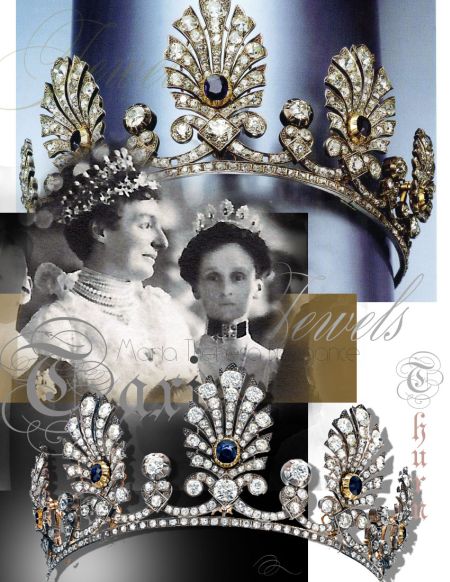
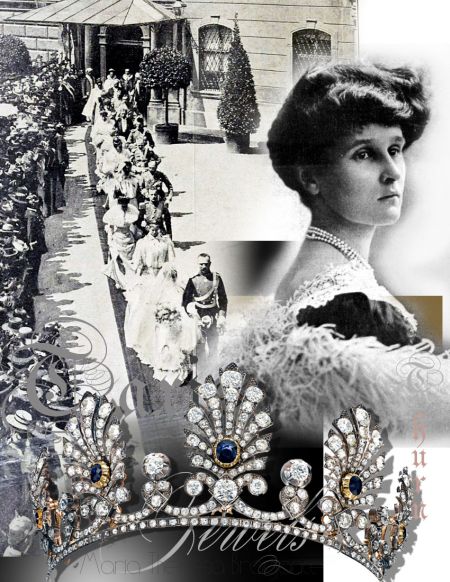
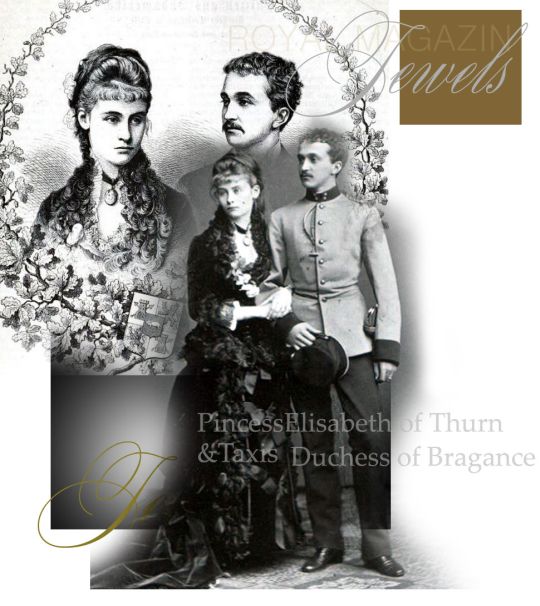
Royal Sapphire and diamond tiara |Palmette Diadem Princess Thurn & Taxis |Infanta Maria Teresa of Braganza| Princess Karl Ludwig Thurn and Taxis |Wedding
Königliche Hochzeit, Infantin Maria Theresa von Portugal Sapphire und Diamant Palmetten Tiara der Prinzessin von Thurn & Taxis | Maria Teresa von Braganza| Prinzen Hochzeit Braut Geschenk
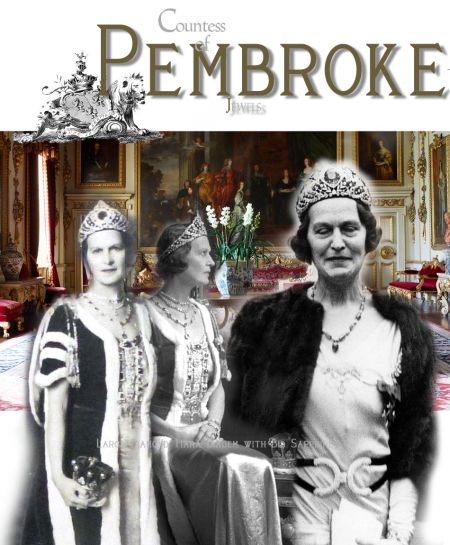
Large Sapphire and Diamond Diadem, Sapphire and Diamond Jewels, Pembroke Sapphires …… wedding gift to Lady Beatrice Paget when she married the heir of the Earl of Pembroke, Reginald Herbert, in 1903.
PembrokeTiara |Countess Pembroke | Lady Beatrice Herbert| Sapphire and Diamond Tiara | Jewel History
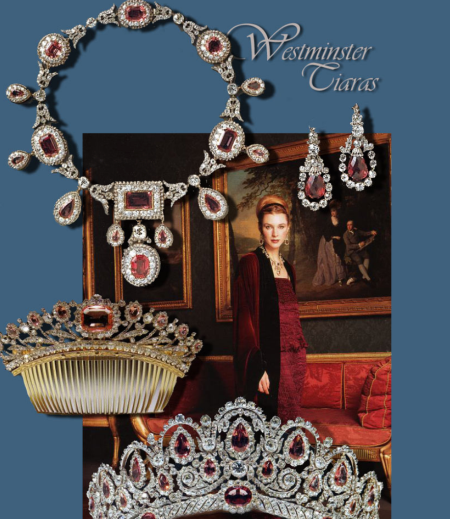
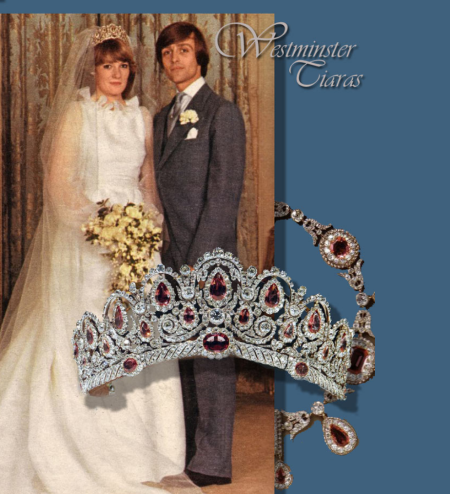
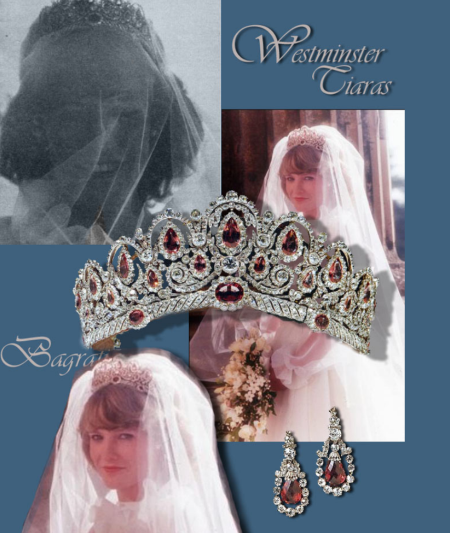
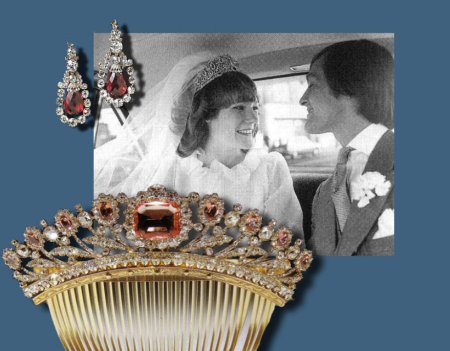
Princess Katharina Bagration pictured with a large cluster and diamond shoulder brooch, in the size of the center stone – in the spinel diamond comb of her spinel and diamond parure.
Probably she could change the stones and the spinel are wearable as single brooch.
Schmuck und Juwelen der Deutsche Fürstenhäuser | Royal Jewels – Historical Jewerly and Treasure of Royals and Aristocracy | bijoux historiques| исторические драгоценности