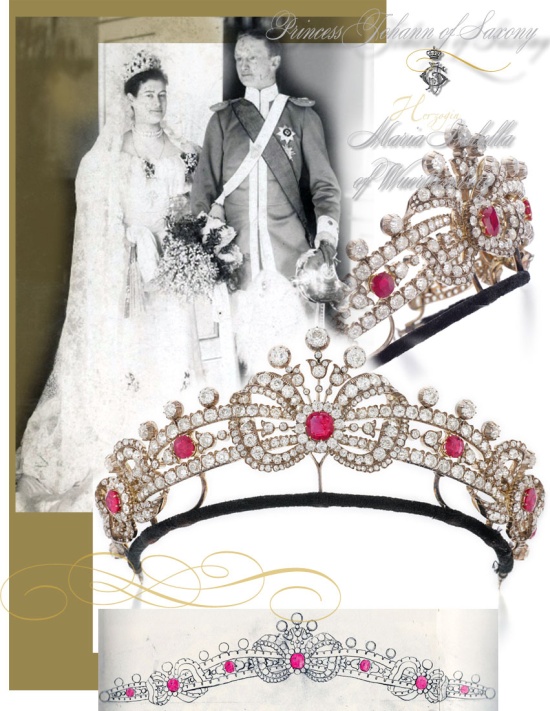
Princess Johann of Saxony-Duchess Isabella of Wuerttemberg, Duchess – Herzogin von Sachsen||Impressive ruby and diamond tiara ca 1896
The first wife of Prinz Johann Georg von Sachsen – Herzogin Maria Isabella von Württemberg on her wedding day.
Herzogin Sophie von Württemberg – Duchess Sophie von Wuerttemberg – tiara of the first wife of Princess Johann of Saxony-Duchess Isabella of Wuerttemberg, Duchess – Herzogin von Sachsen
This magnificent piece was subsequently passed down to her nephew, Albrecht Eugen, Duke of Württemberg (1895-1954).
Above we see his daughter, Duchess Sophie of Württemberg wearing the tiara in the 1960s and she wore it again in the 1990s.
It will be offered from Sotheby’s, at auction in the year 2023 „Vienna 1900 An Imperial and Royal Collection“ at Geneve.
Once formed over 150 kilometers deep within the Earth’s mantle, diamonds now glitter on many a ring finger. A recent study sheds light on how these precious gems made their way to the surface. Through geological clues and model simulations, researchers revealed how the breakup of tectonic plates led to volcanic eruptions that brought these „treasure-rich“ materials within our reach.
Diamonds are made of ordinary carbon, but what sets them apart from materials like coal is their purity and consistency. Naturally, their highly compact crystal structure can only form under immense pressure and heat in the Earth’s mantle, conditions found at depths over 150 kilometers. Over millions of years, diamonds were „baked“ in this extreme environment. The process of how they reached the Earth’s surface was roughly understood: diamond-bearing rocks melted due to geological processes, rose through fissures, and eventually surfaced during volcanic eruptions. The remains of these cooled volcanoes formed the deposits where raw diamonds are found today, typically embedded in a material known as kimberlite, named after the South African diamond-rich location, Kimberley. However, previous models couldn’t fully explain the origin of kimberlite melts deep within the Earth. It was evident that these processes were somehow linked to the restructuring of the Earth’s tectonic plates.
Unraveling the Mobilization Process
To investigate the geological processes leading to mobilization and kimberlite eruptions, the team led by Thomas Gernon from the University of Southampton delved into the matter. „The pattern of diamond eruptions is cyclic and follows the rhythm of supercontinents forming and breaking apart over hundreds of millions of years. However, until now, we didn’t know the process that suddenly brings diamonds to the Earth’s surface after resting 150 kilometers deep for millions or billions of years,“ says Gernon.
To gather new insights, the researchers analyzed the global correlation between the occurrence of kimberlites and the history of tectonic plate movements on Earth. They combined radiometric dating results with tectonic reconstructions, revealing that kimberlites formed over the past billion years typically erupted about 30 million years after the breakup of continental plates in the corresponding regions. This suggested an association with specific processes occurring at rift zones.
Hot Processes at Plate Boundaries
To shed light on the exact mechanisms, the team developed geological model simulations that provided a plausible picture of the processes. According to their explanation, a continental plate thins considerably over many millions of years before it breaks apart. This process, known as „rifting,“ causes the Earth’s surface to sink, eventually forming a rift valley. This is currently happening in East Africa, where the Rift Valley is forming. The model suggests that something similar occurs deep within the Earth: pieces of the underside of the plate sink into the mantle while hotter rock flows in from below to fill the void—similar to seawater on the surface. This incoming magma destabilizes the surrounding rock containing diamonds, turning the previously ductile material into a liquid that then rises upward. Eventually, through volcanic eruptions, it reaches the surface and solidifies into diamond-rich kimberlite.
Furthermore, the researchers can explain why volcanic eruptions with diamond-rich kimberlite can occur relatively far from the continental edges. These eruptions are also ultimately caused by plate breakup. Dynamic processes that extend far and wide occur during this process. „These flows along the underside of tectonic plates remove a considerable amount of rock, dozens of kilometers thick. This chain reaction ultimately reaches regions of the continents that are far from rift zones,“ explains co-author Sascha Brune from the German Research Centre for Geosciences (GFZ) in Potsdam.
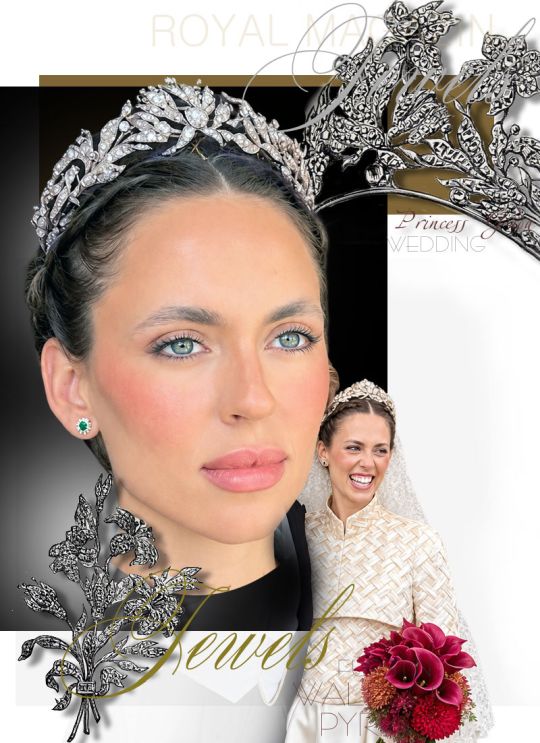
Flower and Leaf Tiara Diamond Diadem Heirloom of the Haus Bayern and Wittelsbach. The bridal tiara is first seen worn from Princess Franz, Prinzessin Isabella Croy after her marriage in 1912.
But it was a brooch earlier and the wedding gift from Princess Ernst Arenberg to her mother, The Duchess of Croy.
Princess Ernst Arenberg was : Prinzessin Sophie Auersperg 1811-1901 oo Fürst Ernst von Arenberg 1777-1857
Flower and Leaf Tiara Diamond Diadem Heirloom of the Haus Bayern and Wittelsbach. The bridal tiara is first seen worn on Princess Franz, Prinzessin Isabella Croy after her marriage in 1912. It was a large brooch earlier and the wedding gift from Princess Arenberg to her mother a Princess of Arenberg before the marriage to the Prince of Croy.Flower and Leaves Tiara Diamond Diadem Heirloom of the Haus Bayern and Wittelsbach. The bridal tiara is first seen worn on Princess Franz, Prinzessin Isabella Croy after her marriage in 1912. But it was a brooch earlier and the wedding gift from Princess Arenberg to her mother .
The diamond flower leaf tiara was later given to Princess Irmingard of Bavaria, her daughter. the tiara of the bride in the form of leafs branches and flowers was already worn by Prince Ludwig’s grandmother, Princess Irmingard of Bavaria, at her wedding in 1950.
Important Romanov Turquoises. The Russian empress Catherine the Great passed down a set of diamond turquoise jewels through the generations, Princess Louise of Prussia – the Duchess of Connaught to Princess Margaret of Connaught, Princess Ingrid of Sweden her daughter is the late Queen Ingrid of Denmark.
Princess Margaret is a maternal grandmother of Queen Margrethe and the paternal grandmother of King Carl-Gustav of Sweden.
That is how these jewels found their way to Queen Margrethe, see above with the older setting and the smaller ear pendants, and she gifted them to Crown Princess Mary in 2022 for her 50th birthday.
Princess Isabella’s Diadem The Turquoise Flower Tiara| Royal Jewels History Denmark The Turquoise Daisy Bandeau Tiara 18th birthday gift from Queen Margrethe ||Turquoise Earrings Queen Mary’s 50th birthday gift from Queen Margrethe
Wreath of rose buds and leaves, composed of the most superb brilliants. Princess Charlotte of Wales’s Royal Wedding in 1816 | Wedding Jewels Royal Jewels History The wedding dress of Princess Charlotte of Wales was worn at her wedding to Prince Leopold of Saxe-Coburg-Saalfeld on 2 May 1816 at Carlton House in London.
Wreath of rose buds and leaves, composed of the most superb brilliants. Princess Charlotte of Wales | Royal Wedding 1816 | Wedding Jewels Royal Jewels History
Princess Charlotte of Wales wedding gown from her marriage to Prince Leopold of Sachsen-Coburg, later King Leopold I. of Belgium in 2nd May 1816
Charlotte was the only child of George, Prince of Wales and Caroline of Brunswick; Leopold was the youngest son of Francis, Duke of Saxe-Coburg-Saalfeld and Countess Augusta Reuss of Ebersdorf.
THE DUCHESS OF ROXBURGHE DIAMOND TIARA Circa 1890, detachable and wearable as a necklace, bandeau, and choker. Estimate: $700,000 – 1,000,000 will be offered by Christie’s Geneva, in May!
Roxburghe Tiara | Fleur de Lys Roxburghe Tiara| Duchess of Roxburghe Tiara
Emeralds from the Sultan Abdul Hamid -Cartier-the Maharaja of Nawanagar -Princess Anastasia of Greece -Harry Winston to Mrs Heidi Horten
Muzo emeralds are found in the Muzo mines of Colombia.
Heidi Horten Important Jewels| Extraordinary Emerald and Diamond Necklace rectangular-shaped emerald 68.13ct Harry Winston| Royal Jewel History Famous Jewellery
The journey of the Sultan’s collection of muzo emeralds from its origins in the Ottoman Empire to its current place in the possession of Mrs. Heidi Horten has been a long and fascinating one. The emerald was initially part of a collection owned by Abdul Hamid II, the last sultan of the Ottoman Empire. When the sultan was forced to abdicate in 1909, his collection of gems was sold at auction in Paris, and his emeralds were purchased by Cartier.
Over the years, the emerald changed hands several times, eventually ending up in the possession of Harry Winston. In 1959, Winston purchased a collection of 17 emeralds from the Maharaja of Nawanagar, six of which were used to create a necklace that included the Sultan’s emerald.
Maharaja of Nawanagar emeralds Famous Emeralds – the emeralds of Abdul Hamid – Heidi Horten Important Jewels|
The necklace, which also included pear-shaped and round diamonds, was valued at one and a half million dollars at the time of its creation. Although several potential buyers expressed interest, only one South American seriously negotiated for it, but he ultimately decided to invest his money elsewhere.
Anastasia Princess of Greece Leeds Famous Emeralds – the emeralds of Abdul Hamid | Royal Jewel History Famous Jewellery
The necklace was eventually sold to a European connoisseur, who had it mounted in its current form.
Mr. Horten later purchased the necklace for his wife, who wore it until her death in 2022. Now, the necklace is set to be offered at auction at Christie’s in Geneva in May 2023.
The story of the Sultan’s emeralds is a testament to the enduring appeal of rare and beautiful gems. Despite changing hands many times over the years, the necklace has remained a coveted piece of jewelry, admired for its exquisite craftsmanship and timeless elegance.
Turquoise Tiara Turquoise Necklace Turquoise Brooch |Wedding Princess Sophia of Prussia | Sophia Queen of the Hellenes| Greece Royal Jewels
The morning of the Royal wedding in Athens was splendidly sunny, with the locals referring to it as „King’s weather.“ The King of Greece, like Queen Victoria, was renowned for his luck with auspicious skies for such occasions. The scent of myrtle filled the city’s streets, where it had been generously used for decorations, transforming Athens into a town of myrtle. The whole town was adorned with flags, evergreens, and triumphal arches at all major street intersections. Early in the day, people from the surrounding countryside flocked to the town, and the national costumes of the peasants added to the picturesque scene. At five o’clock, a salute of five guns was fired, and the bugle calls rang out from all points about the town through the clear morning air, bringing the streets to life with animation. This animation quickly developed into enthusiasm of the wildest description that Athens has ever seen. Every inch of vantage ground along the route followed by the bridal procession was taken up, with all the windows occupied by ladies, gentlemen, and children, and thousands of people viewing the parade from the roofs of houses. The streets were lined with soldiers, and for weeks there had been the keenest desire to obtain tickets for the Cathedral to witness the wedding ceremony.
The first lady to appear in the diplomatic circle was Mrs. Ylakos, dressed in a magnificent Greek costume of white, red, and gold. She was followed by Madame Traubenborg in a court costume, with a pink train and a white satin front, surmounted by a headdress with a pink band ornamented with diamond stars, from which depended a veil. They were closely followed by Olanesko in a sky blue dress with a gold train, Princess Antzo in a costume of red velvet with pink cut en train, a pink front trimmed with gold, and a grand display of diamonds, Madame Rackmetiew wearing a Russian costume of orange and gold, Ojeda with a white Spanish mantilla about her head, Baroness Kosjek in a light blue dress trimmed with gold embroidery, and Lady Monson in a pretty pink silk costume trimmed with gold. The ladies of the Court followed, led by Theocheri, Madame Bapountzakis, and Madame Anargyro, all wearing the national Greek Court costume.
Their entrance was immediately followed by 96 ladies belonging to the suites of the Empress of Germany, the Queen of Italy, the Princess of Wales, and the Empress Frederick, with those of the latter dressed in sombre colours.
The Royal party left the palace at eleven o’clock, and the bride, though nervous, looked very happy. She gracefully acknowledged the applause of the people, who were all pleased with her girlish sweetness. Upon their arrival at the Cathedral, the Metropolitan greeted them at the door.
The company entered the church in the following order: The French Ambassador accompanied the Empress of Germany; the Emperor of Germany escorted the Empress Frederick; the King of Denmark accompanied the Queen of Italy; the Prince of Wales accompanied the Queen of Denmark; Prince Henry of Prussia and the Princess of Wales; the Czarewitch and the Princess of Saxe-Meiningen. Then followed the Duke of Sparta and the Princess Sophie. The ceremony began immediately, with the Empress Frederick leading her daughter to the table and the King of Greece leading his son. The ceremony was of the most impressive character and lasted an hour and a quarter. The wedding service was conducted by the Metropolitan of Athens, Gerraanos, assisted by the Archbishops and Bishops of Greece, all in magnificent vestments. A platform, about a foot high, had been erected, occupying a good half of the floor beneath the dome in front of the altar. ….more
The Russian Sapphire Cluster Brooch is now in the possession of the British royal family, it is similar to this brooch on the left. But different in size and cut!!!
The Russian Sapphire Cluster Brooch |The Queen Consort Camilla wore Queen Elizabeth’s large Romanov Sapphire Cluster Brooch with Diamonds, on the first day of the Commonwealth of King Charles III’s reign.
Camilla’s brooch was the Russian Sapphire Cluster Brooch, previously worn by the late Queen Elizabeth II. The amazing brooch features a large central sapphire surrounded by 18 diamonds, separated from the central gem by an intricate gold filigree.
This was one of the numerous jewels that Queen Elizabeth II inherited from her grandmother, Queen Mary, in 1953. She bought it in 1934, and it was described a magnificent brooch with a sapphire stone as big as a wren’s egg, surmounted by large diamonds.
But for years it was „lent“ and in the jewel casket of the Queen Elizabeth The Queen Mother still in the year 2014, the first time which it was used by Queen Elizabeth II.
Schmuck und Juwelen der Deutsche Fürstenhäuser | Royal Jewels – Historical Jewerly and Treasure of Royals and Aristocracy | bijoux historiques| исторические драгоценности