Grand Duchess Vladimir | Diamond Coronation Brooch 1896 | Romanov Imperial Crown one of the

Grand Duchess Vladimir’s Jewel Collection
Grand Duchess Vladimir | Diamond Coronation Brooch 1896 | Romanov Imperial Crown one of the

Grand Duchess Vladimir’s Jewel Collection
Platinum Chaumet Kokoshnik with blue enamel | from the Collection of the Duke of Westminster


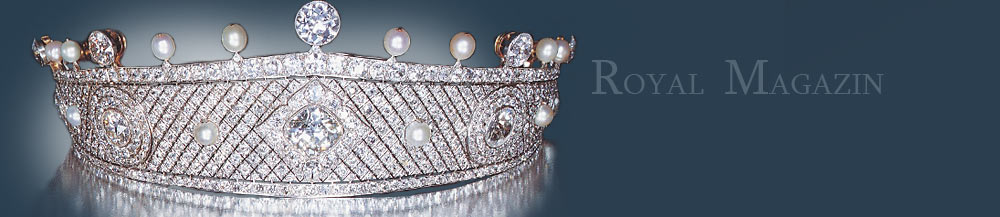
Fürstenberg Tiara |Pearl and Diamond Fleur de Lys Diadem| Princess Paula zu Fürstenberg nee Countess Königsegg
Wedding Present to the Countess Irma Schönborn-Buchheim in 1889 from the grooms mother, „Mama Fürstenberg“ Princess Leontine of Fürstenberg née Kevenhüller-Metsch.
Natural Pearl and Diamond Tiara | Fürstin Irma von Fürstenberg Diadem |Princess Fürstenberg

Eleven diamond motives in the design of a double fleur-de-lys, twenty-three pear-shaped pearls (three larger ones) are all fixed on an old-cut diamond frame.
This is the way that tiara must have been worn at the imperial court in Vienna and Berlin, by its then owner the princess of Fürstenberg née countess Irma of Schönborn Buchheim

The danish crown jewels, Frederik IX’s pipe collection and the more than 400-year-old Rosenborg wine are among the many objects that appear in the program series „The Queen’s Treasury“, which from tonight and the next Tuesdays will be broadcast on DR 1.

The museum collection Kongernes Samling contains Danish kings and queens‘ central objects and works of art, and the program series follows the creation of the exhibitions „A Queen’s Jewelry Box“ and „Mary & the Crown Princesses“, which are currently on display at the Amalienborg Museum and Koldinghus, respectively.
The exhibitions have been created in collaboration with Her Majesty the Queen and Her Royal Highness the Crown Princess, and the programs are included when the Queen and the Crown Princess take part in the preparations for the new exhibitions. The first episode of „The Queen’s Treasury“ will be broadcast tonight at 20.30 on DR1.https://www.dr.dk/drtv/se/dronningens-skatkammer_-smykker-der-taler_307886
At special events such as state visits, the New Year’s table and other major events where a gala is worn, the female members of the royal family like to wear historical jewellery. Often as sets, also called garnishes, with a tiara and earrings, necklace and possibly bracelet. The jewelery is partly the crown jewels, partly jewellery, owned by the Danish Royal House’s Løsørefideikommis and jewelery privately owned by the Royal House.

The crown jewels
The best-known pieces of jewelery are the crown jewels, which primarily consist of four large jewellery sets: a brilliant set, an emerald set, a pearl-ruby set and a rose stone set. The crown jewels belong to the Crown, i.e. the monarch and his queen. After the change of throne, they are therefore available to HM Queen Mary. When the crown jewels are not in use, they are displayed in the treasury in the secured basement under Rosenborg Castle.
It is customary for the crown jewels to remain in Denmark, which means that they are not taken with them when visiting abroad. The Danish crown jewels are the only ones in the world that are both exhibited as museum objects and at the same time worn by the country’s queen.
The history of the crown jewels goes back to Christian VI’s queen, Queen Sophie Magdalene, who in her will from 1746 decided that her jewelery should not pass to one specific person, but always be available to the country’s sitting queen on the grounds that „there in this royal house there are so few jewels and no crown jewels at all“. Most of Queen Sophie Magdalene’s original jewelery has been remade by subsequent queens as jewelery fashions have changed. Today, the four crown jewel sets have the design that Christian VIII’s queen, Queen Caroline Amalie, gave them in 1840.
The jewelery in the Danish Royal House’s Loose Trust Committee
Another group of striking jewelery is the jewelery from the Danish Royal House’s Loose Trust Committee. These pieces include, among others, the Perlepoire set of tiara, necklace, earrings and brooches, the large diamond necklace, called the Rivière , and the diamond frame with royal portrait worn by the Queen at the gala.
The Royal Trust Trust was founded by Frederik 8th and Queen Lovisa in 1910. The purpose was to collect and secure gold, silver and other valuables „that are desired to be preserved in Our Family and therefore must pass undivided from King to King of our House“.
The objects in a fideicommis are inherited in the family. They are not owned by the individual person, and a sale or mortgaging of the inheritance is therefore not possible. In the Royal Trust Committee, this means that important collections – not least the co-founder, Queen Lovisa’s great legacy from her Dutch, German, French and Swedish ancestors – have been able to be kept together in the Royal House.
The Commission of Estates jewelery is worn by the sitting Queen and can be taken abroad for use at gala events.
The royal family’s private jewelery
The queen and the other women in the royal family also have a collection of private jewels which they themselves dispose of.
In Queen Margrethe’s collection, you will find, among other things, the palmette tiara and the sapphire set with necklace and earrings, which Frederik IX had made as a wedding present for his daughter, the successor to the throne, Princess Margrethe. Other important pieces of jewelery are the ruby and pearl set, which was a silver wedding gift from Prince Henrik, and the Greenlandic gold diadem, the flower diadem Naasut – a gift from Greenland in connection with the 40th anniversary of the government in 2012.
In the future Queen Mary’s jewelry collection, you will find the old Russian turquoise and brilliant jewelry that Queen Margrethe gave to her daughter-in-law on her 50th birthday in 2022, and a slender diamond tiara that can also be used as a necklace, and which the future queen herself has purchased at auction.
The most well-known of the privately owned pieces of jewelery worn by the future queen is probably the ruby set, given to the future king by her maternal grandmother Queen Ingrid. The set was made for French Marshal Jean-Baptiste Bernadotte’s wife Desirée and was worn at Emperor Napoleon’s coronation in 1804. The set came to Sweden via the Bernadotte couple when they were appointed Crown Prince Couple of Sweden. Desirée, who in 1818 became Queen Desideria of Sweden, then let it go to her daughter-in-law Josefina. As queen dowager, in 1869 Josefina presented the set to her granddaughter, Princess Lovisa, at her wedding to Danish Crown Prince Frederik (8th) with the reason „the Danish colors for Louisa“.
Queen Alexandrine’s sapphire diadem was bought in 2018 by an unknown at auction in Denmark. Now it turns out that it was probably Queen Margrethe who was the buyer.

The sapphire diadem, which was sold at auction almost four years ago, now appears in the Queen’s jewelery collection.
In the broadcast „Dronningens Skatkammer“ on DR1, a secret is revealed.
Namely who in 2018 bought the Danish-Russian sapphire diadem. There are many indications that it was Queen Margrethe herself. And that will please many Danes.
In the program „Dronningens Skatkammer“ you see the special diamond and sapphire tiara being exhibited together with numerous royal jewelery in „Kongernes Samling“ at Koldinghus.
The three countesses had inherited the historic Danish-Russian diadem from their mother, Countess Anne Dorte, and in December 2018 they sold the expensive diadem for two million kroner at the auction.
There were many Danes who at the time believed that the precious jewelry belonged in Denmark, and with the Danish royal family. And much now it seems that Queen Margrethe meant it too.
The three countesses of Rosenborg, Josephine, Camilla and Feodora, who had inherited the jewelry from their father, Count Christian of Rosenborg and mother, Countess Anne Dorte, sold the tiara.
The royal couple themselves passed the jewelery on in 1933 to their daughter-in-law, Crown Princess Caroline-Mathilde, at her wedding in Fredensborg Castle Church with the king’s youngest son, Crown Prince Knud.
It was he and his sons who lost the right to inherit the throne when a new succession law was passed in 2953, because his older brother, Frederik X „only“ had three daughters, Margrethe, Benedikte and Anne-Marie.
After Caroline-Mathilde’s death in 1995, the youngest of her children, her son Count Christian of Rosenborg and his family inherited diadem, and they have kept the jewelry until it was sold in 2018.
The first episode of the TV series „Dronningens Skatkammer“, where you see the sapphire diadem, was shown on DR1 Tuesday 12 April. But can also be seen on DRTV.

The Princess Thyra Sapphire Tiara is a rare and highly distinctive Danish royal jewel, created in the late nineteenth century for Princess Thyra of Denmark (1880–1945), daughter of the future King Frederik VIII and Queen Lovisa of Denmark. The tiara was a gift from her parents, possibly marking her eighteenth birthday and debut into society in 1898.
But where does the tiara come from? There is no clear answer, but a presumption.
Already in connection with Princess Lovisa of Sweden’s wedding with Crown Prince Frederik (VIII) of Denmark in 1869 there was a rumour about her large jewellery collection. It has been said that it could fill an entire billiard table. And this was only the beginning. Soon after and within the span of
just a few years, she also inherited many pieces of
jewellery from her parents, King Karl XV (1826- 1872)
and Queen Lovisa of Sweden (1828-1871),
her grandmother, the Dowager Queen Josephina of
Sweden (1807-1876) and her grandparents, Prince
Frederick (1797-1881) and Princess Louise of the
Netherlands (1808-1870).
It has been suggested that the Princess Thyra Sap-
phire Tiara could come from her mother’s jewellery
collection. There is, however, no solid proof that
Queen Lovisa gave away many or larger pieces of
jewellery while she lived. She probably did it at her
daughter Princess Ingeborg’s wedding in 1897, but it
was as a wedding gift, and Princess Thyra remained
unwed. At the same time Queen Lovisa’s collection
of jewellery – in particular the larger pieces – is fairly
well covered in history books, and the Princess Thyra
Sapphire Tiara cannot readily be found in any of the
sections of the mother’s familial inheritance lots.
in the front row. The name Thyra was very popular in Denmark in the second half of the 19th century due to a historical interest for the Viking
Age. Thus, King Gorm the Old of Denmark, who lived in the 900s, was married to Queen Thyra.
Designed in the Historicist style, the tiara consists of five graduated upright, heart-shaped foliate ornaments, each centred by a cabochon natural Ceylon sapphire and surrounded by rose-cut diamonds. Stylised flowers, buds and scrolling foliage are set with old mine, rose and single-cut diamonds, with small pearls incorporated into the design. The jewel is mounted in 14-carat gold, rose gold and silver on a curved circlet.
One of its most unusual features is its versatility: the five sapphires can be removed and replaced by five cabochon turquoises, transforming the appearance of the tiara. The sapphires weigh approximately 15.61 carats in total, including the large central stone of approximately 8.90 carats, while the diamonds total about 10 carats.
Although the tiara bears no maker’s mark, its striking similarity to the King Edward VII Ruby Tiara, made by E. Wolff & Co. of London for Princess Margaret of Connaught in 1905, has led to the suggestion that Thyra’s tiara was produced by the same workshop. Its original fitted case, however, is signed by the Copenhagen court jeweller A. Michelsen, which may have acted as the retailer. The attribution to E. Wolff & Co. therefore remains a well-founded hypothesis rather than a documented fact.
Princess Thyra remained unmarried and retained the jewel throughout her life. By testament she left it to her niece Hereditary Princess Caroline-Mathilde of Denmark, who in 1963 gave it to her daughter Princess Elisabeth of Denmark (1935–2018). It subsequently remained among the descendants of King Frederik VIII and Queen Lovisa.
A later modification also tells something of the tiara’s personal history: during the 1920s or 1930s, when tiaras were fashionable worn low across the forehead, a velvet band was added to make it more comfortable to wear. Intriguingly, the fitted case contains space apparently intended for another jewel, suggesting that a bracelet may originally have formed part of the set. The Sapphire Diamond Tiara is now in the Albion Art Collection.
Diamond Brooch in the form of the Russian Imperial Crown, set with 149 diamonds of abourt 21,1 carats. The two largest diamonds are ca 6,8ct and 7,3ct.
This brooch and 17 others were executed on the order of Tsar Nicholas II to Carl Faberge .
The brooch cost 4000 silver roubles.
These brooches were Imperial gifts presented on 24. May 1894. The day before the coronation of Nicholas II and Alexandra Feodorovna.
They were given to both the Grand Duchesses living in Russia and also to those that had, through their marriages, become queens or duchesses outside Russia and attended the coronation.
This was given to Grand Duchess Anastasia Mikhailovna who married in 1879 Grand Duke Friedrich Franz von Mecklenburg-Schwerin.
Their daughter Alexandrine inherited this brooch in 1922. She married in 1898 the Danish Crown Prince Christian. Later Queen Alexandrine of Denmark left it to her daughter-in-law Princess Caroline-Mathilde (Prince Knud’s wife). In 1995 the brooch was inherited by her daughter, Princess Elisabeth of Denmark.
Princess Elisabeth of Denmark, left it to The Royal Danish Collection in her will.
Carl Faberge also executed brooches, in this design but larger diamonds, for the Dowager Empress Maria Feodorovna 10 000 roubles and Empress Alexandra Feodorovna 12 000 roubles. The Queen of Siam was also presented with such a brooch in 1897 the price beeing 5100 roubles.