The story of the jewels from the estate of Princess Henriette of Auersperg, wife of the last Krupp, the Boucheron Art Deco diamond bracelet with pattern of stylized roses and:
Princess Henriette von Auersperg | Bohlen und Halbach Diamond Roses Necklace Collier Princess Henriette Auersperg Bohlen und Halbach Krupp |Diamonds Royal Jewel History Germany
Es genügt, wenn Du für 20 000 Franken in den Korb (Corbeille de Mariage) tust, das Übrige ist für die Geschenke, die Du in München den Töchtern der Kurfürstin von Bayern machst.
Nimm auch das Nötige mit, um den Damen und Offizieren, die den Dienst bei Dir versehen werden, Geschenke zu machen. Benimm Dich recht würdig, aber lass Dir alle Huldigungen gefallen: man ist Dir alles schuldig. Während Du nur Höflichkeit zu geben hast……………“
Prinzessin Charlotte von Sachsen–Hildburghausen, heiratete 1805 den Prinzen Paul von Württemberg (1785-1852) und wurde damals „Prinzessin Paul“ genannt.
Prinzessin Paul, Prinzessin Charlotte von Sachsen-Hildburghausen (1787-1847) war eine Tochter von Herzog Friedrich und Herzogin Charlotte, Nichte der Königin Luise von Preußen und Schwester der bekannten Prinzessin Therese – der späteren Königin von Bayern.
Der Braut des bayrischen Kronprinzen Ludwig, der extrem gegen die Verbindung mit Napoleon war. Somit enges Mitglied der Familie, Ihrer zukünftigen Schwiegertochter Prinzessin Auguste Amalia Ludovika von Bayern.
Kaiserin Josephine Sohn, Eugene Beauharnais, heiratete im Januar 1806, in die bayrische Königsfamile, es wurde ihr von ihrem taktisch-dynastisch denkenden Mann Napoleon aufgetragen, ein besonderes Geschenk zu machen.
1818 trennte sich das Paar und Charlotte kehrte nach Hildburghausen zurück. Sie hatten zusammen fünf überlebende Kinder.
Die älteste Tochter war Prinzessin Charlotte(1807–1873), später Großfürstin Helene Pawlowna ⚭ 1824 Großfürst Michael Pawlowitsch (1798–1849) sie war durch die großzügigen Brautgeschenke und Brautausstattung auch für angeheiratete Bräute, der Familie Romanov, mit Juwelen und Schmuck, versorgt.
Ihr ältester Sohn Prinz Friedrich von Württemberg 1808-1870 heiratete am 20. November 1845 seine Cousine Prinzessin Katharina von Württemberg (1821–1898), eine Tochter von König Wilhelm I. Er erbte von seiner Mutter den Hochzeitsschmuck – die Topazparure.
Das einzige Kind aus dieser Verbindung war der 1848 in Stuttgart geborene Prinz Wilhelm, der 1891 als Wilhelm II. König von Württemberg wurde.
Im Jahr 1877 heiratete Prinz Wilhelm Prinzessin Marie zu Waldeck und Pyrmont.
Princess Marie of Wurtemberg Pink Topaz Parure Tiara Napoleons wedding present to Princess Paul of Wurtemberg
Und hier ging nun die imperiale Topaz Parure an Prinzessin Marie.
Das Paar hatte drei Kinder, von denen zwei nicht über das Säuglingsalter hinaus kamen. Lediglich die Tochter Prinzessin Pauline (1877–1965), wurde erwachsen und später die Gemahlin von Fürst Friedrich zu Wied (1872–1945).
Im April 1882 verstarb Prinzessin Marie während der Entbindung von Ihrem dritten Kind, das bei seiner Geburt nicht lebensfähig war.
Die Topazparure mit Topas-Tiara, zwei Topas Armbändern, Topas Broschen, Topas Ohrringen und Topas Halsband alles mit Diamanten und rosa Topasen besetzt ging an Tochter Prinzessin Pauline, der späteren Fürstin Wied.
:::::::::::::::::::::::::::::::::::::
Zum Vergleich: die Kosten für die Erstellung der Saphir Parure der Kaiserin Josephine, wurde 1805, mit ca 84 000 Franc angegeben. Diese bestand jedoch noch zusätzlich zu der Tiara, Halsband und Armbändern aus einem Gürtel, einem Kamm und mehreren Broschen und Ohrringen.
Die berühmten Rosa Topase |Königlicher Schmuck der Prinzessin Marie von Württemberg
Quote from Emperor Napoleon’s letters to Empress Josephine in November 1805 in Strasbourg……….
„I write to Mr. von Harville that you should leave for Baden and go from there to Stuttgart and Munich.
In Stuttgart you present the bridal present to Princess Paul.
It is enough if you put it in the basket (Corbeille de Mariage) for 20,000 francs, the rest is for the gifts you give in Munich to the daughters of the Elector of Bavaria.
Take with you what is necessary to give gifts to the ladies and officers who will serve you. Behave in a dignified manner, but be willing to accept all homages: they owe you everything.
Princess Charlotte von Sachsen-Hildburghausen, married Prince Paul von Württemberg (1785-1852) in 1805 and was then called „Princess Paul“.
Princess Paul, Princess Charlotte of Saxon-Hildburghausen (1787-1847) was a daughter of Duke Friedrich and Duchess Charlotte, niece of Queen Luise of Prussia and sister of the famous Princess Therese – later the Queen of Bavaria.
The bride of the Bavarian crown prince Ludwig, who was against the connection with Napoleon.
Thus close member of the family, her future daughter-in-law Princess Auguste Amalia Ludovika of Bavaria.
Empress Josephine’s son, Eugene Beauharnais, married in January 1806, into the Bavarian royal family. Her tactically dynastic husband Napoleon instructed her to make a special gift.
In 1818 the couple separated and Charlotte returned to Hildburghausen. Together they had five surviving children.
The eldest daughter was Princess Charlotte (1807-1873), later Grand Duchess Helene Pavlovna ⚭ 1824 Grand Duchess Michael Pavlovich (1798-1849) she was provided with jewels and jewellery by the generous bridal gifts and bridal equipment also for married brides, the Romanov family.
Her eldest son Prince Friedrich von Württemberg 1808-1870 married on November 20, 1845 his cousin Princess Katharina von Württemberg (1821-1898), a daughter of King Wilhelm I. He inherited from his mother the wedding jewellery – the Topazparure.
The only child from this marriage was Prince Wilhelm, born 1848 in Stuttgart, who became King of Württemberg in 1891 as Wilhelm II.
In 1877 Prince Wilhelm married Princess Marie zu Waldeck and Pyrmont. This marriage with a small princely house, a marriage of affection, met with little enthusiasm in Württemberg.
Princess Marie of Wurtemberg Pink Topaz Parure Tiara Napoleons wedding present to Princess Paul of Wurtemberg
And here the imperial Topaz Parure went to Princess Marie.
The couple had three children, two of whom did not go beyond infancy. Only the daughter Princess Pauline (1877-1965) grew up and later the wife of Prince Friedrich zu Wied (1872-1945).
In April 1882 Princess Marie died giving birth to her third child, who was not viable at birth.
The topaz parure with topaz tiara, two topaz bracelets, topaz brooches, topaz earrings and topaz collar all set with diamonds and pink topazes went to daughter Princess Pauline, later Princess Wied.
Emperor Napoleon’s letters to Empress Josephine in November 1805 in Strasbourg
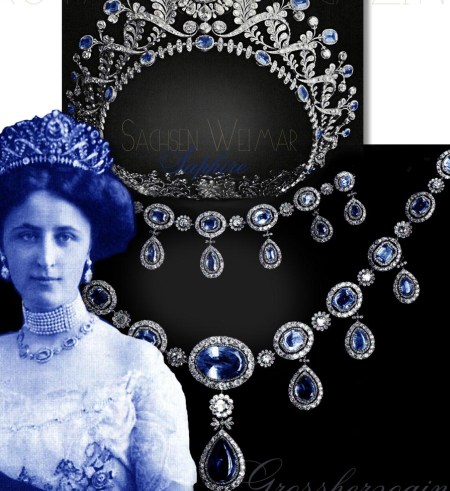
Maria Pavlovna Romanowa Grand Duchess of Saxe-Weimar Imperial Royal Diamond and Sapphire Tiara | Saxe-Weimar Imperial Jewelry History
The diadem was designed by the court jeweler Duval in St Petersburg in 1825, see design drawing in the link – and also produced.
Originally, 16 acacia branches set with diamonds were to be arranged as ornaments, as provided in the design. In the original, however, it was much more.
Alternating with this, flower ornaments with diamonds and a sapphire and 2 diamond roses were placed in the diadem.
The „S“-shaped diamond volutes connect the different ornaments with each other.
The base ring consisted of 9 sapphires framed by diamonds and alternating four diamond intermediate parts.
The center of the tiara consists of two sapphires. A crescent-shaped cabochon sapphire and an oval sapphire together form a rosette.
The diadem was originally designed as a Kokoshnik, then as a Coronet crown.
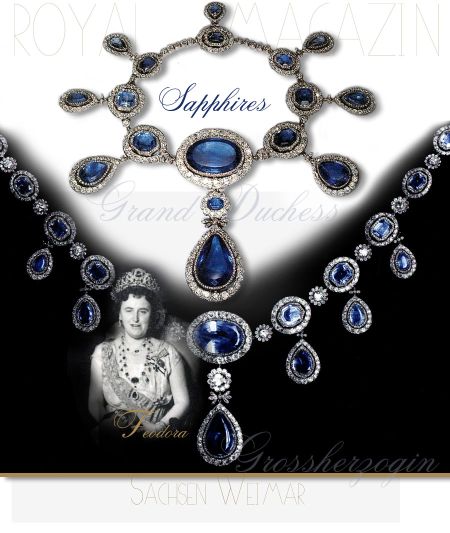
Grand Duchess Maria Pavlovna Romanova | Sapphire Diamond Necklace Tsar’s Daughter |Saxe-Weimar Royal Imperial Jewels
This sapphire jewellery was made for the decoration of the Maria Pavlovna Romanova, Grand Duchess of Russia Мария Павловна Романова, at the same time as the Trousseau of her sister Grand Duchess Anna Pavlovna, later Queen of the Netherlands.
Grand Duchess Feodora of Saxe-Weimar wore the parure – as in the picture with the smaller version of the sapphire necklace. For the wedding of her daughter to Prince Schwarzburg-Rudolfstadt, the Grand Duchess is depicted with the large version of the parure.
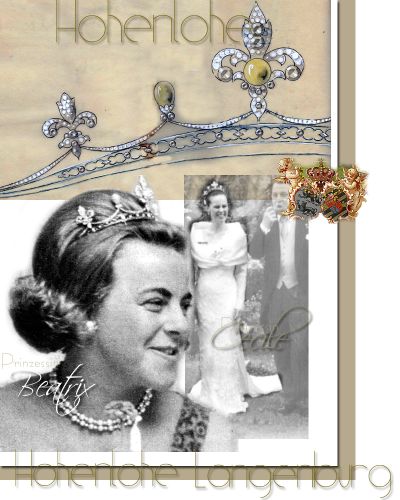
Hohenlohe-Langenburg Diamond Fleur de Lys | Tiara with Pearls Royal Jewels|Wedding Tiara of Cecilie Princess of Hohenlohe-Langenburg | Saskia Fürstin of Hohenlohe Langenburg
The story behind the royal jewel, click for more history:
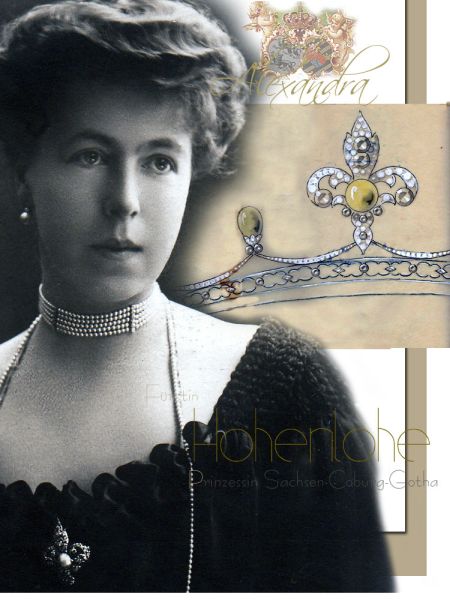
Diadem mit Diamanten Bourbonen-Lilie ehemald Brosche der Fürstin Alexandra| Prinzessin Beatrix, Prinzessin Cecile und Fürstin Saskia von Hohenlohe Langenburg | Königlicher Schmuck Geschichte der Juwelen
Princess Alexandra of Saxe-Coburg and Gotha (1878-1942) Princess of Hohenlohe-Langenburg.
The hereditary princess of Hohenlohe-Langenburg is pictured above, with a diamond fleur de Lys brooch.
She wore the brooch first after her engagement, which was a secret in May of the year and later for public in September 1895. Her grandmother Queen Victoria was not amused.
Princess Alexandra’s Royal Diamond Ribbon and Bow Tiara | Princess Hohenlohe-Langenburg
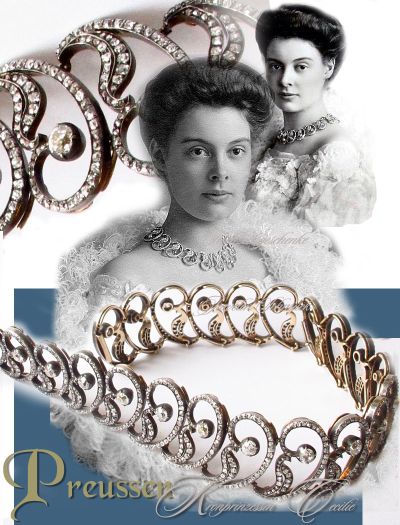
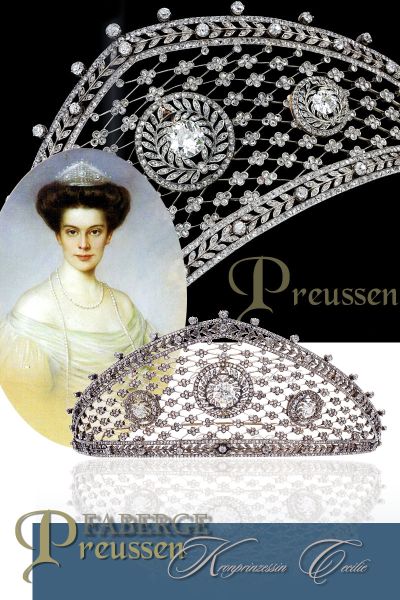
Notes from the press of the days: It is going to cost Germany over half a million dollars to get her future Emperor married, but in return for their money the folk of the fatherland will have a show of pomp and ceremony such as seldom has been seen in modern Europe. In the preparations for his eldest son’s wedding to the Duchess Cecilie of Mecklenburg-Schwerin, which is now set for Monday, May 22,1905, the Kaiser is giving full reign to his love of imperial splendor and display. On the marriage ceremony itself, which will take place in the magnificent new cathedral in Berlin in the presence of an exalted company whose like never has gathered under one roof, $50,000 will be spent. The presents which will be given to the young couple by municipalities and public corporations will amount to a. total of at least $250,000, while a similar sum is being spent on the bride’s trousseau.
On her wedding day the Duchess Cecilie of Mecklenburg-Schwerin will be almost 19 years of age, while her young husband will have attained the age of 23.
No part of the elaborate ceremonial In connection with her wedding will be more impressive than the Duchess Cecilie’s journey from her home in Schwerin to Berlin, which will take place a few days before her marriage. From the palace of her brother, the Grand Duke of Mecklenburg-Schwerin with whom she has lived up to now, to the Schwerin railway station the Duchess will be escorted by the Grand Duke himself, by the Ministers of state of the grand duchy, by the high officers of the garrison at Schwerin and by a deputation of noblemen and noblewomen representing the leading families of Mecklenburg aristocracy.
Surrounded by a magnificent company, Duchess Cecilie will drive in an open carriage from her home to the railway station, where a special train will be waiting to convey her to Berlin. This train will consist of cars painted in blue and gold. The locomotive will be gaily decorated with flowers and a wreath of myrtle will be hung around the stack. The Grand Duke and the Grand Duchess of Mecklenburg-Schwerin as well as a magnificent suite consisting of over fifty persons will escort Duchess Cecilie to Berlin, a journey of about three hours. A guard of honor will be drawn up on the platform of the station at Schwerin and at the moment the train begins to glide away on its journey these troops will present arms, a roll will be beaten on the drums and a blast of trumpets will proclaim the departure of the Crown Prince’s bride. At the same moment the guns of the fortress of Schwerin will boom out a salute of thirty-three guns, and there will be cheers from the children of the public schools of the little capital, drawn up on the platform.
The arrival at Berlin will be a still more impressive affair. On the platform the German Emperor, the Crown Prince, the five younger sons of the Kaiser, the Emperor’s brother, Prince Henry, and four other royal princes of the Hohenzollern family will be waiting to greet Duchess Cecilie. The moment the train slops the bride-elect will descend the steps of the saloon car and will be embraced and kissed first by the Emperor and then by the Crown Prince, who probably will secretly resent the rigid rules of court etiquette which gives this imperial father the right of precedence on this occasion.
Duchess Cecilie will then shake hands with the other royal princes while the usual military honors are being paid to her. The royal party will then enter open carriages to drive to the Imperial castle situated in the heart of the city of Berlin. The Emperor and the Duchess Cecilie will ride side by side in the first carriage, the Crown Prince sitting opposite to them with his back to the coachman. The other royal princes and the various suites will follow in other carriages, of which there will be about thirty in the procession. The state carriages conveying the Emperor, Crown Prince and Duchess Cecilie will be drawn by six white horses and will be preceded and followed by a squadron of cavalry guards as an escort. The streets through which the procession of the carriages will pass will be lined with spectators who will accord their future Empress a warm popular reception. The German Empress will be waiting on the threshold pt the imperial castle, where she will embrace and kiss her future daughter-in-law. Duchess Cecilie will remain in her residence at the imperial castle, but the Crown Prince will continue to reside in the palace at Potsdam, coming into Berlin each morning by train and returning each evening, for etiquette provides that he shall not sleep under the same roof as his bride during the few nights preceding the wedding. The last day or two will be fully occupied with the completion of all the necessary arrangements.
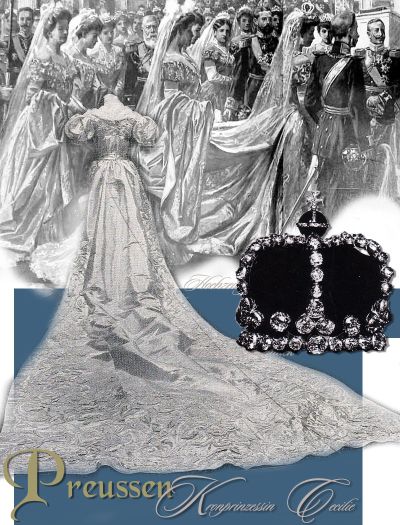
The wedding ceremony will be solemnized in the new cathedral which the German Emperor has erected on the open space in front of the imperial castle in Berlin. The distance from the imperial castle to the cathedral is only two or three hundred yards and the wedding party will pass from one building to the other on foot. The Crown Prince will wear the uniform of the First Regiment of Guards, consisting of a long blue coat, blue trousers and gaiters extending to the knees. He will wear a helmet with white plumes and his breast will be decorated with tho ribbons of all the exalted orders to which he belongs.
After the Crown Prince has taken up his stand in the cathedral in front of the altar the German Emperor will leave the imperial castle, accompanied by the Empress, the other members of the Prussian royal family and all the royal guests, who will be present as representatives of the reigning families of Europe. These will include the King of Spain; the Czar‘ s brother. Grand Duke Michael of Russia: the successor to the Austrian throne. Archduke Francis Ferdinand, the Duke of Aosta, representing Italy, and the Prince of Wales, representing England.
Including the rulers of the smaller German states, there will be twenty reigning monarchs and thirty royal Princes and Princesses, making a total of over fifty royal personages present at the wedding. These royalties, with their suites of gorgeously uniformed officers, will form a company of unprecedented brilliancy.
After the members of this party have entered the cathedral and have taken their allotted seats the bride will leave the Imperial castle to proceed to the ceremony.
She will wear a white dress adorned with the costliest lace, for which her dressmaker will receive a check for $25,000; a long white veil and a small wreath of myrtle with the nuptial crown, „The Prinzessinnenkrone „on her head.
The ceremony will last rather more than half an hour and as soon as it is concluded the organ will strike up a wedding march, while the guns of the forts around Berlin will fire a salute of 101 guns.
A magnificent state banquet will be given In the imperial castle, at which covers will be laid for five hundred guests. The Crown Prince and the Crown Princess will sit side by side at one end of the central table, with the Emperor and the Empress opposite them at the other end. The Emperor will propose the toast of the young couple, and he’s expected to make a speech in which he will refer to the high destiny in store for his son when he is called upon to ascend the Imperial throne of Germany.
The wedding presents, which will number many hundreds, will be piled in heaps on tables in one of the big halls of the castle and will be inspected by the guests of the wedding party.
Later In the day the Crown Prince and his bride will leave Berlin to spend their honeymoon at the Crown Prince’s estate in Silesia. The distinguished pair will possess a stable of 200 horses, some for riding and some for driving.
The bride’s trousseau will come of hundreds of trunks, full of coats and fur tunes articles. It is hat the presents given to the imperial couple by royal personages throughout Europe win amount to a total of at least S28M*
Princess Marie-Louise of Schleswig-Holstein, Princess of Great Britain & Ireland, in her later days, she wore an unknown Diamond Tiara probably of palmette and scroll ornaments and earlier owned by her mother the Princess Helena of Schleswig-Holstein, Princess of Great Britain, daughter of Queen Victoria.
On the right side, Princess Helena wearing a Palmette tiara and sapphire and diamond necklace, which was later altered.
After her death, Lady Ramsay is seen with this diamond palmette tiara.
Lady Patricia Ramsay, formerly Princess Patricia of Connaught 1886-1974, was bequeathed with some of the costly jewels of her aunt.
Schmuck und Juwelen der Deutsche Fürstenhäuser | Royal Jewels – Historical Jewerly and Treasure of Royals and Aristocracy | bijoux historiques| исторические драгоценности