Amethyst Diamond Cross Necklace, Imperial Jewels | Grand Duchess Victoria Feodorovna.

Grand Duchess Kirill Romanov |Vladimirovitch Romanov| Grand Duchess Victoria Melita

Romanovs, Romanov Russia Royal Jewellery & Aristocratic Jewels Imperial Russia Imperial family Tsarina, Tsarewitch, tsarevna, cesarewitch, empress of russia, emperor of russia, tsar, czar, romanow, romanoff,russian Imperatrice, Imperator, russian, nicholas II, alexander, zarewna, großfürst, großfürstin, grand duchess, grand duke, grand princess, grand princess, House Romanov-Holstein-Gottorp Kronjuwelen der Romanows. Schmucksammlung der Kaiserin Maria Fedorovna |Hofjuweliere des Russischen Reiches, Romanoff courtjeweller, romanov court Fedor Butzjeweler, kaemmerer, zaefgen, bolin, ghan, hahn, Butz, ewing,zeftiger,zeftigen,leopold zeftigen,jeweller uweliere des Russischen Reiches. Russische Hofjuweliere Juweliere des Russischen Reiches. Russische Hofjuweliere, Juwelier F. Butz, Grachev, Kehli, I. Vaillant und Gigot de Villefen, Juweliere Brik und Rasmussen, Frankfurter Juwelier Robert Koch
r Hofjuweliere Georg-Friedrich Eckart und Jeremiah Pozier.Karl Eduard Bolin,Leopold Seftingen
empressalexandra empressalexandrafeodorovna princessalix princessalixofhesseandbyrhine empressofallrussias romanov romanovdynasty russia imperialfamily russianimperialfamile, Juwelier Ovchinnikov, Kokoshnik. Hofjuweliere des Zaren Nichols & Plinke, St. Petersburg, Großfürstin und Ehefrau des künftigen Zaren Alexander trägt eine prächtige Hofrobe mit üppigem Spitzenbesatz und Goldstickerei.
Katharina die Große Namenstag Hofjuwelier Duval & Söhne schuf die Saphir-Diamant Tiara, die Ohrringe und diverse 20 karätige Einzelsteine,Duval, Louis David 1727 – 1788
Geburtsort
Genève (bis 1814)
Sterbeort
Sankt Petersburg
Goldschmied ; Juwelier
Duval, Louis David
Djuval‘, David Petrovič
Djuval‘, Lui David
L’Imperatrice Elisabeth Alexeiwna, Romanovs Archives
Amethyst Diamond Cross Necklace, Imperial Jewels | Grand Duchess Victoria Feodorovna.
Grand Duchess Kirill Romanov |Vladimirovitch Romanov| Grand Duchess Victoria Melita
Imperial Jewels – Grand Duchess Victoria Melita’s Meander Kokoshnik
update the website from 2006
Greek Key Tiara with Diamonds of Grand Duchess Viktoria Melitta| Royal Jewel History
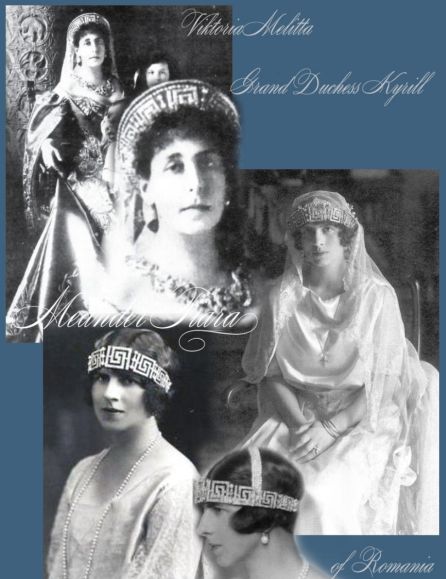
Princess Helen of Romania Royal Wedding Princess Helena of Greece |Royal Jewel History
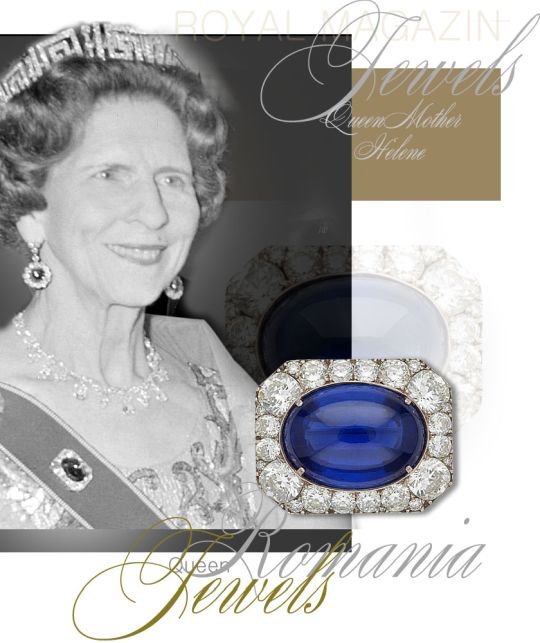
Since Sunday my full update has been online – you can read all details here: royal-magazin.de Unfortunately, it seems that once again others have taken the content without credit. Please note that the original research and images are mine.
Princess Anastasia Petrović-Njegoš of Montenegro 1868-1935 was the third (of eight)daughter of King Nikola I Petrović-Njegoš of Montenegro 1841–1921 and his wife, Queen Milena 1847–1923.
She became Grand Duchess Anastasia Nikolaevna Romanov of Russia when she married Grand Duke Nicholas Nikolaevich in 1907 after a longtime friendship, when she was still the wife of Duke of Leuchtenberg.
Her husband, Grand Duke Nicholas Nikolaevich, was a descendant of Emperor Nicholas I of Russia (1796–1855) he was his grandson through a direct male line. His mother was Grand Duchess Alexandra Petrovna Romanova, she sold half of her emerald parure for building a monastery, the rest she gave to her son. We could see one of the ornaments of the large emeralds with ivy leaf ornaments worn by Grand Duchess Anastasia, below.

Grand Duchess Anastasia Nikolaijevna| Princess of Montenegro | Duchess of Leuchtenberg | Romanov Emeralds of the Nikolaevich

Born Duchess Alexandra Frederica Wilhelmina of Oldenburg.
2 June 1838 – 25 April 1900 was a great-granddaughter of Emperor Paul I of Russia and the wife of Grand Duke Nicholas Nikolaevich of Russia, the elder.

Update website from the year 2006 ..
Grand Duchess Vladimir | Diamond Coronation Brooch 1896 | Romanov Imperial Crown one of the

Grand Duchess Vladimir’s Jewel Collection
Queen Alexandrine’s sapphire diadem was bought in 2018 by an unknown at auction in Denmark. Now it turns out that it was probably Queen Margrethe who was the buyer.

The sapphire diadem, which was sold at auction almost four years ago, now appears in the Queen’s jewelery collection.
In the broadcast „Dronningens Skatkammer“ on DR1, a secret is revealed.
Namely who in 2018 bought the Danish-Russian sapphire diadem. There are many indications that it was Queen Margrethe herself. And that will please many Danes.
In the program „Dronningens Skatkammer“ you see the special diamond and sapphire tiara being exhibited together with numerous royal jewelery in „Kongernes Samling“ at Koldinghus.
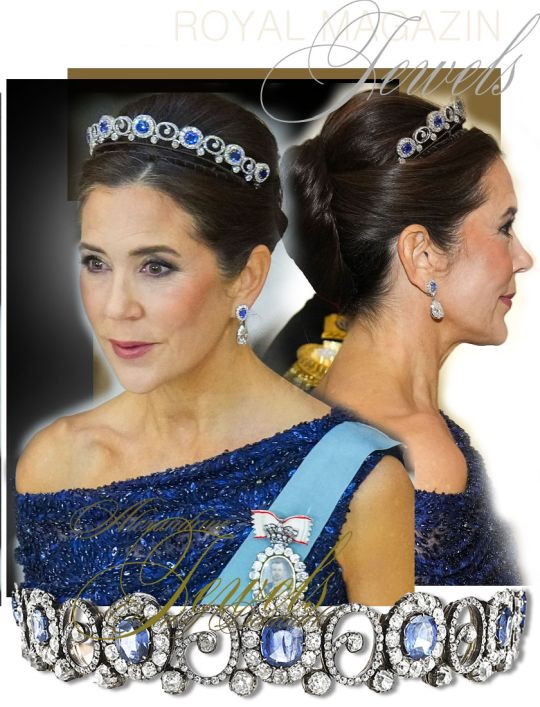
The three countesses had inherited the historic Danish-Russian diadem from their mother, Countess Anne Dorte, and in December 2018 they sold the expensive diadem for two million kroner at the auction.
There were many Danes who at the time believed that the precious jewelry belonged in Denmark, and with the Danish royal family. And much now it seems that Queen Margrethe meant it too.
The three countesses of Rosenborg, Josephine, Camilla and Feodora, who had inherited the jewelry from their father, Count Christian of Rosenborg and mother, Countess Anne Dorte, sold the tiara.
The royal couple themselves passed the jewelery on in 1933 to their daughter-in-law, Crown Princess Caroline-Mathilde, at her wedding in Fredensborg Castle Church with the king’s youngest son, Crown Prince Knud.
It was he and his sons who lost the right to inherit the throne when a new succession law was passed in 2953, because his older brother, Frederik X „only“ had three daughters, Margrethe, Benedikte and Anne-Marie.
After Caroline-Mathilde’s death in 1995, the youngest of her children, her son Count Christian of Rosenborg and his family inherited diadem, and they have kept the jewelry until it was sold in 2018.
The first episode of the TV series „Dronningens Skatkammer“, where you see the sapphire diadem, was shown on DR1 Tuesday 12 April. But can also be seen on DRTV.
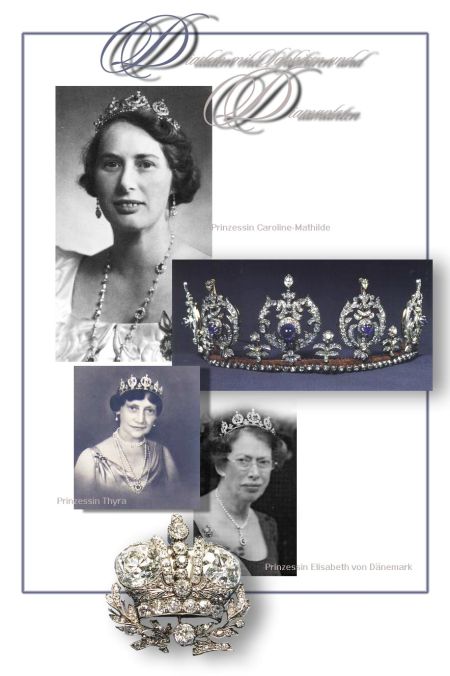
The Princess Thyra Sapphire Tiara is a rare and highly distinctive Danish royal jewel, created in the late nineteenth century for Princess Thyra of Denmark (1880–1945), daughter of the future King Frederik VIII and Queen Lovisa of Denmark. The tiara was a gift from her parents, possibly marking her eighteenth birthday and debut into society in 1898.
But where does the tiara come from? There is no clear answer, but a presumption.
Already in connection with Princess Lovisa of Sweden’s wedding with Crown Prince Frederik (VIII) of Denmark in 1869 there was a rumour about her large jewellery collection. It has been said that it could fill an entire billiard table. And this was only the beginning. Soon after and within the span of
just a few years, she also inherited many pieces of
jewellery from her parents, King Karl XV (1826- 1872)
and Queen Lovisa of Sweden (1828-1871),
her grandmother, the Dowager Queen Josephina of
Sweden (1807-1876) and her grandparents, Prince
Frederick (1797-1881) and Princess Louise of the
Netherlands (1808-1870).
It has been suggested that the Princess Thyra Sap-
phire Tiara could come from her mother’s jewellery
collection. There is, however, no solid proof that
Queen Lovisa gave away many or larger pieces of
jewellery while she lived. She probably did it at her
daughter Princess Ingeborg’s wedding in 1897, but it
was as a wedding gift, and Princess Thyra remained
unwed. At the same time Queen Lovisa’s collection
of jewellery – in particular the larger pieces – is fairly
well covered in history books, and the Princess Thyra
Sapphire Tiara cannot readily be found in any of the
sections of the mother’s familial inheritance lots.
in the front row. The name Thyra was very popular in Denmark in the second half of the 19th century due to a historical interest for the Viking
Age. Thus, King Gorm the Old of Denmark, who lived in the 900s, was married to Queen Thyra.
Designed in the Historicist style, the tiara consists of five graduated upright, heart-shaped foliate ornaments, each centred by a cabochon natural Ceylon sapphire and surrounded by rose-cut diamonds. Stylised flowers, buds and scrolling foliage are set with old mine, rose and single-cut diamonds, with small pearls incorporated into the design. The jewel is mounted in 14-carat gold, rose gold and silver on a curved circlet.
One of its most unusual features is its versatility: the five sapphires can be removed and replaced by five cabochon turquoises, transforming the appearance of the tiara. The sapphires weigh approximately 15.61 carats in total, including the large central stone of approximately 8.90 carats, while the diamonds total about 10 carats.
Although the tiara bears no maker’s mark, its striking similarity to the King Edward VII Ruby Tiara, made by E. Wolff & Co. of London for Princess Margaret of Connaught in 1905, has led to the suggestion that Thyra’s tiara was produced by the same workshop. Its original fitted case, however, is signed by the Copenhagen court jeweller A. Michelsen, which may have acted as the retailer. The attribution to E. Wolff & Co. therefore remains a well-founded hypothesis rather than a documented fact.
Princess Thyra remained unmarried and retained the jewel throughout her life. By testament she left it to her niece Hereditary Princess Caroline-Mathilde of Denmark, who in 1963 gave it to her daughter Princess Elisabeth of Denmark (1935–2018). It subsequently remained among the descendants of King Frederik VIII and Queen Lovisa.
A later modification also tells something of the tiara’s personal history: during the 1920s or 1930s, when tiaras were fashionable worn low across the forehead, a velvet band was added to make it more comfortable to wear. Intriguingly, the fitted case contains space apparently intended for another jewel, suggesting that a bracelet may originally have formed part of the set. The Sapphire Diamond Tiara is now in the Albion Art Collection.
Diamond Brooch in the form of the Russian Imperial Crown, set with 149 diamonds of abourt 21,1 carats. The two largest diamonds are ca 6,8ct and 7,3ct.
This brooch and 17 others were executed on the order of Tsar Nicholas II to Carl Faberge .
The brooch cost 4000 silver roubles.
These brooches were Imperial gifts presented on 24. May 1894. The day before the coronation of Nicholas II and Alexandra Feodorovna.
They were given to both the Grand Duchesses living in Russia and also to those that had, through their marriages, become queens or duchesses outside Russia and attended the coronation.
This was given to Grand Duchess Anastasia Mikhailovna who married in 1879 Grand Duke Friedrich Franz von Mecklenburg-Schwerin.
Their daughter Alexandrine inherited this brooch in 1922. She married in 1898 the Danish Crown Prince Christian. Later Queen Alexandrine of Denmark left it to her daughter-in-law Princess Caroline-Mathilde (Prince Knud’s wife). In 1995 the brooch was inherited by her daughter, Princess Elisabeth of Denmark.
Princess Elisabeth of Denmark, left it to The Royal Danish Collection in her will.
Carl Faberge also executed brooches, in this design but larger diamonds, for the Dowager Empress Maria Feodorovna 10 000 roubles and Empress Alexandra Feodorovna 12 000 roubles. The Queen of Siam was also presented with such a brooch in 1897 the price beeing 5100 roubles.


